
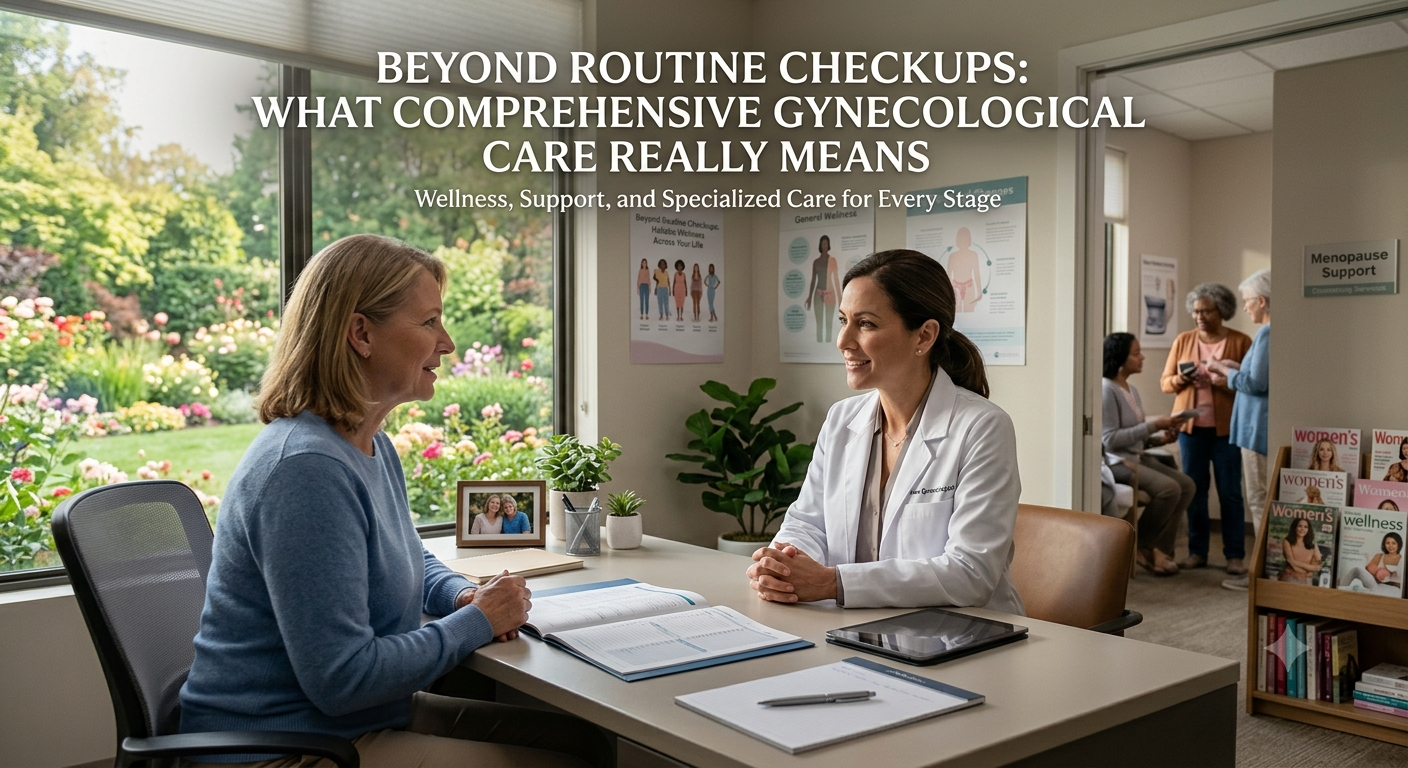
The moment a woman steps into my consultation room, I often see the same guarded look. She's prepared for the stirrups, the cold speculum, the pap smear. She's ready to tick the boxes. What she isn't ready for is the conversation. Most women believe that a gynecological visit is a mechanical procedure—a physical inspection that ends with a clean bill of health or a prescription.
That is not medicine. That is a transaction.
Comprehensive gynecological care is not about a single test or an annual ritual. It is the art of understanding the entire architecture of a woman's life, and how her biology interacts with it. It is the difference between treating a symptom and understanding the root of a story.
The Architecture of a Good History
The most powerful tool in my clinic is not an ultrasound machine. It is the chair. Before I ever perform an examination, I listen.
A comprehensive consultation begins in the mind. We discuss lifestyle, sleep, stress, and relationships. We discuss her mother's health, her grandmother's struggles, and her own history in ways that are rarely captured in a standard form. This is where we find the clues that blood tests often miss.
For instance, a woman presenting with chronic pelvic pain is not always looking for a surgical answer. Sometimes, she is looking for permission to talk about the anxiety that is tightening her muscles. Endometriosis, fibroids, or infertility—they do not exist in a vacuum. They exist within a life that has its own pressures.
You cannot cure what you do not understand.
The Myth of the "Routine" Checkup
There is a dangerous comfort in the word "routine." It implies that the body follows a script. It does not.
A true health assessment is dynamic. It changes with age, with sexual activity, with childbirth, and with the inevitable shifts of perimenopause and menopause. What was normal for a woman at thirty is irrelevant at forty-five.
In my practice, we discard the cookie-cutter approach. We consider cardiovascular risk alongside bone density. We evaluate mental health with the same seriousness as we evaluate cervical health. The body does not compartmentalize, and neither should her care.
Well-Woman Care as Prevention
Prevention is not just about catching cancer early. It is about building resilience. Nutritional counseling, genetic counseling, and discussions about lifestyle modifications are just as critical as a mammogram.
I often tell my patients that I am less interested in treating disease than I am in preventing its conditions. This is where the partnership between doctor and patient becomes real. We discuss everything from bone health to bladder health, from sleep hygiene to heart health. No area is trivial.
Fertility, Perimenopause, and the Fear of Change
Two stages of a woman's life bring the most anxiety: the struggle to conceive and the transition into menopause.
In fertility, comprehensive care goes beyond ovulation induction. We look at the whole environment—the hormonal harmony, the emotional readiness, the physical infrastructure. It is a process of profound patience, and it requires a plan that feels bespoke, not prescribed from a textbook.
For perimenopause, there is often a sense of loss or invisibility. I have seen women suffer through hot flashes, mood swings, and sleeplessness, believing they simply have to endure it. They do not. We offer interventions that span hormonal, nutritional, and psychological therapies. The goal is not just to manage symptoms but to reclaim vitality.
Sexual and Intimate Health
This is the conversation that a lot of the time stays unspoken. A woman may feel kinda embarrassed to talk about painful intercourse, a drop in desire, or the changes in her body after childbirth. Still, it’s not really “small stuff” though. Those things, even if they sound uncomfortable, they’re foundational for her overall quality of life.
Comprehensive care offers a safe, non-judgmental space to talk about these concerns, and well it can feel kinda straightforward, but also not. It also understands that sexual health is a crucial indicator , not something to hide behind a taboo. And this fits into the “whole woman” approach, meaning that healthcare shifts from being just a clinical meeting into something more like a healing encounter.
The Long-Term Partnership
Medicine is not a one-time fix. It is a marathon run together. The best care is continuous, where the doctor knows the patient's history not from a file, but from memory and trust. It is a partnership where the patient feels empowered , to ask questions, to voice concerns and take an active role in her health journey, like she is part of it, not just going through.
This is why the relationship matters as much as the expertise.
If you are looking for care that looks beyond the surface, that treats you as a whole person rather than a set of symptoms, you need to consult with Gynecologist in Lajpat Nagar New Delhi. The environment you choose for your healthcare ought to be built on trust, safety , and a kind of deep understanding. It should feel like a place where you are actually heard, not only examined.
Ultimately, you have to book an appointment with Best Gynecologist in Lajpat Nagar New Delhi to ensure that you are receiving care that is not dictated by a clock, but by your unique needs.
Because being healthy is not just about what the tests show. It is about how you feel in your skin, in your relationships, and in your future. That is what I aim to restore.

 Arabic
 French
 Spanish
 Portuguese
 Deutsch
 Turkish
 Dutch
Dutch
 Italiano
 Russian
 Romaian
 Portuguese (Brazil)
 Greek
Greek