
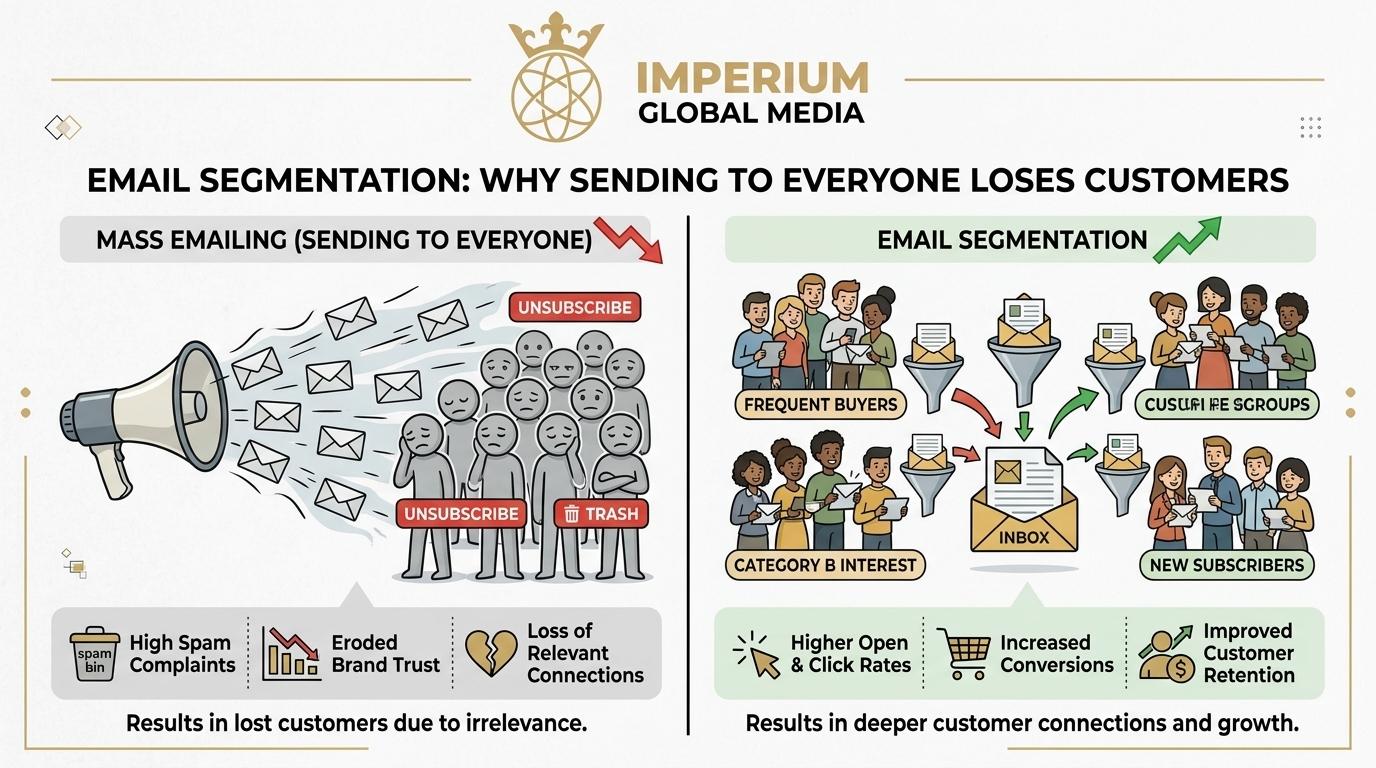
Every email you send goes to your entire list, regardless of what each person actually bought, browsed, or cares about. Open rates keep sliding, and unsubscribes quietly climb. The problem usually isn't your content; it's that you're sending the same message to people who want completely different things. Here's why segmentation fixes that and how to start.
One Message Can't Serve Everyone
Your list contains new subscribers, loyal repeat customers, and people who bought once years ago. Treating them identically ignores how differently they actually relate to your brand.
A message perfectly tailored for a first-time subscriber feels irrelevant to a loyal customer, and vice versa.
Segmentation simply matches the message to who's actually receiving it.
What Segmentation Actually Means
Segmentation splits your list into smaller groups based on shared traits: purchase history, engagement level, interests, or location.
Instead of one blanket email, each segment receives a version genuinely relevant to them.
The extra effort in setup pays back repeatedly in performance, since each send works harder.
Purchase History Is a Powerful Starting Point
Customers who bought a specific product respond better to related recommendations than to generic promotions for unrelated items.
Segmenting by past purchases lets you send genuinely relevant follow-ups, replenishment reminders, or complementary product suggestions.
This single segmentation approach often delivers some of the strongest returns available in email.
Engagement Level Changes the Approach
Highly engaged subscribers, who open and click regularly, can handle more frequent promotional content.
Disengaged subscribers need a different approach entirely, a re-engagement campaign, or eventual removal from active sending to protect deliverability.
Sending both groups the identical cadence wastes the engaged group's patience and the disengaged group's inbox space.
New Subscribers Need a Different Welcome
Someone who just joined your list doesn't yet know your brand the way a loyal customer does.
A dedicated welcome sequence, introducing your story, best products, and value, converts new subscribers far better than dropping them straight into your regular promotional stream.
First impressions in email matter as much as they do anywhere else.
Geography Matters for Multi-Location Businesses
If you serve multiple areas or emirates, location-based segmentation lets you send genuinely relevant local offers or events rather than generic content irrelevant to half your list.
A promotion for a Dubai Marina location means nothing to a subscriber near Abu Dhabi.
Small relevance details like this quietly compound into meaningfully better engagement.
Behavioural Triggers Beat Scheduled Blasts
Rather than sending everyone the same email on the same day, behavioural segmentation reacts to what someone actually did: an abandoned cart, a browsed category, an anniversary of their signup.
These triggered emails consistently outperform generic scheduled sends because they arrive at a moment genuinely relevant to that individual.
This is where automation and segmentation work together most powerfully.
The Deliverability Payoff
Highly relevant emails get opened and clicked more, and email providers reward that engagement with better inbox placement over time.
Irrelevant, generic blasts get ignored or marked as spam, which quietly damages your sender reputation for every future email, not just that one.
Segmentation isn't only about relevance; it's about protecting your ability to reach the inbox at all.
Starting Small With Segmentation
You don't need dozens of segments immediately. Start with two or three meaningful splits: new versus existing customers, or engaged versus disengaged.
Prove the lift in performance, then expand into more granular segments as your data and confidence grow.
A simple, well-executed segmentation strategy beats an overly complex one nobody maintains.
Building the System Properly
Effective segmentation depends on clean data and the right tools to actually act on it.
A specialist in email marketing services in Dubai sets up the segmentation, automation, and tracking properly, so relevant emails go out consistently rather than requiring manual effort each time.
Stop sending the same message to everyone and hoping it lands. Segment thoughtfully, and the same list you already have starts performing like a far larger, more responsive one.

 English
 Arabic
 French
 Spanish
 Portuguese
 Deutsch
 Turkish
 Dutch
Dutch
 Italiano
 Romaian
 Portuguese (Brazil)
 Greek
Greek