
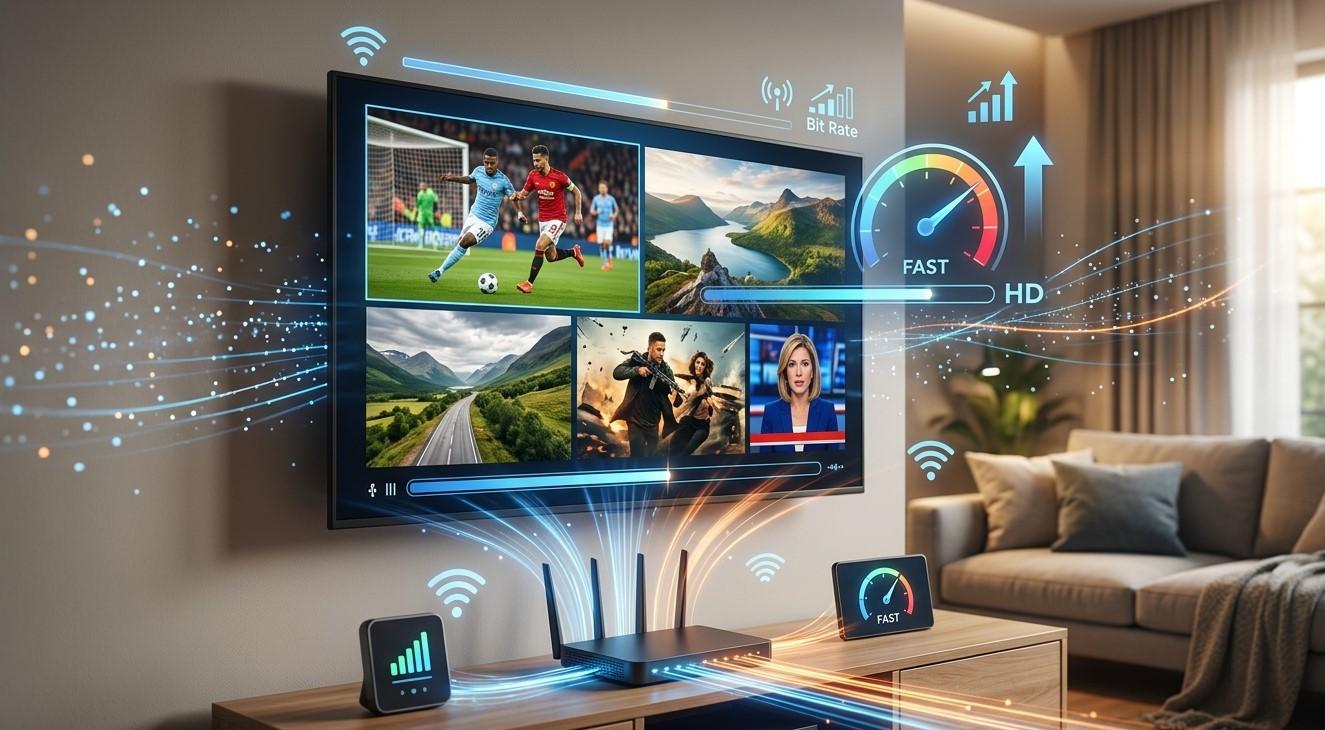
One of the most common questions from new IPTV users is how much internet speed is actually needed for smooth, buffer-free streaming. Whether you're planning to watch live sports, HD movies, or your favorite Indian channels, having the right internet speed makes all the difference. In this guide, we'll break down exactly what speed you need to run IPTV India smoothly and get the most out of your Indian IPTV Box.
Table of Contents
- Why Internet Speed Matters for IPTV
- Recommended Internet Speeds for IPTV
- Factors That Affect IPTV Streaming Quality
- Wired vs Wireless Connections for IPTV
- How to Test Your Internet Speed
- Tips to Improve IPTV Streaming Performance
- FAQs
Why Internet Speed Matters for IPTV
Unlike traditional cable or satellite TV, IPTV relies entirely on your internet connection to deliver content. This means your streaming quality — whether it's smooth HD playback or constant buffering — depends directly on how much bandwidth is available. If your internet speed is too slow, you'll likely experience frozen frames, pixelation, or long loading times, especially during live broadcasts.
For anyone setting up an Indian IPTV Box at home, understanding your internet requirements upfront can save a lot of frustration later.
Recommended Internet Speeds for IPTV
Here's a general breakdown of the internet speeds recommended for different streaming quality levels:
| Streaming Quality | Recommended Speed |
|---|---|
| Standard Definition (SD) | 3-5 Mbps |
| High Definition (HD) | 10-15 Mbps |
| Full HD (1080p) | 15-20 Mbps |
| 4K Ultra HD | 25+ Mbps |
Keep in mind these numbers are per stream. If multiple people in your household are streaming IPTV or other content simultaneously, you'll need to add up the bandwidth requirements accordingly.
For a Single IPTV Stream
Most IPTV India providers recommend a minimum of 10-15 Mbps for smooth HD viewing without interruptions.
For Multiple Devices or Streams
If your household streams on more than one device at a time, aim for at least 25-50 Mbps to keep everything running smoothly without buffering conflicts.
Factors That Affect IPTV Streaming Quality
Internet speed alone isn't the only thing that determines streaming quality. Several other factors play a role:
- Network congestion – Streaming during peak hours when many users are online can slow things down.
- Router quality – Older or budget routers may struggle to handle high-bandwidth streaming.
- Distance from the router – Devices farther from your Wi-Fi router often receive weaker signals.
- Number of connected devices – More devices connected to your network means less available bandwidth per device.
- ISP reliability – Some internet providers experience more fluctuations in speed than others.
Wired vs Wireless Connections for IPTV
While Wi-Fi is convenient, a wired Ethernet connection generally provides more stable and consistent speeds for IPTV streaming. If your Indian IPTV Box is located near your router, connecting it directly via an Ethernet cable can significantly reduce buffering issues, especially for HD or 4K content.
If Wi-Fi is your only option, try to:
- Position your router as close as possible to your streaming device
- Reduce the number of walls or obstructions between the router and device
- Use a 5GHz Wi-Fi band if available, as it typically offers faster speeds over shorter distances
How to Test Your Internet Speed
Before troubleshooting buffering issues, it's worth checking your actual internet speed. You can do this by:
- Visiting a free online speed test tool
- Running the test while no other devices are actively streaming or downloading
- Comparing the results to the recommended speeds for your desired streaming quality
If your speed consistently falls below what's needed, it may be time to contact your ISP or consider upgrading your plan.
Tips to Improve IPTV Streaming Performance
- Restart your router regularly to clear temporary network issues.
- Limit background downloads or other bandwidth-heavy activities while streaming.
- Upgrade your internet plan if you consistently experience buffering.
- Use a quality Ethernet cable for a wired connection when possible.
- Keep your Indian IPTV Box updated with the latest firmware for optimal performance.
FAQs
1. What is the minimum internet speed for IPTV?
Most providers recommend at least 10-15 Mbps for smooth HD streaming, though SD content can work with as little as 3-5 Mbps.
2. Do I need faster internet for 4K IPTV streaming?
Yes, 4K streaming typically requires at least 25 Mbps or more for consistent, buffer-free playback.
3. Why does my IPTV keep buffering even with fast internet?
Buffering can be caused by network congestion, weak Wi-Fi signals, an outdated router, or too many devices sharing the connection.
4. Is a wired connection better than Wi-Fi for IPTV?
Yes, a wired Ethernet connection generally provides more stable speeds and fewer interruptions compared to Wi-Fi.
5. How much speed do I need if multiple people are streaming IPTV at once?
You should aim for at least 25-50 Mbps or more, depending on how many devices are streaming simultaneously and at what quality.
Get Smooth, Uninterrupted IPTV Streaming
Don't let slow internet ruin your favorite Indian shows and channels. Pair a reliable internet connection with a quality Indian IPTV Box and enjoy seamless IPTV India streaming in HD or even 4K. Explore our IPTV plans today and start watching with zero buffering hassle.

 Arabic
 French
 Spanish
 Portuguese
 Deutsch
 Turkish
 Dutch
Dutch
 Italiano
 Russian
 Romaian
 Portuguese (Brazil)
 Greek
Greek