
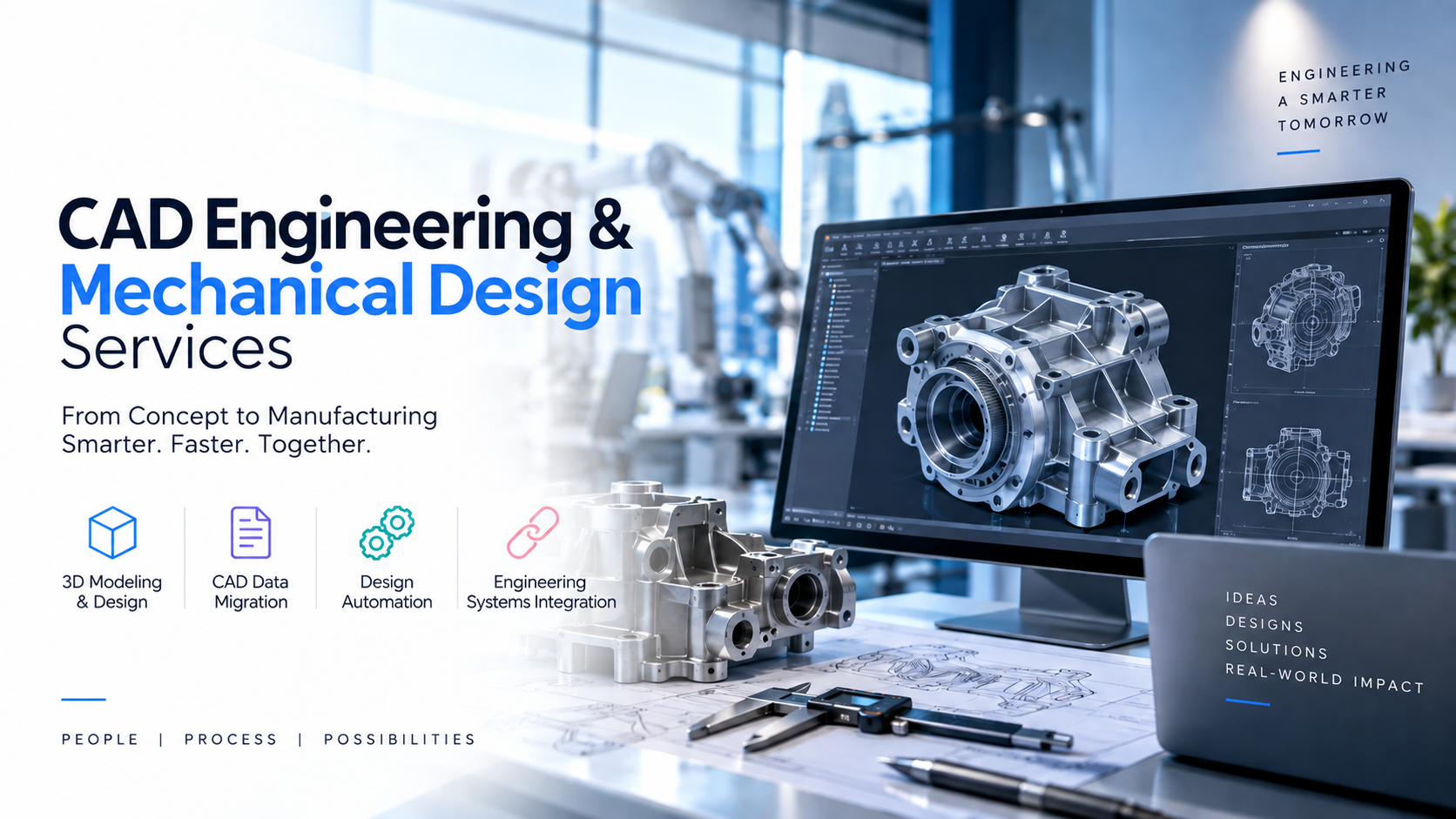
CAD Engineering & Mechanical Design for Complex Products
Product development teams are under increasing pressure to move designs from concept to manufacturing without adding unnecessary engineering cycles. In this environment, CAD engineering is more than creating accurate 2D drawings or 3D models. It is about maintaining design intent, supporting engineering decisions, and ensuring that digital product data remains useful throughout development.
For manufacturers and OEMs, problems often appear when CAD data is disconnected from manufacturing requirements, engineering changes, or other product information. A technically correct model can still create downstream issues if drawings, assemblies, bills of materials, and revisions are not properly aligned.
Where CAD Engineering Creates Business Value
A structured CAD engineering process can help teams address several common product-development challenges:
- Design accuracy: Detailed 2D and 3D models help maintain dimensional and assembly requirements.
- Faster engineering changes: Digital models allow teams to evaluate and implement design changes without rebuilding the entire design.
- Manufacturing readiness: CAD development can incorporate manufacturability and assembly considerations earlier in the process.
- Design reuse: Standardized components and existing engineering data can reduce repetitive design work.
- Better collaboration: Consistent CAD information helps mechanical, electrical, manufacturing, and other engineering teams work from common product data.
Mechanical Design Is More Than 3D Modeling
Mechanical design decisions influence manufacturing cost, assembly, product performance, serviceability, and future revisions.
This is why engineering teams need to consider the complete product environment rather than treating the CAD model as an isolated deliverable. Material selection, component interfaces, tolerances, manufacturing processes, packaging, and assembly requirements can all influence the final design.
For complex products, this broader approach can help identify potential problems before they reach prototyping or production.
Managing Legacy CAD Data
Many manufacturers also operate with years of engineering information created in different CAD platforms and formats. Legacy files may contain duplicate components, outdated standards, inconsistent naming, or incomplete relationships between models and product structures.
A structured CAD data migration process can help organizations clean, standardize, and organize this information while moving toward modern engineering environments.
This is particularly relevant when companies are consolidating engineering systems, changing CAD platforms, or integrating CAD with PLM, PDM, ERP, or manufacturing workflows.
Design Automation and Engineering Efficiency
Repetitive CAD activities can also become a significant source of engineering time.
Design automation can help standardize repetitive modeling, drafting, configuration, and documentation tasks. Instead of repeatedly performing the same engineering operations manually, organizations can develop rules and automated workflows around established design requirements.
The result is not simply faster modeling. It can also improve consistency across product variants and reduce the opportunity for repetitive manual errors.
Building a More Connected CAD Workflow
The most effective CAD engineering environments connect design with the larger product-development process.
CAD models, drawings, BOMs, engineering changes, manufacturing requirements, and product data need to remain aligned as a product moves through development.
For manufacturers and OEMs, this connected approach can help reduce rework, improve engineering collaboration, and create a stronger foundation for production-ready product development.
Jaydu LLC supports manufacturers and OEMs with CAD engineering, mechanical design, CAD data migration, design automation, and broader engineering systems services for complex product-development environments.

 English
 Arabic
 French
 Spanish
 Portuguese
 Deutsch
 Dutch
Dutch
 Italiano
 Russian
 Romaian
 Portuguese (Brazil)
 Greek
Greek