
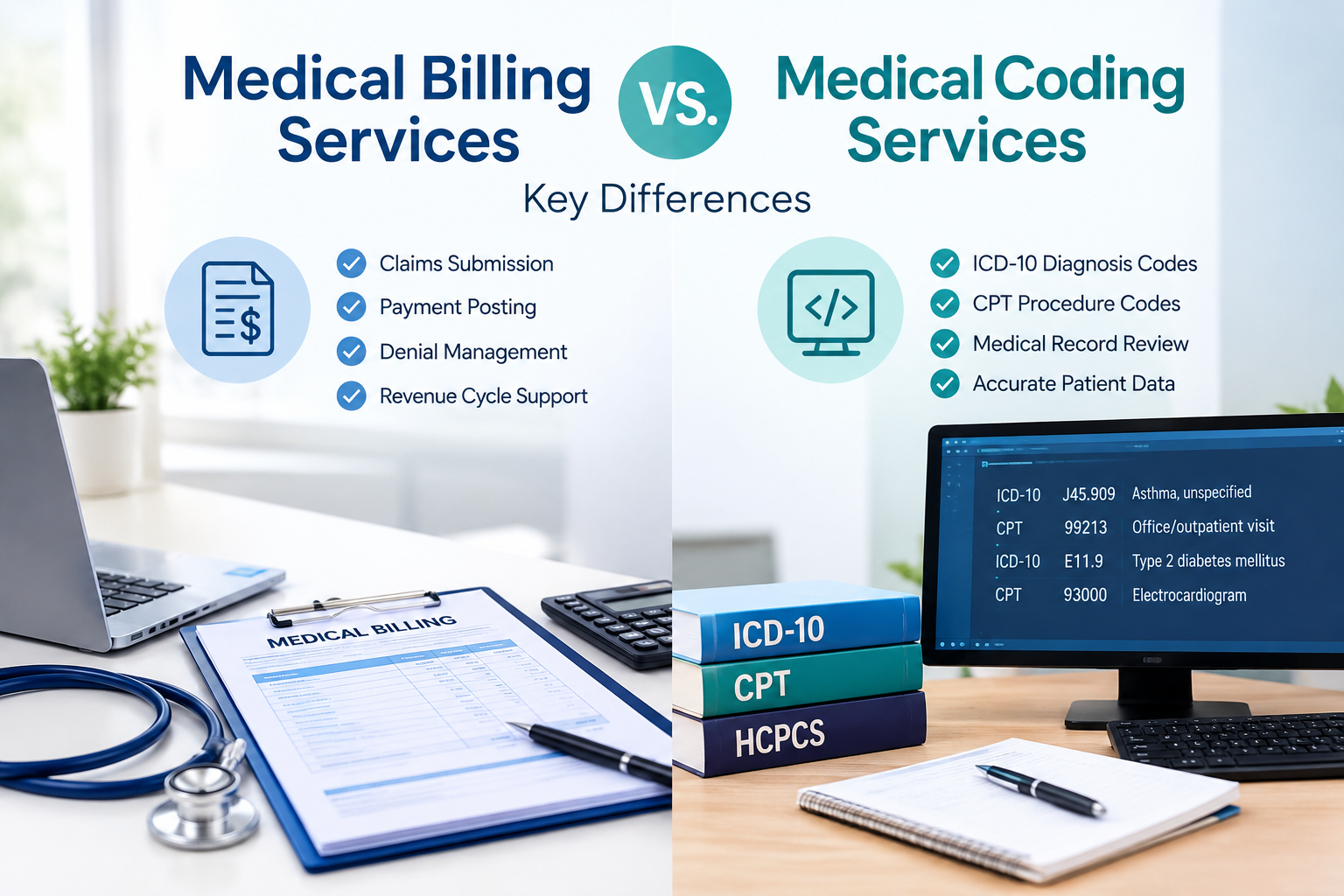
Medical billing services and medical coding services are essential parts of the healthcare revenue cycle. Although they work closely together, they have different responsibilities. Medical coding converts documented diagnoses, procedures, and healthcare services into standardized codes, while medical billing uses those codes and other necessary information to prepare and manage insurance claims and payments.
For healthcare providers in the United States, understanding the difference between medical billing and medical coding can help improve claim accuracy, reduce avoidable denials, and support effective revenue cycle management. Choosing the right services can also help medical practices manage administrative workloads and focus more on patient care.
This article explains medical billing services vs. medical coding services, their responsibilities, key differences, benefits, and how healthcare practices can determine which services they need.
What Are Medical Billing Services?
Medical billing services manage the financial side of healthcare administration. Their primary purpose is to help healthcare providers receive payment for the services they deliver.
Medical billers work with patient information, insurance details, diagnosis codes, procedure codes, and charge information to prepare and submit insurance claims. They may also follow up on unpaid claims, investigate denials, post payments, and manage patient balances.
Many healthcare practices outsource medical billing to professional service providers to reduce administrative workloads and improve their revenue cycle processes.
Key Responsibilities of Medical Billing Services
Medical billing services may include the following responsibilities:
-
Insurance verification: Checking patient insurance eligibility and coverage before appointments or procedures.
-
Charge entry: Recording charges for the healthcare services provided.
-
Claim submission: Preparing and submitting insurance claims electronically or through other accepted methods.
-
Payment posting: Recording payments received from insurance companies and patients.
-
Denial management: Reviewing rejected or denied claims and identifying the reasons for those issues.
-
Accounts receivable follow-up: Monitoring unpaid claims and contacting insurance companies about outstanding balances.
-
Patient billing: Preparing patient statements and helping patients understand their financial responsibilities.
-
Revenue cycle reporting: Monitoring claim status, collections, outstanding balances, and other financial performance indicators.
The exact responsibilities depend on the service agreement. Some medical billing companies provide complete revenue cycle management, while others specialize in specific billing tasks.
How Medical Billing Services Work
The medical billing process generally begins after a patient receives healthcare services.
First, the practice collects the necessary patient and insurance information. The billing team reviews the available documentation and charge details, prepares the claim, and submits it to the appropriate payer.
The insurance company processes the claim according to the patient's coverage, applicable policies, and other requirements. The billing team then records the payment, reviews any remaining balance, and follows up on unresolved claims.
If a claim is denied, the team investigates the reason and determines whether a correction, additional documentation, reconsideration, or appeal is appropriate.
The goal is to help healthcare providers manage claims efficiently and collect payments accurately.
What Are Medical Coding Services?
Medical coding services focus on converting documented diagnoses, medical procedures, treatments, and other healthcare services into standardized codes.
These codes communicate information about patient encounters in a consistent format. Healthcare providers and insurance payers use them for claims processing, reimbursement, recordkeeping, reporting, and other administrative purposes.
Medical coders review clinical documentation and select codes that accurately represent the documented conditions and services. They must follow applicable coding guidelines and payer requirements rather than selecting codes simply because they may result in higher reimbursement.
In the United States, common coding systems include ICD-10-CM for diagnoses, CPT for many professional procedures and services, HCPCS Level II for certain supplies and services, and ICD-10-PCS for procedures performed in inpatient hospital settings.
Key Responsibilities of Medical Coding Services
Medical coding services may include the following tasks:
-
Medical record review: Examining provider documentation to understand the patient's encounter.
-
Diagnosis coding: Assigning appropriate ICD-10-CM codes to documented conditions and reasons for visits.
-
Procedure coding: Selecting applicable procedure and service codes based on the documentation.
-
Modifier assignment: Applying appropriate modifiers when supported by the circumstances and relevant coding rules.
-
Documentation review: Identifying missing, unclear, or conflicting information that may require clarification.
-
Coding compliance: Following applicable coding guidelines and payer policies.
-
Code updates: Keeping coding practices aligned with relevant code-set revisions.
-
Coding audits: Reviewing code accuracy and identifying potential coding or documentation errors.
These responsibilities help healthcare organizations maintain accurate records and support appropriate claim processing.
How Medical Coding Services Work
Medical coding generally begins with a review of the clinical documentation created during a patient encounter.
The coder examines the provider's notes, diagnoses, procedures, and other relevant records. Based on the documentation, the coder assigns the appropriate codes using current guidelines and the applicable code set.
If the documentation does not provide sufficient information to support accurate code assignment, the coder may request clarification through the organization's approved process.
Once coding is complete, the coded information is made available to the billing team or integrated billing system. The billing team then uses that information, along with other required claim details, to prepare a claim.
Accurate coding is essential, but assigning the correct codes does not guarantee that an insurance company will cover or pay for a service.
Medical Billing Services vs. Medical Coding Services: Key Differences
The main difference between medical billing and medical coding is their purpose. Medical coding translates clinical information into standardized codes, while medical billing manages the claims and payment process using those codes and other required information.
Although these services are closely connected, their responsibilities, workflows, and performance measures differ.
Medical Billing vs. Medical Coding Comparison
| Comparison factor | Medical billing services | Medical coding services |
| Main purpose | Manage claims and payments | Translate documentation into standardized codes |
| Primary focus | Financial and administrative processes | Clinical documentation and code accuracy |
| Main input | Patient details, charges, codes, and insurance information | Clinical notes and medical records |
| Key activities | Claim submission, payment posting, and denial follow-up | Diagnosis coding, procedure coding, and coding reviews |
| Common systems | Practice management and billing software | Coding tools, medical records, and code references |
| Main output | Submitted claims, payment records, and billing reports | Assigned diagnosis and procedure codes |
| Common challenges | Claim rejections, denials, unpaid claims, and payment delays | Coding errors, insufficient documentation, and incorrect code selection |
| Performance measures | Claim acceptance, accounts receivable, and collection performance | Coding accuracy, audit findings, and compliance |
| Overall goal | Support accurate reimbursement and collections | Represent documented healthcare services accurately |
Both services contribute to an effective revenue cycle. However, neither replaces the other when a healthcare workflow requires both coding and billing.
Medical Billing vs. Medical Coding: An Example
Consider a patient who visits a physician because of knee pain.
The physician evaluates the patient, documents the findings, and orders an appropriate diagnostic service. The medical coder reviews the documentation and assigns the applicable diagnosis and procedure codes according to the relevant coding guidelines.
Next, the medical billing team uses the coded information, patient and provider details, charge information, and payer requirements to prepare and submit the claim.
The insurance company reviews the claim and determines payment according to the patient's coverage, applicable policies, and other requirements. The billing team then posts the payment and follows up if the claim is denied or underpaid.
In this example, medical coding describes the documented healthcare encounter, while medical billing manages the financial transaction.
If the diagnosis is coded incorrectly, the claim may require correction or additional review. Similarly, even when the coding is accurate, incorrect insurance information can result in a rejected or delayed claim.
This example demonstrates why accurate coding and efficient billing processes are both important.
Why Medical Billing and Medical Coding Must Work Together
Medical billing and medical coding are separate functions, but they depend on each other. A weakness in either area can affect the overall revenue cycle.
1. Improve Claim Accuracy
Correct coding provides the billing team with appropriately classified diagnoses and services. The billing team must then ensure that the information is entered and transmitted correctly.
Coordinated workflows help reduce preventable errors and support accurate claim submissions.
2. Reduce Avoidable Claim Denials
Claims may be denied for several reasons, including coding errors, incomplete documentation, missing information, eligibility problems, and payer-specific requirements.
Coordinated billing and coding teams can identify recurring problems, communicate necessary corrections, and improve their processes. However, neither service can guarantee that every claim will be approved.
3. Support Faster Reimbursement
Incorrect or incomplete claims may require additional work before payment is received.
When coding and billing teams work together, they can reduce preventable rework and help claims move through the payment process more efficiently. Actual reimbursement times still depend on payer processing, coverage rules, documentation, and other factors.
4. Strengthen Compliance
Healthcare organizations must follow applicable coding standards, billing requirements, payer policies, and documentation rules.
Medical coders help ensure that reported codes reflect the medical record. Medical billers help ensure that claims contain the required information and are submitted through appropriate processes.
Together, these functions support accurate reporting and help reduce compliance risks.
5. Improve Revenue Cycle Visibility
When billing and coding teams share relevant performance information, healthcare managers can better understand why claims are delayed, denied, or underpaid.
For example, repeated denials associated with a particular code may indicate a coding, documentation, or payer-policy issue. Reviewing the underlying cause helps the practice identify the appropriate corrective action.
Benefits of Outsourcing Medical Billing Services
Outsourcing medical billing service can help healthcare practices manage administrative responsibilities without handling every billing task internally.
Reduced Administrative Workload
Professional billing companies can handle claim preparation, submission, payment posting, follow-up, and other agreed-upon tasks. This may allow practice staff to spend more time on patient scheduling and other operational responsibilities.
Better Claim Follow-Up
Unpaid claims require consistent monitoring. An organized billing team can track outstanding balances, investigate claim status, and follow up according to established procedures.
Access to Billing Expertise
Experienced billing professionals may understand payer workflows, common claim errors, electronic submissions, and denial management processes. The value of this expertise depends on the provider's experience, service quality, and familiarity with the practice's specialty.
More Organized Financial Reporting
Outsourced billing services may provide reports showing collections, outstanding claims, denial trends, and accounts receivable. These reports help practice managers identify operational problems and make informed decisions.
Flexible Operational Support
A practice may outsource its entire billing function or only selected tasks. The appropriate arrangement depends on claim volume, internal staffing, budget, specialty requirements, and management preferences.
Benefits of Outsourcing Medical Coding Services
Professional medical coding services can help healthcare organizations maintain consistent and accurate coding practices.
Improved Coding Accuracy
Qualified coding professionals review documentation and apply the relevant code sets and guidelines. Appropriate coding reviews can help identify mistakes before they affect claims or medical records.
Support for Coding Compliance
Coding guidelines and code sets change over time. A coding service with appropriate quality-control procedures can help a practice maintain processes that reflect applicable updates and specialty-specific requirements.
Reduced Pressure on Internal Staff
Outsourcing coding responsibilities may give clinical and administrative teams more time for their primary duties. This can be useful when a practice has a high documentation workload or limited internal coding resources.
Identification of Documentation Gaps
Coding professionals may identify unclear or incomplete clinical documentation that prevents accurate code assignment. They can flag these issues for clarification through the provider's approved workflow.
Support for Coding Audits
Coding audits can reveal recurring documentation problems, incorrect code selection, and opportunities for staff education. These reviews help healthcare organizations strengthen their processes and maintain more consistent records.
Which Service Does Your Healthcare Practice Need?
The right choice depends on the challenges your practice is experiencing. Medical billing and medical coding address different parts of the revenue cycle, so a practice should evaluate its operational needs before choosing a service.
Choose Medical Billing Services If:
-
Your practice struggles to follow up on unpaid claims.
-
Insurance claims are frequently rejected because of incorrect or incomplete billing information.
-
Accounts receivable are increasing.
-
Your internal team has difficulty managing payment posting and denial follow-up.
-
You need more organized claims management and financial reporting.
A professional medical billing service may help address these challenges by managing the relevant administrative and financial workflows.
Choose Medical Coding Services If:
-
Your practice needs help assigning diagnosis and procedure codes.
-
Coding audits identify recurring errors.
-
Clinical documentation frequently requires clarification.
-
Your internal coding team has a heavy workload.
-
You need support maintaining coding accuracy and following applicable guidelines.
A specialized coding service may help improve coding workflows and identify documentation issues that require attention.
When Should You Consider Both Services?
Consider both medical billing and medical coding services if your practice experiences problems throughout the revenue cycle.
For example, repeated claim denials may involve both coding and billing issues. Your practice may need a coding review to identify inaccurate code assignment and a billing review to investigate claim submission errors, eligibility issues, or payer-specific requirements.
Coordinated services can improve communication between the coding and billing functions. Before outsourcing, clarify which tasks each company will perform, how errors will be handled, and who will monitor performance.
How to Choose a Reliable Medical Billing and Coding Company
Selecting the right service provider requires more than comparing prices. Healthcare practices should evaluate expertise, quality controls, communication, security, and reporting.
1. Check Industry Experience
Look for a company with experience in your medical specialty and practice type. Different specialties may have different documentation, coding, and payer requirements.
Ask about the provider's experience handling workflows similar to yours.
2. Review Quality Assurance Procedures
Ask how the company checks coding accuracy, reviews claims before submission, investigates denials, and corrects errors.
A reliable provider should explain its review process and how it measures performance.
3. Evaluate Technology and Integration
Confirm that the provider can work with your electronic health record (EHR), practice management system, and other relevant tools.
Discuss how information will be transferred, how exceptions will be reported, and how the team will maintain accurate records.
4. Ask About Data Security and HIPAA
Healthcare practices should evaluate how a service provider protects patient information and meets applicable privacy and security obligations.
Depending on the arrangement, a written business associate agreement and appropriate safeguards may be required under HIPAA. Review access controls, secure data transmission, incident response procedures, and subcontractor arrangements.
5. Understand Pricing and Service Scope
Request a clear explanation of the pricing model and the tasks included in the agreement.
Medical billing fees may be based on a percentage of collections, a per-claim rate, a fixed fee, or another arrangement. Coding services may charge per record, per chart, hourly, or through another pricing structure.
Compare the total cost with the actual scope of work, reporting, support, and quality controls rather than choosing a provider based on price alone.
6. Review Reporting and Communication
Ask how frequently you will receive reports and who your primary contact will be.
Useful reporting may include claim status, denial categories, accounts receivable, coding audit results, and outstanding documentation issues. Clear communication helps the practice address problems promptly.
Common Mistakes to Avoid When Comparing Medical Billing and Coding Services
Healthcare practices can make better outsourcing decisions by avoiding these common mistakes.
Assuming billing and coding are the same: Coding focuses on the standardized representation of clinical information, while billing focuses on claim and payment management.
Expecting accurate codes to guarantee payment: A correctly coded claim can still be denied because of coverage restrictions, missing authorization, eligibility issues, or other payer requirements.
Choosing a company based only on price: Lower fees may not provide the level of specialty knowledge, quality assurance, reporting, or communication your practice requires.
Ignoring documentation quality: Coding professionals rely on appropriate clinical documentation. Missing or unclear information may require clarification before accurate code assignment is possible.
Failing to monitor performance: Outsourcing does not remove the need for oversight. Practices should review agreed-upon performance measures and investigate recurring problems.
Avoiding these mistakes helps healthcare organizations set realistic expectations and select services that match their operational needs.
Final Thoughts
Medical billing services and medical coding services perform different but complementary roles in healthcare administration. Medical coding converts documented diagnoses, procedures, and services into standardized codes, while medical billing uses the relevant information to prepare claims, manage submissions, post payments, and follow up on outstanding balances.
For healthcare practices in the United States, both functions contribute to claim accuracy, compliance, and effective revenue cycle management. The right choice depends on whether your primary challenge involves coding accuracy, claim processing, payment follow-up, or several areas at once.
Before selecting a provider, assess your current workflow, review recurring problems, and compare service scope, industry experience, security practices, and reporting capabilities. With the right support and appropriate internal oversight, your practice can build a more organized and efficient billing and coding process.
Frequently Asked Questions
1. What Is the Main Difference Between Medical Billing and Medical Coding?
Medical coding translates documented diagnoses, procedures, and services into standardized codes. Medical billing uses those codes and other necessary information to prepare and submit insurance claims, record payments, and follow up on outstanding balances.
2. Is Medical Billing More Difficult Than Medical Coding?
Neither field is universally more difficult. Medical coding requires knowledge of clinical documentation, code sets, and coding guidelines. Medical billing requires knowledge of claim submission, payer requirements, payment posting, and denial management. The level of difficulty depends on the individual's experience and the complexity of the work.
3. Can a Medical Billing Company Provide Medical Coding Services?
Yes. Some companies offer both medical billing and medical coding, while others specialize in one service. Healthcare practices should confirm the exact scope of services and whether coding and billing quality checks are included.
4. Why Is Accurate Medical Coding Important for Medical Billing?
Accurate coding helps represent documented diagnoses and services correctly. Billing teams use this information when preparing claims. Coding errors can lead to claim corrections, denials, compliance concerns, or payment delays, depending on the circumstances.
5. Does Correct Medical Coding Guarantee Insurance Reimbursement?
No. Correct coding is important, but reimbursement also depends on factors such as insurance eligibility, coverage, medical necessity, authorization requirements, documentation, timely filing, and payer policies.
6. Should a Small Medical Practice Outsource Billing and Coding?
Outsourcing may be useful when a small practice has limited staff, a high administrative workload, recurring claim problems, or insufficient internal coding expertise. The practice should compare costs, service scope, security arrangements, and expected operational benefits before deciding.
7. What Coding Systems Are Commonly Used in the United States?
Common coding systems include ICD-10-CM for diagnoses, CPT for many professional procedures and services, HCPCS Level II for certain supplies and services, and ICD-10-PCS for inpatient hospital procedures. The applicable system depends on the service, setting, and reporting requirements.
8. How Do Medical Billing Services Help Reduce Claim Denials?
Medical billing services can help identify missing information, verify claim details, monitor claim status, investigate denials, and submit appropriate corrections or appeals. Their effectiveness depends on the underlying cause of the denial and the quality of the billing process.
9. How Much Do Medical Billing and Coding Services Cost?
Costs vary according to claim volume, specialty, service scope, pricing model, and operational complexity. Billing may be priced per claim, as a percentage of collections, or through a fixed fee. Coding may be priced per chart, per record, hourly, or under another agreement. Request a detailed quote to compare providers fairly.
10. How Can a Healthcare Practice Choose the Right Medical Billing and Coding Provider?
Evaluate specialty experience, quality assurance, technology compatibility, data security, HIPAA-related obligations, communication, pricing, and reporting. Choose a provider whose services address your practice's actual problems and whose performance can be evaluated through clear, measurable standards.

 English
 Arabic
 French
 Spanish
 Portuguese
 Turkish
 Dutch
 Italiano
 Russian
 Romaian
 Portuguese (Brazil)
 Greek