
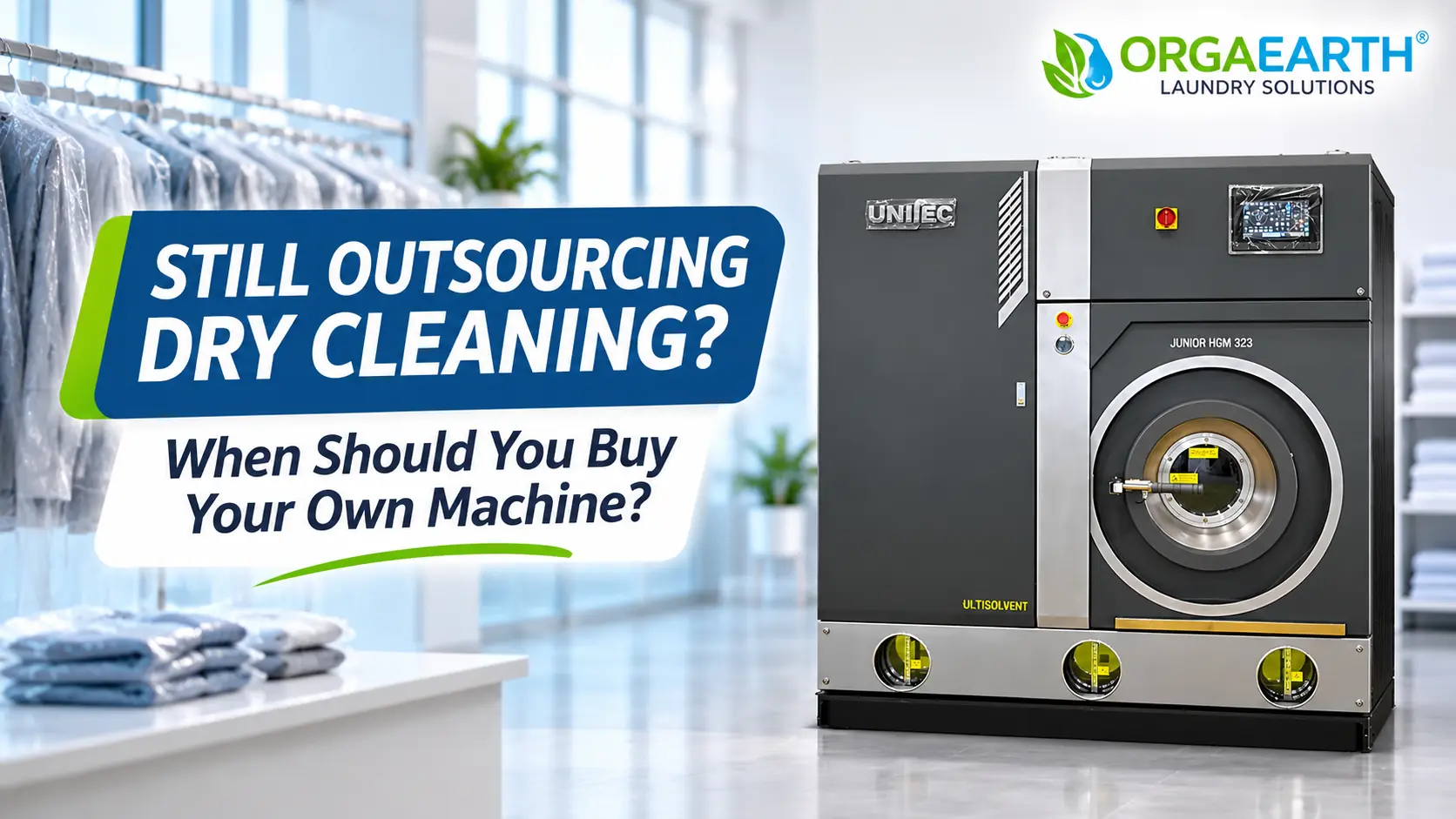
Your dry-cleaning shop receives regular customer orders, but every garment still goes to an outside processing facility. You pay the vendor, wait for delivery and depend on their schedule to meet customer commitments.
As orders increase, outsourcing expenses can become a significant part of your operating costs.
But does that mean buying an industrial dry cleaning machine is the right decision?
Not necessarily. Machine ownership brings greater control over processing, but it also requires investment, trained operators and ongoing maintenance.
The right time to switch depends on your monthly order volume, processing expenses and ability to manage dry cleaning in-house.
How Does Outsourced Dry Cleaning Work for a Retail Shop?
Many retail dry cleaners begin as collection centres. They accept garments, inspect them, record customer requirements, and send orders to a separate processing facility.
This model reduces the need for machinery and technical staff during the early stages.
However, the shop depends on the vendor for cleaning quality, turnaround times and processing availability.
Transport delays, garment mix-ups and inconsistent finishing can affect customer satisfaction.
Outsourcing may remain practical for smaller operations, but growing businesses should periodically review whether their processing arrangement still meets customer demand.
Is Outsourcing Dry Cleaning Cheaper Than Buying Your Own Machine?
Outsourcing usually involves a processing charge for each garment. In-house operations involve both fixed and variable expenses.
Consider this hypothetical comparison:
| Monthly expense | Outsourcing | In-house |
| Garments processed | 1,000 | 1,000 |
| Processing cost per garment | ₹100 | ₹45 |
| Monthly fixed processing costs | — | ₹40,000 |
| Total monthly cost | ₹1,00,000 | ₹85,000 |
In this example, in-house processing costs ₹15,000 less per month.
The figures are illustrative, not actual supplier prices. The fixed and variable costs must include relevant labour, utilities, solvent, maintenance, equipment ownership, waste handling and compliance expenses.
Businesses should calculate their costs using actual vendor invoices and realistic machine operating expenses.
How Many Garments Per Month Justify an Industrial Dry Cleaning Machine?
There is no universal monthly garment volume that makes machine ownership profitable.
The break-even point depends on the difference between outsourcing charges and in-house variable costs.
Using the previous example:
Break-even volume = Monthly fixed costs ÷ Savings per garment
₹40,000 ÷ (₹100 − ₹45) = approximately 728 garments per month.
At this volume, the two processing models have similar estimated costs.
However, garment count alone can be misleading. A heavy coat and a lightweight shirt occupy different machine capacities and may need different treatment.
Review at least three to six months of orders, including garment types, seasonal demand and actual dry-cleaning requirements.
How Much Does an Industrial Dry Cleaning Machine Cost in India?
The purchase price depends on machine capacity, solvent compatibility, filtration, recovery systems and available features.
Installation, transport, operator training and supporting equipment can increase the total investment.
A small retail operation may have different requirements from a central processing facility serving several outlets.
Instead of comparing machine-only prices, request a complete installed quotation.
Also calculate the expected monthly financing or ownership cost before comparing it with your outsourcing bill.
What Size Commercial Dry Cleaning Machine Does Your Shop Need?
Machine capacity should match the weight and type of garments processed each day.
For example, a shop receiving 100 garments daily cannot determine its required capacity from garment count alone.
Actual dry weight, batch compatibility, cycle duration and working hours must be considered.
An oversized machine may remain underutilised, while an undersized machine can create delays during busy periods.
Ask suppliers to calculate realistic daily output using your order records rather than relying only on rated capacity.
What Changes When You Bring Dry Cleaning In-House?
Owning a machine means taking responsibility for the complete cleaning process.
Your business must manage garment inspection, sorting, spotting, machine operation, finishing and quality checks.
Solvent management, equipment maintenance and proper waste handling also become operational responsibilities.
Trained employees are essential because different fabrics, trims and stains require appropriate processing decisions.
In-house production may provide greater scheduling control, but successful operation requires more than simply installing a machine.
Hydrocarbon vs PERC: Which Dry Cleaning Machine Should You Consider?
Different dry-cleaning systems use different compatible solvents and operating arrangements.
Perchloroethylene, commonly called PERC, has established industrial cleaning applications but presents occupational and environmental hazards that require appropriate controls.
Hydrocarbon systems have different solvent properties, including potential flammability concerns, and require equipment designed for their intended solvent.
Neither technology should be selected solely on advertised cleaning performance.
Evaluate garment compatibility, solvent handling, recovery arrangements, safety requirements, available utilities and applicable regulations before choosing equipment.
What Hidden Operating Costs Should Dry Cleaners Consider?
Several expenses are easy to overlook when evaluating an in-house facility.
These include solvent replenishment, filters, electricity or steam, trained labour, equipment servicing, spare parts and compliant waste disposal.
Ventilation, safety arrangements and site modifications may also require investment.
A low processing cost per garment is meaningful only when all necessary operating expenses are included.
Compare costs at realistic monthly volumes rather than assuming the machine will operate at full capacity throughout the year.
Can In-House Dry Cleaning Improve Turnaround Time?
Processing garments at your own facility may reduce dependence on external pickup and delivery schedules.
It can also provide greater control over urgent orders and internal quality checks.
However, faster turnaround is not guaranteed.
Machine downtime, staffing shortages or poor workflow planning can still delay deliveries.
Before investing, identify whether outsourcing delays are a recurring business problem or an occasional inconvenience.
A machine purchase should solve a measurable operational need.
Should You Stop Outsourcing Completely After Buying a Machine?
Not always.
A hybrid model can be practical during the transition to in-house processing.
For example, a shop may process suitable regular garments internally while continuing to outsource specialist items or excess seasonal volumes.
Maintaining an alternative processing arrangement also helps during scheduled maintenance or unexpected machine downtime.
This approach allows the business to expand its capabilities without immediately taking responsibility for every garment category.
What Should You Check Before Investing in Your First Dry Cleaning Machine?
Before purchasing, confirm that your business has consistent processing demand and sufficient working capital.
Evaluate the proposed machine's capacity, compatible solvent system, installation requirements, maintenance arrangements and operator training.
Check whether the premises can accommodate the equipment and comply with applicable safety and environmental requirements.
Finally, prepare a conservative cost forecast using actual monthly orders.
A purchase should be supported by business records, not simply the expectation that ownership will automatically increase profits.
How Orgaearth Can Help You Choose the Right Industrial Dry Cleaning Machine
Orgaearth Laundry Solutions supplies professional UNISEC dry-cleaning equipment for garment-care businesses, retail dry cleaners and commercial laundry operations across India.
Its range includes PERC and multi-solvent machine options for different processing requirements.
Orgaearth can assist businesses with machine selection, capacity assessment, installation planning and after-sales requirements.
Shop owners considering in-house processing can explore Orgaearth's industrial dry cleaning machines to compare available equipment and request a quotation suited to their operations.
Conclusion: When Is Buying Your Own Dry Cleaning Machine Worth It?
Buying a dry-cleaning machine becomes worth considering when consistent order volume, outsourcing costs and operational requirements justify the investment.
For businesses with irregular demand, outsourcing may remain the more practical option.
For established shops with sufficient workload, in-house processing may offer greater control over costs, quality and turnaround.
The best approach is to compare realistic expenses, confirm equipment requirements and calculate break-even before making a purchase.
Frequently Asked Questions
1. When should a dry cleaning shop buy its own machine?
A shop should consider machine ownership when regular order volume and processing costs justify the investment, and it has suitable premises, trained staff and sufficient working capital.
2. Is outsourcing cheaper than buying an industrial dry cleaning machine?
Outsourcing can be cheaper at low volumes because there is no machinery investment. In-house processing may become economical when consistent demand spreads fixed costs across more garments.
3. How many garments per month justify a dry cleaning machine?
There is no fixed threshold. Calculate the break-even volume using monthly fixed costs and the difference between outsourced and in-house variable processing costs.
4. What is the industrial dry cleaning machine price in India?
Prices depend on capacity, solvent technology, recovery systems, configuration and installation requirements. Request a supplier quotation for accurate pricing.
5. Can a small dry cleaning shop operate with one machine?
Yes, if the machine suits the shop's workload and garment categories. The business must also plan for finishing, maintenance, specialist processing and downtime.
6. Is a hydrocarbon dry cleaning machine better than a PERC machine?
Neither is universally better. Selection depends on garment requirements, compatible solvents, operating costs, equipment design, safety controls and applicable regulations.
Contact Us:
Orgaearth Laundry Solutions
Plot no. 774, Udyog Vihar, Phase 5, Gurugram, Haryana, India-122016
Email: marketing@orgaearth.com
Contact No. +91 7042912777

 English
 Arabic
 French
 Portuguese
 Deutsch
 Turkish
 Dutch
 Italiano
 Russian
 Romaian
 Portuguese (Brazil)
 Greek