
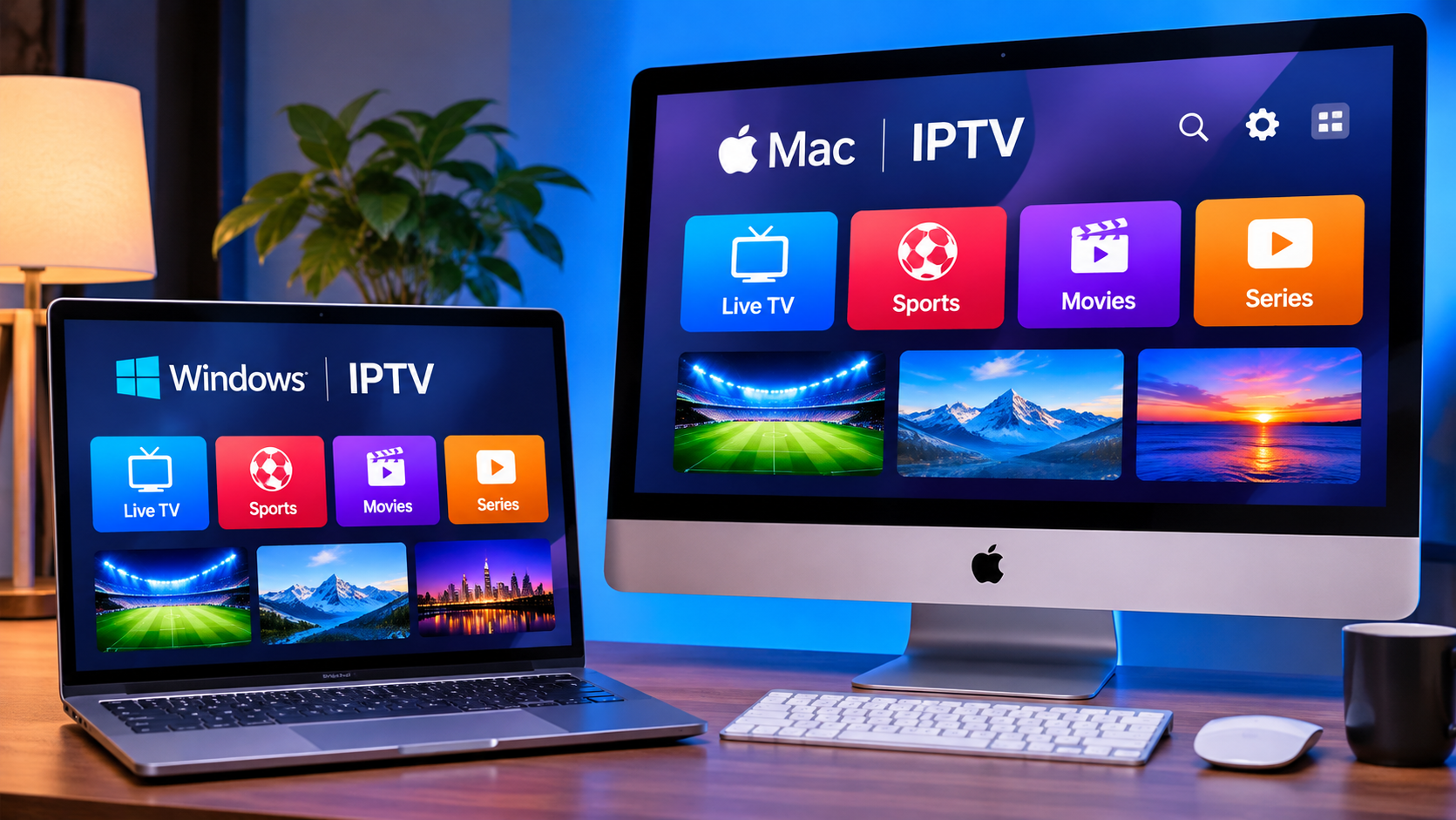
Watching IPTV on a desktop or laptop can be a practical option for users who prefer a larger screen, keyboard controls, and easy access to multiple applications. Both Windows and macOS can support compatible IPTV players, allowing viewers to access live TV, sports, movies, and series through an internet connection.
Desktop streaming can also be useful for users who want to test their IPTV subscription before setting it up on a Smart TV or streaming box.
The experience depends on the player, network connection, computer performance, and login method used by the IPTV service.
How IPTV Works on a Computer
IPTV delivers television content through the internet rather than a traditional cable or satellite connection.
On a Windows PC or Mac, an IPTV player acts as the interface between the user and the subscription.
A typical setup requires:
-
A Windows PC or Mac
-
A stable internet connection
-
A compatible IPTV player
-
An active subscription
-
Login or playlist information
The exact setup process depends on the application being used.
Choose a Player That Supports Your Login Method
Not every IPTV player accepts the same type of connection.
Before downloading an application, check whether it supports the information supplied by your provider.
Common setup methods include:
-
M3U playlist URLs
-
Username and password login
-
Server URLs
-
EPG sources
-
Portal-based connections
Users comparing IPTV services such as Rapid IPTV should check device compatibility and setup instructions before selecting a desktop player.
Using a compatible application from the beginning can prevent unnecessary login and playlist problems.
Windows and Mac May Use Different Apps
An application available for Windows may not have a macOS version, and the opposite can also happen.
Check the developer's supported operating systems before installing a player.
Users should also confirm whether their computer meets the minimum system requirements.
Older computers may still handle basic IPTV playback, but high-resolution video can require more processing power.
Download Applications From Trusted Sources
Desktop computers allow software to be installed from many different websites, which makes source verification important.
Whenever possible, download IPTV players from:
-
Official developer websites
-
Microsoft Store
-
Mac App Store
-
Recognized software platforms
Avoid modified programs from unknown download sites.
Untrusted software may create privacy, security, or stability problems.
Keep Your Login Information Private
IPTV subscription details should be treated like other account credentials.
Do not publicly share:
-
Usernames
-
Passwords
-
Private M3U links
-
Server details
-
Portal information
This is especially important on desktop computers because users may copy URLs into browsers, text files, or messaging applications.
Store credentials somewhere secure rather than leaving them visible on the desktop.
Copy and Paste Details Carefully
One advantage of setting up IPTV on a computer is that long URLs are easier to enter.
Instead of typing an M3U address manually, users can usually copy and paste it directly into the player.
Still, check for:
-
Extra spaces
-
Missing characters
-
Incorrect server addresses
-
Expired login details
A small formatting error can prevent the playlist from loading.
Use a Stable Internet Connection
Desktop IPTV streaming depends heavily on network quality.
A fast connection can still perform poorly if it suffers from congestion, Wi-Fi interference, or temporary drops.
Common symptoms include:
-
Buffering
-
Freezing
-
Delayed channel loading
-
Reduced picture quality
-
Streams disconnecting
If problems appear across several channels, check the local network before changing advanced player settings.
Ethernet Can Be Useful for Desktop Streaming
Desktop computers are often located close to routers or network equipment.
When possible, Ethernet can provide a more consistent connection than Wi-Fi.
A wired connection may help reduce:
-
Wireless interference
-
Signal fluctuations
-
Congestion on busy Wi-Fi networks
-
Problems caused by distance from the router
Ethernet is especially useful for longer viewing sessions or higher-resolution streams.
Improve Wi-Fi on Laptops
Laptop users often prefer Wi-Fi for convenience.
If the signal is weak, try:
-
Moving closer to the router
-
Using a less congested wireless band
-
Keeping the router in an open location
-
Avoiding thick walls or metal objects
-
Reducing unnecessary network activity
A weak connection can make the IPTV player appear faulty even when the application itself is working correctly.
Close Heavy Background Downloads
Computers may perform large downloads without the user noticing.
Operating system updates, cloud synchronization, game downloads, and file transfers can all consume bandwidth.
If IPTV starts buffering unexpectedly, check whether the computer or another device on the network is downloading something large.
Pausing background activity can improve available bandwidth immediately.
Use Favorites to Organize Channels
Desktop IPTV players often offer more screen space than mobile applications.
This can make large playlists easier to browse, but favorites are still useful.
Users can create a smaller list containing frequently watched:
-
Sports channels
-
News
-
Movies
-
Entertainment
-
International channels
-
Family content
A well-organized playlist can make daily navigation much faster.
EPG Can Improve Desktop Viewing
EPG stands for Electronic Program Guide.
When supported by the IPTV player and service, it can display information about current and upcoming programs.
An EPG may show:
-
Program names
-
Start times
-
End times
-
Channel schedules
-
Upcoming shows
Desktop screens provide enough space for detailed guide layouts, which can make EPG browsing particularly convenient.
Check Timezone Settings if EPG Is Wrong
If the program guide appears several hours early or late, the playlist may not be the problem.
Check the computer's:
-
Date
-
Time
-
Timezone
-
Regional settings
Incorrect system time can cause program schedules to appear shifted.
Keep automatic time synchronization enabled when appropriate.
Windows Firewall and Security Software
Desktop computers often use firewalls, antivirus programs, or network security tools.
These can occasionally interfere with streaming applications if they block network access.
If an IPTV player cannot connect while other internet applications work normally, check whether the security software has restricted the application.
Do not disable security tools permanently just to make a player work.
Instead, review the application's permissions and use trusted software.
Keep Windows and macOS Updated
Operating system updates can improve:
-
Security
-
Network stability
-
Video playback
-
Application compatibility
-
Device drivers
Keeping Windows or macOS current can prevent problems with newer streaming applications.
Restart the computer after major updates when requested.
Update the IPTV Player
The IPTV application should also remain current.
Updates may include:
-
Playback fixes
-
Better playlist support
-
EPG improvements
-
Security updates
-
Interface changes
-
Compatibility fixes
If a previously stable player begins behaving strangely, check whether a newer version is available.
Why IPTV May Buffer on a Computer
Buffering can have several causes.
Possible reasons include:
-
Weak Wi-Fi
-
Network congestion
-
Background downloads
-
High-resolution streams
-
Limited computer resources
-
Player settings
-
Temporary stream problems
Avoid assuming immediately that the IPTV subscription is responsible.
Test several channels and compare performance with other streaming applications.
Watch CPU and Memory Usage
Older computers may struggle with demanding video streams.
If the system becomes slow while IPTV is playing, open the operating system's task manager or activity monitor.
Check whether:
-
CPU usage is unusually high
-
Memory is nearly full
-
Another program is using significant resources
-
The computer is overheating
Closing unnecessary software can free resources for video playback.
Browser Tabs Can Affect Performance
Users often keep many browser tabs open while watching IPTV on a computer.
Modern browsers can use significant memory, particularly when several video or web applications are active.
If the IPTV player becomes slow, close unnecessary tabs and programs.
This can be especially helpful on computers with limited memory.
Higher Resolution Requires More Resources
4K and other high-resolution streams require more bandwidth and computing power than lower resolutions.
If HD streams work normally but 4K content buffers or drops frames, the problem may be related to:
-
Network speed
-
Graphics performance
-
Processor performance
-
Player compatibility
Testing a lower resolution can help identify the limitation.
Stable playback is usually more useful than forcing the highest available resolution.
External Displays Can Improve the Experience
A laptop or desktop can also be connected to a larger monitor or television.
Depending on the computer, users may use:
-
HDMI
-
USB-C video output
-
DisplayPort
-
Compatible wireless display methods
This can make desktop IPTV more comfortable for longer viewing sessions.
Check the display settings to ensure the correct resolution and audio output are selected.
Check Audio Output
Computers can have several audio devices connected at once.
If video plays but there is no sound, check whether audio is being sent to:
-
Laptop speakers
-
External monitor
-
Television
-
Bluetooth headphones
-
USB audio device
Selecting the correct output device can solve many apparent IPTV audio problems.
Restart Before Reinstalling
If the IPTV player stops working, do not immediately delete it.
Try these steps first:
-
Close the application.
-
Restart the computer.
-
Check the internet connection.
-
Confirm the subscription is active.
-
Test another channel.
-
Check for updates.
Reinstalling may remove saved playlists, favorites, or settings, so it is better used after simpler troubleshooting steps.
Test Several Channels
One channel failing does not necessarily mean the entire setup is broken.
Try streams from different categories.
If most channels work normally, the issue may be limited to a particular source.
If everything fails, investigate:
-
Login details
-
Internet connection
-
Player configuration
-
Subscription status
-
Security software
Testing systematically makes troubleshooting easier.
Windows vs Mac for IPTV
Both platforms can work well for IPTV.
Windows may offer a wider selection of desktop media players, while macOS users can choose from applications designed specifically for Apple's desktop environment.
The better option depends on:
-
Available IPTV players
-
Computer hardware
-
Personal workflow
-
Preferred interface
-
Existing devices
There is no single platform that is best for every user.
Final Thoughts
Windows and Mac computers can provide a flexible way to watch IPTV, especially for users who want a larger interface, easy playlist management, and simple access to login information.
Start by choosing a trusted IPTV player that supports your subscription method. Keep the operating system and application updated, use a stable internet connection, and protect your account credentials.
If streaming problems appear, test multiple channels, check background network activity, monitor computer performance, and restart the application before changing advanced settings.
With a compatible player and reliable network, a desktop or laptop can provide a practical way to access live TV, sports, movies, and series through IPTV.

 English
 Arabic
 French
 Spanish
 Portuguese
 Deutsch
 Turkish
 Italiano
 Russian
 Romaian
 Portuguese (Brazil)
 Greek