
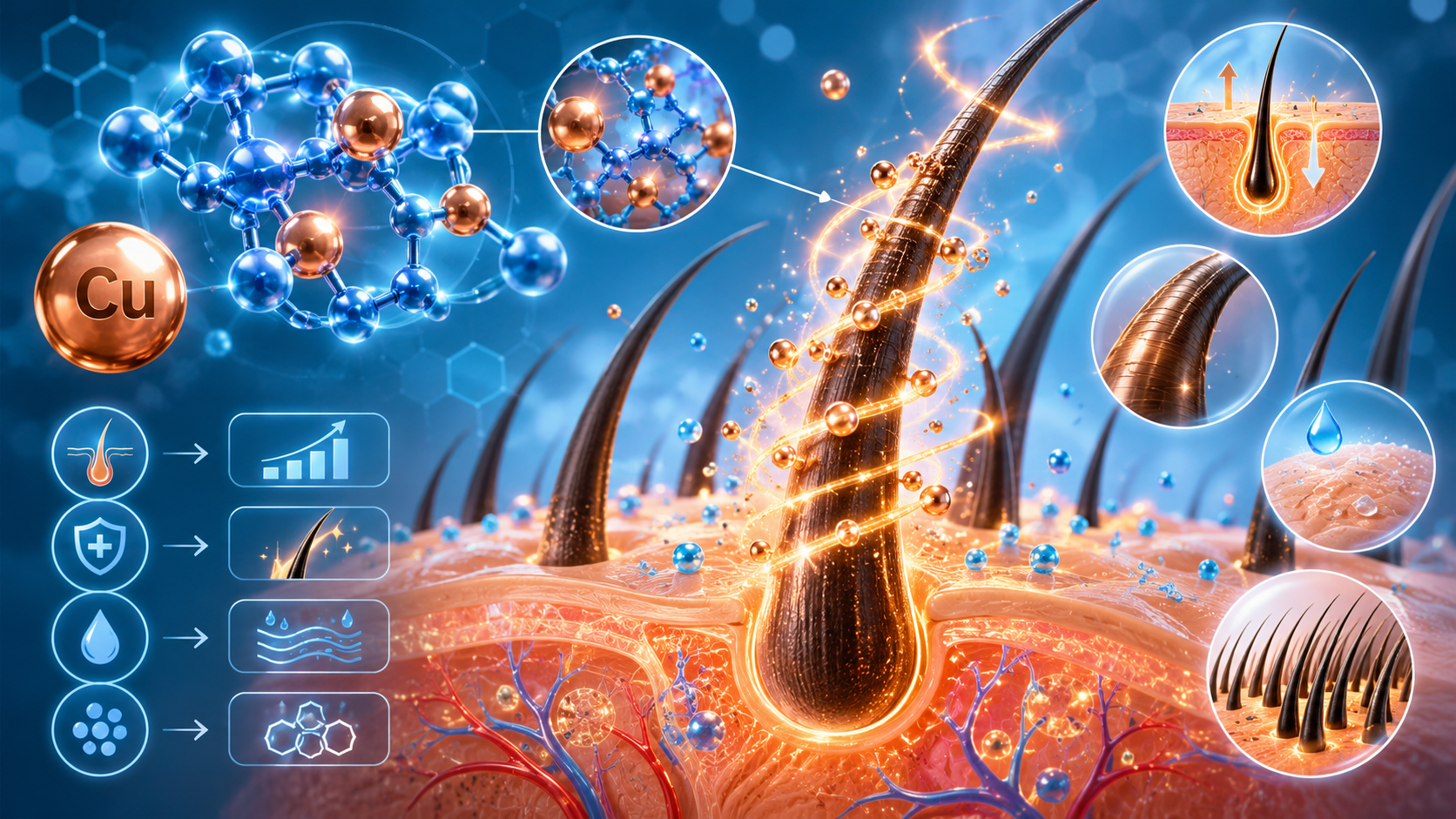
Healthy, fuller-looking hair starts with a healthy scalp. While shampoos, conditioners, and hair oils often receive the most attention, peptides are emerging as interesting ingredients in modern hair and scalp care. Among them, copper peptides have attracted particular interest for their potential roles in skin repair, tissue maintenance, and follicle-supporting environments.
Copper peptides combine copper ions with small chains of amino acids. One of the best-known examples, GHK-Cu, has been studied for its involvement in several biological processes associated with skin health and tissue regeneration. Although researchers continue to investigate its potential benefits for hair growth, early findings have generated interest in peptide-based scalp treatments.
So, what makes copper peptides different from conventional hair care ingredients? Can they support healthier hair follicles, improve scalp condition, or help address thinning? Understanding the science behind these compounds can help consumers make informed decisions about incorporating peptides into their hair care routines.
What Are Peptides in Hair and Scalp Care?
Peptides are short chains of amino acids, the building blocks of proteins. In the body, different peptides participate in biological communication and influence processes such as tissue maintenance, repair, and cellular activity. Skincare formulations use selected peptides to support specific cosmetic goals, including improving the appearance of skin texture and promoting a healthier-looking complexion.
In hair care, researchers and cosmetic formulators are exploring peptides for hair because of their potential to support the scalp environment and hair follicles. Hair follicles are complex structures that depend on communication between different cells, adequate nutrient availability, and healthy surrounding tissue. Consequently, ingredients that promote scalp health may offer additional benefits as part of a comprehensive hair care routine.
Understanding Copper Peptides
Copper peptides are complexes formed when copper ions bind to peptide molecules. GHK-Cu, also called copper tripeptide-1 in cosmetic ingredient terminology, is a particularly well-known example. It contains the amino acids glycine, histidine, and lysine, along with a copper ion.
Researchers have investigated GHK-Cu for its involvement in processes related to collagen production, tissue remodeling, and wound repair. These properties make it interesting for skin and scalp formulations. However, evidence supporting its potential for hair growth remains less established than research into some of its skin-related applications.
How Copper Peptides May Support Hair Follicle Health
Hair growth follows a repeating cycle involving growth, transition, and resting phases. These stages, known as anagen, catagen, and telogen, determine how long individual hairs grow and when they naturally shed. A disruption in this cycle can contribute to excessive shedding or visible thinning.
Copper peptides have attracted scientific attention because they may influence biological pathways involved in tissue maintenance and cellular activity. Researchers are exploring whether these effects could also benefit the structures surrounding hair follicles. Nevertheless, promising biological mechanisms do not automatically demonstrate improved hair growth in humans.
1. Supporting the Scalp's Natural Repair Processes
A healthy scalp provides the foundation for comfortable, manageable hair. Environmental exposure, dryness, irritation, and excessive styling can affect its condition. GHK-Cu has been studied for its potential involvement in tissue repair and remodeling, making it an interesting ingredient for products designed to support scalp care.
By supporting the appearance and condition of the scalp, copper peptide formulations may complement other hair care practices. However, consumers should distinguish between supporting scalp health and directly stimulating new hair growth. These are different outcomes, and research has not yet established that topical copper peptides reliably deliver both.
2. Exploring Collagen and Extracellular Matrix Support
The extracellular matrix is a network of proteins and other molecules that surrounds cells and helps maintain tissue structure. Collagen is one of its major components. Research into GHK-Cu suggests that it may influence collagen-related processes and aspects of tissue remodeling.
Because hair follicles sit within the skin, the condition of surrounding tissue matters to their overall environment. Scientists therefore have an interest in understanding whether copper peptides could support follicular surroundings. Still, evidence connecting these mechanisms directly to meaningful improvements in human hair density remains limited.
3. Investigating Antioxidant and Anti-Inflammatory Activity
Oxidative stress occurs when reactive molecules overwhelm the body's antioxidant defenses. Environmental pollutants, ultraviolet exposure, and other stressors can contribute to oxidative damage. Researchers have investigated GHK-Cu for potential antioxidant and inflammation-modulating activity in laboratory and experimental settings.
These findings are relevant because scalp irritation and inflammation can accompany certain hair and skin conditions. Nevertheless, copper peptides should not be considered a proven treatment for inflammatory scalp disorders. Persistent itching, redness, flaking, or hair loss requires appropriate evaluation rather than relying exclusively on cosmetic ingredients.
Potential Benefits of Copper Peptides for Hair and Scalp Care
Interest in copper peptides continues to grow as cosmetic science explores ingredients that support healthier-looking skin and hair. Although research remains developing, several potential benefits explain why formulators include these compounds in specialized scalp products.
A Healthier-Looking Scalp Environment
Copper peptides may help support skin-conditioning and repair-related processes. As a result, they can be attractive additions to scalp serums designed to improve overall scalp appearance and comfort. However, the actual experience depends on the complete formulation, concentration, product stability, and individual skin response.
Support for Hair Care Formulations Targeting Thinning
Some peptide-based hair products target the appearance of thinning by focusing on follicle-supporting ingredients. Copper peptides are included in this area of research because of their biological activity in skin-related processes.
However, consumers should approach hair regrowth claims carefully. There is currently insufficient high-quality human clinical evidence to establish topical GHK-Cu as a reliable standalone treatment for androgenetic alopecia or other common forms of hair loss.
Complementary Support for Overall Hair Care
Copper peptides may complement a routine that prioritizes gentle cleansing, scalp comfort, adequate nutrition, and reduced styling damage. They are not substitutes for evidence-based treatments, but carefully formulated products may offer an additional cosmetic option for people interested in peptide-based scalp care.
Copper Peptides vs. Other Hair Growth Ingredients
Not all hair care ingredients work in the same way. Understanding their differences helps consumers choose products based on realistic expectations rather than marketing claims.
| Ingredient | Primary area of interest | Evidence for hair growth |
| Copper peptides (GHK-Cu) | Tissue maintenance and repair-related processes | Limited human clinical evidence |
| Minoxidil | Promoting hair growth and prolonging the growth phase | Established clinical evidence for certain types of hair loss |
| Caffeine | Potential effects on follicular activity | Limited and developing clinical evidence |
| Biotin | Supporting normal hair health when deficiency exists | Limited benefit without deficiency |
| Niacinamide | Scalp skin conditioning and barrier support | Not an established hair regrowth treatment |
Minoxidil stands apart because clinical studies support its use for certain types of hair loss. Copper peptides, by comparison, remain an emerging cosmetic ingredient with interesting biological properties but insufficient evidence to establish comparable results.
How to Use Copper Peptides in a Hair Care Routine
Choosing an appropriate product, such as a well-formulated peptide scalp serum, and using it consistently can help consumers evaluate how their scalp responds. However, applying more products does not necessarily lead to better results. A thoughtful routine should prioritize formulation quality, tolerability, and realistic expectations.
Choose a Well-Formulated Scalp Serum
Look for products that clearly identify copper peptides or GHK-Cu in their ingredient lists. Copper tripeptide-1 is a useful ingredient name to recognize. Consider the complete formulation rather than focusing on one ingredient, since the vehicle, supporting ingredients, and product stability can influence performance.
Follow the Manufacturer's Directions
Apply the product according to its instructions. Some scalp serums work best on clean, dry skin, while others may recommend application after washing. Avoid increasing the recommended frequency in an attempt to accelerate results, as excessive application can increase the likelihood of irritation.
Introduce the Product Gradually
Before regular use, perform a patch test according to the manufacturer's guidance. Start with the recommended application frequency and monitor your scalp for redness, itching, burning, or discomfort. Discontinue use if irritation develops, and seek professional advice if symptoms persist.
Maintain a Balanced Hair Care Routine
Copper peptides cannot compensate for damaging hair practices or untreated medical conditions. Use a gentle shampoo suited to your scalp, condition the lengths of your hair, minimize excessive heat styling, and avoid hairstyles that create repeated tension on the roots. Balanced nutrition and adequate protein intake also support normal hair health.
Are Copper Peptides Safe for the Scalp?
Topical copper peptide products are generally marketed as cosmetic formulations, but their safety depends on the specific ingredients, concentration, formulation, and method of use. Individual sensitivity can vary, particularly among people with reactive or damaged scalp skin.
Always follow product instructions and avoid applying a formulation to broken or severely irritated skin unless a healthcare professional recommends it. Furthermore, do not assume that combining multiple active ingredients will improve results. If you already use medicated scalp treatments, consult a dermatologist before introducing additional products.
Pregnant or breastfeeding individuals and people managing persistent scalp conditions should seek appropriate professional advice before experimenting with specialized treatments. If a product causes discomfort or an unexpected reaction, stop using it.
Who May Benefit From Copper Peptide Hair Products?
Copper peptide scalp products may interest people who want to explore advanced cosmetic ingredients and support their overall scalp care routine. They may also appeal to consumers looking for alternatives to conventional conditioning products or those interested in emerging peptide-based formulations.
However, anyone experiencing sudden shedding, expanding bald patches, significant scalp inflammation, or progressive thinning should consult a dermatologist. Hair loss can result from genetics, hormonal changes, nutritional deficiencies, medications, autoimmune conditions, and other health factors. Identifying the underlying cause is essential for choosing an effective treatment.
What Does the Future Hold for Copper Peptides in Hair Care?
Scientific interest in copper peptides reflects a broader movement toward understanding how cosmetic ingredients interact with biological processes. Researchers continue to investigate GHK-Cu in tissue repair, skin biology, and other areas that may help explain its potential applications.
Future human clinical trials will need to establish whether topical copper peptides meaningfully influence hair density, follicle activity, or the duration of the hair growth cycle. Researchers must also determine effective concentrations, suitable delivery systems, long-term safety, and which individuals may respond best.
Until stronger evidence becomes available, copper peptides should be viewed as promising ingredients for further investigation rather than proven hair regrowth solutions.
Conclusion
Copper peptides, particularly GHK-Cu, offer an interesting approach to modern hair and scalp care. Their potential involvement in tissue repair, collagen-related activity, and skin maintenance has attracted scientific and cosmetic interest. Nevertheless, evidence supporting direct hair regrowth in humans remains limited.
For consumers, the most practical approach is to choose well-formulated products, follow application instructions, and maintain a consistent scalp care routine. Most importantly, address persistent or unexplained hair loss with professional guidance. Copper peptides may have a place in the future of advanced hair care, but further research must establish what they can reliably achieve.

 Arabic
 French
 Spanish
 Portuguese
 Deutsch
 Turkish
 Dutch
 Italiano
 Russian
 Romaian
 Portuguese (Brazil)
 Greek