
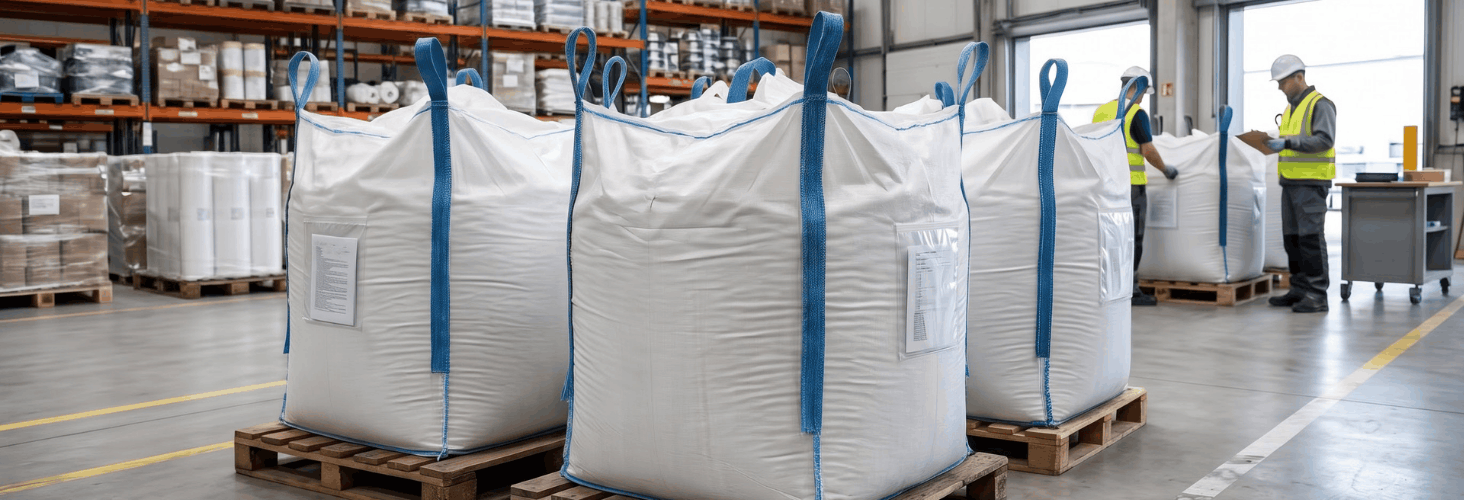
A single FIBC bulk bag can hold a tonne or more of product. That makes it one of the most efficient ways to move powders, granules and grains. It also means a wrong spec is costly. A bag that is rated too low, built for the wrong use or unsafe around dust can put people, product and plant at risk.
This guide explains the three things every buyer should understand: SWL, safety factor and bag type. It also covers what to check before you place an order with an FIBC bags manufacturer.
What Are FIBC Bulk Bags?
FIBC stands for Flexible Intermediate Bulk Container. These are large bags woven from polypropylene fabric, with strong lifting loops sewn at the top. They are filled from the top, lifted by forklift or crane, and emptied from the top or through a spout at the bottom.
They are used for cement, sand, minerals, chemicals, fertilisers, food grains, sugar, plastic granules and more. Empty bags fold flat, so they take very little space in storage and on return trips.
SWL: Safe Working Load
SWL is the maximum weight the bag is designed to carry in normal use. It is the most important number on any FIBC label. Common SWL ratings range from 500 kg to 2,000 kg.
Choose SWL based on your real fill weight, not your hopes for it. Keep these points in mind:
-
Match the fill weight: if you fill 1,000 kg, choose a bag rated for at least 1,000 kg. Never fill above the SWL.
-
Check bulk density: light products need a larger bag to reach the same weight. Dense products fill a smaller bag fast.
-
Think about handling: lifting, stacking and transport all add stress. Rough handling calls for a stronger build, not a higher fill.
-
Read the label: every bag should carry its SWL, safety factor and handling marks in clear print.
Safety Factor: The Margin Built In
The safety factor (SF) tells you how much stronger the bag is than its SWL. It is shown as a ratio. A bag with an SWL of 1,000 kg and a 5:1 safety factor has been tested to hold 5,000 kg without failing.
-
5:1 safety factor: the standard for single-trip bags. These are filled, shipped and emptied once.
-
6:1 safety factor: for multi-trip bags designed to be reused. Reuse is only safe with proper inspection, cleaning and records between trips.
Ask your FIBC bags manufacturer how the bags are tested. Top-lift tests check that the bag and its loops hold the rated load with the safety margin built in. Batch test reports show the rating is real, not just printed on a label.
Bag Types A, B, C and D
When dry products flow in and out of a bag, they create static electricity. In the wrong setting, a spark can ignite flammable dust or vapour. FIBCs are grouped into four types based on how they handle static:
-
Type A: plain woven PP with no static protection. Use only for non-flammable products in areas with no flammable dust or vapour.
-
Type B: made from fabric that prevents high-energy discharges. It suits dry flammable powders, but not areas with flammable vapours.
-
Type C: woven with conductive threads that must be connected to earth during filling and emptying. It suits flammable settings, but only when grounding is in place every time.
-
Type D: made from static-dissipative fabric that releases static safely without grounding. It suits flammable settings where grounding is hard to guarantee.
The right type depends on your product and your plant. If flammable dust or solvents are present, involve your safety team before choosing a bag.
Other Design Choices to Confirm
Beyond SWL and type, the build of the bag shapes how it fills, stacks and empties:
-
Body style: U-panel, four-panel or circular woven bodies, each with different strength and shape.
-
Baffles: baffle bags keep a square shape when filled. They stack neatly and save space in trucks and containers.
-
Top: open top, duffle top or a filling spout to suit your filling line.
-
Bottom: flat bottom for single use, or a discharge spout for controlled emptying.
-
Loops: corner, cross-corner or sleeve loops to suit forklifts and cranes.
-
Liners and coating: inner liners or coated fabric for fine powders, moisture-sensitive products or food use.
-
UV treatment: important if filled bags are stored outdoors.
Questions to Ask an FIBC Bags Manufacturer
A good spec on paper is only half the job. Before you commit to an FIBC bags manufacturer, ask:
-
Can you share top-lift test reports for this SWL and safety factor?
-
Which bag types (A, B, C, D) do you supply, and what test data backs them?
-
Do you weave, stitch and finish in-house?
-
What are the MOQ and lead time for a custom size or print?
-
Which certifications and memberships do you hold?
-
How do you pack bags for export, and what documents do you provide?
Why Experience and Process Control Matter
FIBC failures rarely start at the filling line. They start with weak fabric, uneven stitching or loose quality checks. A supplier that controls each step can keep every batch at the rated strength.
Mewar Polytex has made woven packaging since 1979. With 46+ years in business, 14+ manufacturing facilities and over 8,000 MT of monthly capacity, it handles weaving, lamination, printing, stitching and finishing in-house. The company is ISO 9001 certified, a member of EFIBCA (the European FIBC association), and exports to 25+ countries.
The right FIBC bulk bag starts with three clear answers: how much it must carry, how often it will be used, and how static must be controlled. Get those right, test samples, and work with an FIBC bags manufacturer that can prove every rating it prints.

 English
 Arabic
 French
 Spanish
 Portuguese
 Deutsch
 Turkish
 Dutch
 Italiano
 Russian
 Romaian
 Portuguese (Brazil)