
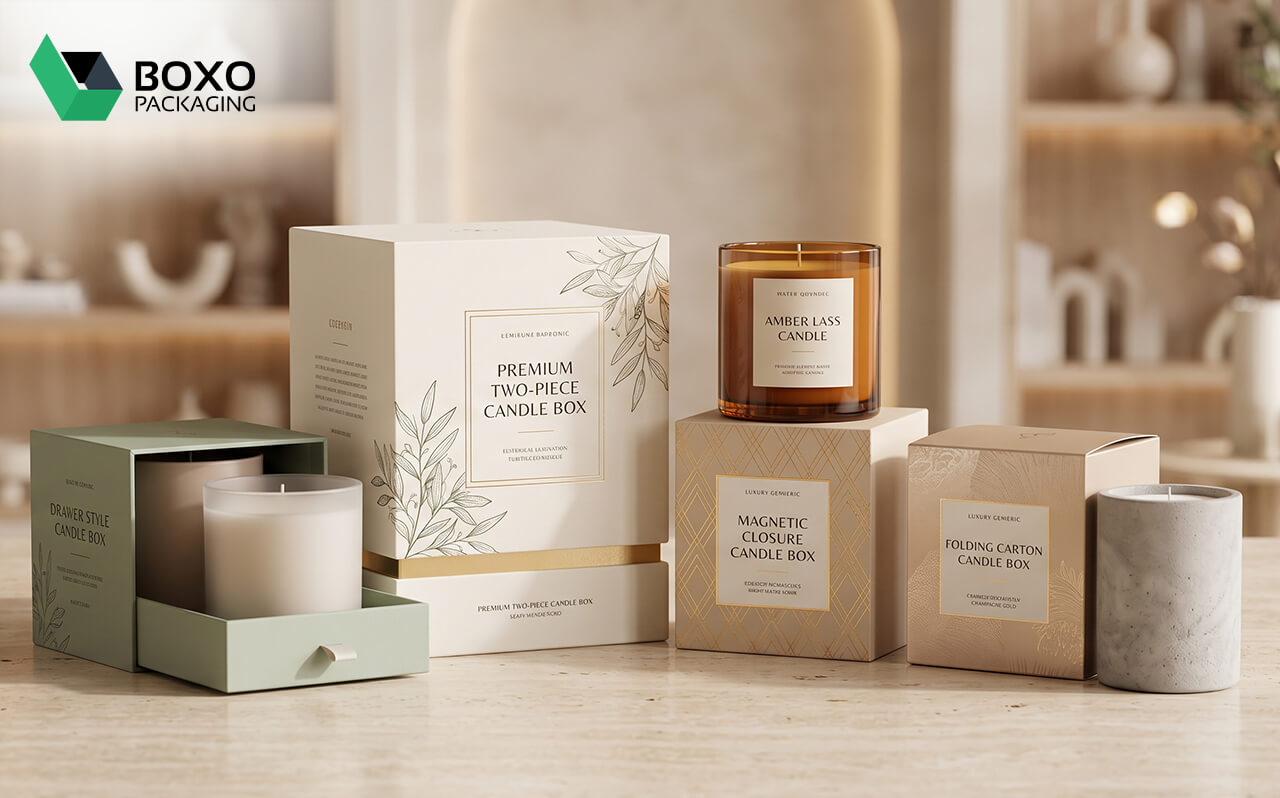
There's a specific moment in a candle brand's growth where packaging stops being a small line item and starts becoming a real operational decision. Maybe orders have gone from a few dozen a month to a few hundred. Maybe a wholesale retail account just came through and suddenly needs consistent branded packaging at a scale the brand has never produced before. This is usually the point where candle makers start looking seriously at wholesale packaging instead of continuing to buy boxes in small, ad hoc batches. It's a shift that pays off in more ways than just lower unit cost.
This article looks at why wholesale candle boxes matter specifically for growing brands, what problems they solve beyond price, and how to approach the switch without overcommitting too early.
Why Candles Are a Packaging-Sensitive Product
Before getting into wholesale specifically, it's worth understanding why candle packaging carries more weight than it might for other product categories. Candles are fragile in ways that aren't always obvious. Glass vessels can chip or crack in transit. Wax can be sensitive to heat, meaning packaging sometimes needs to account for temperature exposure during shipping. Scented candles need some degree of odor containment so fragrances don't bleed into other products during storage or transport. And because candles are frequently purchased as gifts or home décor items, presentation matters more here than it would for a purely functional product.
All of this means candle packaging isn't just a branding surface, it's doing real protective work. Getting it right, and doing so consistently across every order, becomes more important as a brand scales past the point where a founder is hand-wrapping each candle individually.
What Wholesale Packaging Actually Solves for Growing Brands
Cost Efficiency at the Volume That Matters
The most obvious benefit is unit cost. Wholesale pricing structures reward volume because fixed costs like print setup and material sourcing get spread across more units. A growing brand producing hundreds or thousands of candles a month is well past the point where small retail-style packaging orders make financial sense. Buying wholesale often cuts packaging cost per unit significantly, freeing up margin that can go toward production quality, marketing, or simply improving overall profitability.
Consistency Across a Growing Order Volume
As order volume increases, consistency becomes harder to maintain without deliberate sourcing. A brand buying small batches of boxes from whichever supplier has stock at the moment risks slight variations in color, print quality, or box dimensions between orders. Wholesale relationships, especially standing agreements with a single supplier, help lock in consistent quality and specifications, which matters a lot when customers start noticing a brand's packaging as a recognizable part of the product itself.
Meeting Retail and Wholesale Account Requirements
Once a candle brand starts supplying boutiques, gift shops, or larger retail accounts, packaging requirements often become less flexible. Retailers frequently expect uniform, professional packaging across an entire order, sometimes with specific labeling or barcode requirements built in. Small-batch, inconsistent packaging can actually become a barrier to landing or keeping these accounts. Wholesale packaging, produced to a fixed specification, makes it much easier to meet these expectations reliably.
Reducing Time Spent on Packaging Logistics
Every time a brand places a small packaging order, there's time spent researching, ordering, tracking, and unboxing that shipment, on top of the actual dollar cost. As order frequency increases, that overhead adds up. Moving to wholesale, with larger but less frequent orders, reduces the operational burden of managing packaging as a recurring task, freeing up time that a growing brand usually needs for other priorities like production, sales, or marketing.
Making Custom Branding Financially Realistic
Custom printed boxes, embossed logos, and specialty finishes often carry minimum order quantities that don't make sense at small retail volumes. Wholesale ordering is frequently the point where a brand can finally afford real custom packaging rather than relying on plain stock boxes with a sticker slapped on top. This matters more than it might seem, since packaging is one of the more affordable ways for a growing brand to differentiate itself, especially against larger competitors with bigger marketing budgets but often more generic packaging.
Supporting Predictable Growth Planning
Wholesale packaging agreements, particularly standing orders or scheduled reorders, help a growing brand plan production more predictably. Knowing that packaging supply is locked in for the next several months removes one variable from an already complex growth process, letting a brand focus more attention on scaling production, sales channels, and fulfillment without worrying whether boxes will be available when they're needed.
What to Watch Out for When Buying Wholesale
Wholesale isn't automatically the right move at every stage of growth, and buying too early or too aggressively can create its own problems.
Storage becomes a real constraint. Bulk packaging takes up physical space, and a growing brand operating out of a home studio or small workspace may not have room to store several months' worth of boxes without creating clutter or risking damage to inventory.
Order sizes need to match actual, not hoped-for, demand. It's tempting to order at the largest discount tier available, but unused packaging sitting in storage isn't a saving, it's tied-up capital. A more conservative approach, ordering enough for a realistic three to six month window, tends to work better for brands still in an active growth phase where demand can shift.
Scent and seasonal packaging can complicate bulk ordering. Candle brands that rotate scents seasonally or run limited editions need to think carefully about how much branded packaging to commit to for products that won't be sold indefinitely. Neutral, reusable packaging designs sometimes make more sense than heavily scent-specific boxes for brands with frequent product rotation.
Supplier reliability matters as much as price. A lower wholesale price isn't worth much if lead times are inconsistent or quality control is weak, especially for a growing brand that can't afford packaging delays right as demand is picking up.
Getting Started With Wholesale Candle Packaging
For brands approaching this transition for the first time, a few steps tend to smooth the process:
Start by reviewing actual order history over the past several months to get a realistic sense of packaging volume needs, rather than guessing based on hoped-for growth.
Request samples from a few suppliers before committing to a large order, paying close attention to how the material handles candle weight and any heat sensitivity concerns specific to the product.
Consider a mid-sized first wholesale order rather than jumping straight to the largest available volume discount, to confirm quality and fit before scaling up further.
Ask potential suppliers directly about flexibility for future orders, since a growing brand's packaging needs will likely keep changing, and a supplier who can adjust volume and specifications over time is generally more valuable than one offering the lowest price on a single large order.
The Bottom Line
Wholesale candle boxes solve more than a cost problem for growing brands. They bring consistency at a scale small-batch ordering can't match, make custom branding financially realistic, and remove some of the operational friction that comes with rapid growth. The switch works best when it's timed to actual demand rather than made too early or too aggressively, but for brands that have outgrown small retail-style packaging orders, wholesale is usually less of a luxury and more of a practical next step in scaling the business responsibly.

 English
 Arabic
 French
 Spanish
 Portuguese
 Turkish
 Dutch
Dutch
 Italiano
 Russian
 Romaian
 Portuguese (Brazil)
 Greek
Greek