
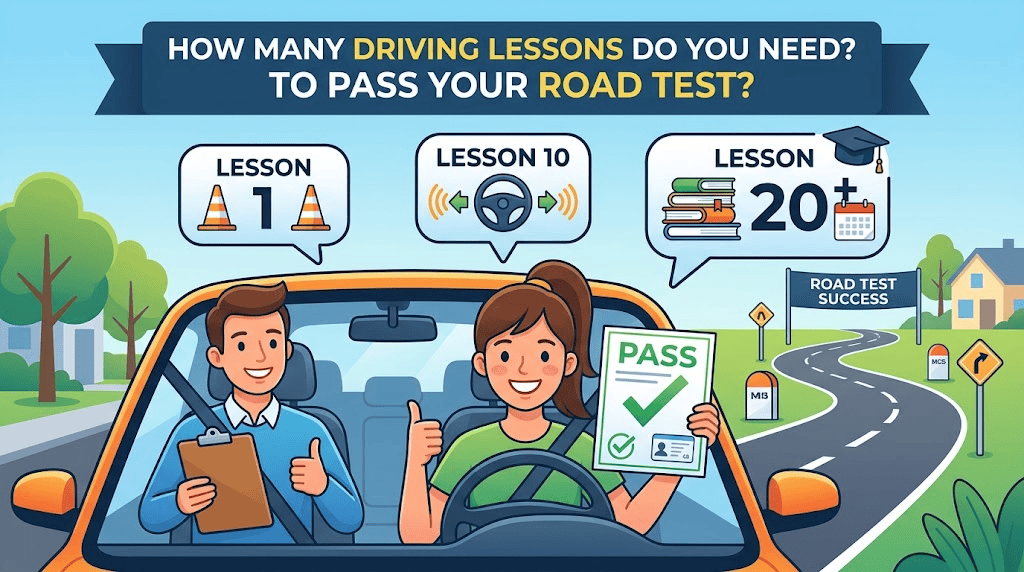
Passing your road test is about much more than knowing how to start, stop, and steer a vehicle. You need to demonstrate safe decision-making, good observation, proper lane positioning, smooth control, and the ability to respond calmly to changing traffic conditions. One of the most common questions from new drivers is, “How many driving lessons do I actually need before I’m ready?” The honest answer is that there is no single number that works for everyone.
For some learners, a handful of focused lessons combined with regular practice may be enough. Others need more time to become comfortable with busy intersections, parking, lane changes, or unfamiliar roads. Quality Driving Lessons Vancouver can help learners identify their weaknesses, build practical skills, and develop the confidence needed to handle real-world traffic rather than simply memorizing what to do during a test.
There Is No Perfect Number of Driving Lessons
Every learner starts with a different level of experience. Someone who has spent months practicing with a qualified supervisor may need fewer professional lessons than someone who has barely driven before. Your learning speed, confidence, availability for practice, and ability to understand feedback can all affect how many lessons you need.
Instead of choosing a fixed number and assuming you will automatically be ready afterward, think about your lessons as a way to build specific skills. The goal is not to complete a certain number of sessions. The goal is to reach a level where you can drive safely and consistently without relying heavily on instructions from another person.
A professional instructor can assess your current ability and give you a more realistic idea of how much additional training may be useful.
What Determines How Many Lessons You Need?
Your Previous Driving Experience
If you have never driven before, you will generally need more time to develop basic vehicle control. Learning how to accelerate smoothly, brake correctly, steer accurately, and maintain appropriate speed takes practice.
If you already have some supervised driving experience, your lessons may focus more on correcting habits and preparing you for the specific skills expected during a road test.
However, previous experience does not always mean fewer lessons. A learner who has developed poor habits may require additional practice to replace them with safer techniques.
Your Confidence Behind the Wheel
Confidence can make a significant difference during a road test. A nervous driver may know the correct procedure but struggle to apply it when several things happen at once.
For example, you might understand how to change lanes but hesitate when traffic is moving quickly. You may know how to park but become overwhelmed when another vehicle is waiting behind you.
Regular practice helps turn individual driving skills into natural responses. As you gain experience, you can spend less mental energy worrying about basic controls and more attention on traffic, pedestrians, signs, and other road users.
How Often You Practice
Taking lessons without practicing between them can slow your progress. Driving is a practical skill, so repetition matters.
If your schedule allows, practice the skills covered during your lesson while the information is still fresh. Work on areas such as:
-
Smooth starts and stops
-
Proper mirror and shoulder checks
-
Lane changes
-
Turning at intersections
-
Speed control
-
Parallel parking
-
Reverse parking
-
Following distances
-
Merging into traffic
-
Responding to pedestrians and cyclists
You do not need every practice session to be long. Consistent, supervised practice can be more useful than occasionally driving for several hours without a clear purpose.
Focus on Skills, Not Lesson Count
One of the biggest mistakes learners make is treating the number of lessons as the main measure of readiness.
Imagine two learners who have each completed ten lessons. One can consistently check mirrors, scan intersections, maintain safe spacing, control speed, and make decisions independently. The other still needs frequent reminders to check blind spots and reduce speed before turns.
They have completed the same number of lessons, but they are not equally prepared.
A better question is: Can I perform the required skills safely and consistently without constant reminders?
If the answer is yes, you may be approaching test readiness. If the answer is no, additional practice can help address the specific areas causing problems.
Common Skills You Should Master Before Your Road Test
Observation and Scanning
Good observation is one of the foundations of safe driving. You should be regularly checking mirrors, scanning intersections, watching for pedestrians, and identifying potential hazards before they become immediate problems.
During a test, simply looking ahead is not enough. You need to demonstrate that you are aware of what is happening around your vehicle.
Lane Changes
A safe lane change requires more than turning on your signal and moving over. You need to check your mirrors, assess the surrounding traffic, check your blind spot where appropriate, signal clearly, and move only when there is enough space.
These actions should become consistent rather than something you remember only because an instructor tells you.
Speed Management
Driving too fast can create safety problems, but driving unnecessarily slowly can also affect traffic flow and control. You should understand how to adjust your speed based on road conditions, traffic, visibility, intersections, and posted limits.
A strong learner understands that safe driving is not simply about maintaining one number on the speedometer. It is about choosing an appropriate speed for the situation.
Parking and Reversing
Parking maneuvers can make some learners particularly nervous. They require accurate steering, spatial awareness, controlled speed, and good observation.
Practice different parking situations rather than repeating the exact same maneuver in one familiar location. This helps you develop transferable skills instead of memorizing a single routine.
Intersections and Turns
Intersections require constant attention because several road users may be making different movements at the same time. You should be comfortable approaching intersections at an appropriate speed, checking for hazards, positioning the vehicle correctly, and completing turns safely.
Practice both familiar and unfamiliar intersections so that you learn to respond to the road rather than depending on memory.
How to Know When You Are Ready
Your instructor can provide valuable feedback, but you should also learn to evaluate your own driving.
You may be getting close to test readiness when you can drive through normal traffic without frequent corrections or reminders. You should be able to complete common maneuvers calmly, recognize hazards early, follow road signs, and make safe decisions independently.
Another useful test is consistency.
Making one excellent lane change does not necessarily mean you have mastered lane changes. Ask yourself whether you can perform the maneuver correctly again and again, including when traffic is busy or conditions are unfamiliar.
A road test measures how you drive under pressure, so your skills should be reliable rather than occasional.
What If You Still Make Mistakes?
Making mistakes during lessons does not mean you are a poor driver. In fact, lessons are the right place to make mistakes because you have an instructor who can identify what went wrong and explain how to improve.
Pay attention to patterns in your errors. If you repeatedly forget shoulder checks, for example, make that a specific practice goal. If your turns are too wide, work on positioning and speed. If parking is difficult, spend several sessions breaking the maneuver into smaller steps.
Targeted practice is usually more productive than simply adding lessons without addressing the underlying problem.
Quality Practice Matters More Than Quantity
Ten unfocused lessons are not necessarily better than five well-planned lessons combined with regular practice.
Before each session, identify one or two areas you want to improve. During the lesson, focus on those skills. Afterward, think about what went well and what still needs work.
You can also keep a simple progress record. Write down the skills you have mastered, the ones you are improving, and the areas that still require instructor guidance. This makes your progress easier to see and can prevent you from practicing only the skills you already enjoy.
Should You Take a Final Lesson Before the Test?
A lesson shortly before your road test can be useful, especially if it is treated as a readiness check rather than another ordinary practice session.
Your instructor can observe your driving, identify any last-minute issues, and help you become more comfortable with situations that may make you nervous. This is also a good opportunity to review common mistakes and make sure your driving habits are consistent.
However, avoid trying to learn everything at the last minute. Ideally, the final lesson should confirm that your existing skills are reliable rather than introduce several completely new techniques.
Give Yourself Enough Time to Learn
It is understandable to want to pass your road test as quickly as possible, but rushing your preparation can create unnecessary stress. Driving is a skill you will use long after the test is over, so the objective should be safe, independent driving not simply getting through an examination.
Some learners may be ready after relatively few professional lessons, while others benefit from a longer training period. There is nothing wrong with needing additional practice. What matters is identifying your weaknesses and working on them deliberately.
Conclusion
So, how many driving lessons do you need to pass your road test? There is no universal number. Your experience, confidence, practice habits, learning pace, and ability to drive independently all influence how much training you need. Instead of counting lessons, focus on whether you can consistently demonstrate safe observation, vehicle control, lane changes, parking, turns, speed management, and sound decision-making.
Working with an experienced instructor can make that process more structured and productive. Benche Driving School can be a useful option for learners who want professional guidance while developing the practical skills and confidence needed for their road test. The real goal is not simply to pass on test day it is to become a safe and capable driver every day afterward.

 English
 Arabic
 Spanish
 Portuguese
 Deutsch
 Turkish
 Dutch
Dutch
 Italiano
 Russian
 Romaian
 Portuguese (Brazil)
 Greek
Greek