
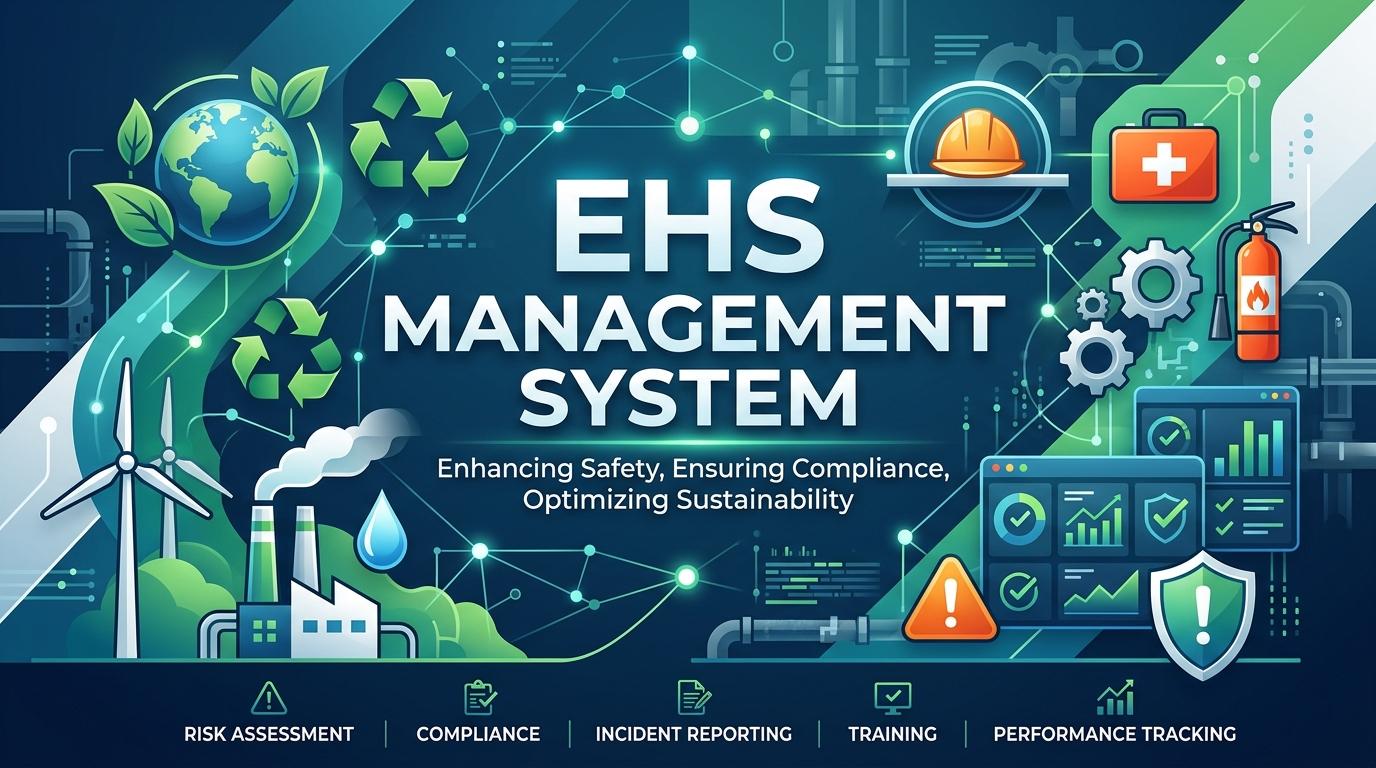
An EHS Management System gives organisations a structured way to manage environmental health and safety responsibilities across their workplaces. Businesses often deal with hazards, incidents, inspections, risk assessments, compliance records and corrective actions at the same time. When these activities remain in separate spreadsheets, emails or paper files, it can become difficult for safety teams to keep information accurate and follow up on pending tasks.
An EHS management system brings many of these activities into a central digital environment. You can use it to record workplace hazards, assess risks, report incidents, assign corrective actions and maintain safety records. It does not replace trained safety professionals or workplace procedures. Instead, it provides a practical system for organising information and supporting consistent safety processes.
What Is an EHS Management System
An EHS management system is a structured framework that helps an organisation manage environmental, health and safety responsibilities.
The system can include digital tools for
- Risk assessments
- Hazard reports
- Safety inspections
- Incident reports
- Corrective actions
- Compliance records
- Safety audits
- Employee training
- Environmental records
- Safety documentation
- Performance reports
The exact requirements depend on the organisation.
A manufacturing facility may need detailed controls for equipment, chemicals and workplace hazards. An office may have greater focus on ergonomics, emergency procedures, workplace inspections and employee training.
A useful EHS system should therefore match the organisation's actual activities and risks.
Why Environmental Health and Safety Matters
Environmental health and safety covers several responsibilities that directly affect employees, workplaces and surrounding environments.
A company may need to identify hazards before they cause harm, investigate incidents, maintain safe procedures and demonstrate compliance with applicable requirements.
Safety teams may regularly ask questions such as
- Which hazards have been reported?
- Which risks require additional controls?
- Are any corrective actions overdue?
- When was a particular location last inspected?
- Which incidents occurred during a specific period?
- Which employees require safety training?
- Which compliance activities are due?
A structured system can make these questions easier to answer because relevant information remains organised.
EHS Software and Workplace Safety
EHS software can help safety teams manage daily workplace activities through defined digital processes.
For example, an employee may notice an unsafe condition in a warehouse. Instead of sending an informal message to a supervisor, the employee can submit a hazard report through the appropriate system.
The safety team can then review the report, assess the risk and assign an action to the responsible person.
The process can follow a simple structure
Hazard report → Risk review → Corrective action → Completion → Verification
Keeping these activities connected gives the organisation a clearer record of what happened after the initial hazard was identified.
Workplace Safety Software
Workplace safety software can support several routine activities from one platform.
Employees may use it to report hazards and incidents. Supervisors can review submissions and assign actions. Safety managers can monitor inspections, audits and risk assessments.
Common functions include
- Digital safety checklists
- Incident reporting
- Hazard reporting
- Risk assessment
- Corrective action tracking
- Safety inspections
- Audit management
- Training records
- Safety reports
The main value comes from creating a consistent process that employees can follow without unnecessary complexity.
Workplace Risk Management
Workplace risk management is an important part of an EHS system.
The basic process involves identifying hazards, evaluating risks and determining suitable controls.
A digital risk assessment may contain
| Information | Purpose |
|---|---|
| Hazard | Describes the potential source of harm |
| Location | Identifies where the hazard exists |
| People affected | Shows who may be exposed |
| Existing controls | Records current precautions |
| Likelihood | Indicates how probable the event may be |
| Severity | Records potential consequences |
| Risk level | Helps prioritise action |
| Additional controls | Records further measures |
| Responsible person | Assigns ownership |
| Review date | Supports future assessment |
The exact method used for risk assessment should reflect the organisation's procedures and applicable requirements.
Incident Reporting Software
Incident reporting software provides a structured way to record workplace incidents and near misses.
A digital report can contain
- Date and time
- Location
- People involved
- Incident category
- Description
- Immediate response
- Witness information
- Photographs
- Investigation details
- Corrective actions
A consistent format helps safety teams compare incidents and identify recurring problems.
For example, if several similar incidents occur in one area, historical records may help the safety team identify a repeated issue that requires further attention.
Incident Investigation
Recording an incident is only the first part of the process.
An organisation may also need to investigate the circumstances behind the event.
An EHS management system can provide a place to record
- Immediate causes
- Contributing factors
- Root causes
- Investigation findings
- Corrective measures
- Preventive measures
Suppose employees repeatedly report incidents involving the same machine.
The safety team can review previous reports and investigate whether the problem relates to maintenance, operating procedures, employee training or another factor.
The purpose is not simply to collect incident numbers. The information should support practical decisions about workplace controls.
EHS Compliance Software
EHS compliance software can help organisations maintain records related to applicable environmental and safety requirements.
Compliance activities may include
- Regulatory obligations
- Internal policies
- Safety inspections
- Environmental checks
- Audit findings
- Required documentation
- Corrective actions
- Review dates
Requirements vary according to location, industry and workplace activities.
For that reason, organisations should configure their EHS processes according to the obligations that apply to their specific operations.
Safety Management System and Audits
A safety management system provides a structured approach to workplace safety responsibilities.
Audits can help organisations determine whether established procedures are being followed and whether identified issues have been addressed.
An audit may produce several findings.
An EHS platform can assign each finding to a responsible person and record
- Finding details
- Priority
- Due date
- Corrective action
- Evidence
- Completion status
- Verification
This creates a clearer record after the audit is complete.
Corrective Action Management
Identifying a hazard or audit finding does not solve the problem by itself.
Someone needs to take action, and the organisation needs to verify that the action has been completed properly.
An EHS system can track actions through different statuses.
For example
| Status | Description |
|---|---|
| Open | An issue has been identified |
| Assigned | Responsibility has been given |
| In progress | Work has started |
| Completed | The assigned work is finished |
| Verified | The result has been reviewed |
This can help safety managers identify overdue actions and areas that require follow up.
Environmental Health and Safety Software
Environmental health and safety software can cover both workplace safety and environmental responsibilities.
Depending on the industry, environmental activities may include
- Waste records
- Environmental inspections
- Emissions records
- Chemical management
- Environmental incidents
- Permit information
- Compliance activities
For industrial businesses, environmental responsibilities may be closely connected to everyday operations.
A combined system can help authorised users manage relevant environmental and safety records from a common platform.
EHS Management Software for Training Records
Employee training is another area where EHS management software can provide useful records.
Some employees may require specific training because of their roles or workplace exposure.
Training records can include
- Employee information
- Course name
- Completion date
- Renewal date
- Certificate
- Training status
A digital record can make it easier for managers to see whether required training has been completed.
Where the system supports reminders, employees or managers can also receive notifications about upcoming renewal dates.
Safety Inspections
Regular inspections can help identify unsafe conditions before they lead to incidents.
An EHS platform can provide digital checklists for different workplace areas.
For example, a company may use separate checklists for
- Warehouses
- Production floors
- Offices
- Laboratories
- Equipment rooms
- Outdoor work areas
Inspectors can record findings directly against the relevant checklist.
If a problem is identified, the finding can lead to a corrective action with an assigned owner and due date.
EHS Dashboards and Reports
Managers may need a straightforward view of workplace safety performance.
An EHS management system can provide reports related to
- Reported incidents
- Near misses
- Open corrective actions
- Overdue actions
- Inspection status
- Audit findings
- Risk levels
- Training records
Reports can sometimes be filtered by department, location, date or incident category.
The purpose of these reports should be to help managers identify areas that need attention rather than simply generate large amounts of data.
Mobile Access for Workplace Teams
Safety activities often take place away from an office desk.
An inspector may be walking through a warehouse or production area when a hazard is identified.
Mobile access can allow the employee to record the finding at the location.
A typical process could involve
- Opening the relevant inspection
- Recording the observation
- Adding a photograph
- Assigning an action
- Submitting the record
This can reduce the need for handwritten notes and later data entry.
How to Select an EHS Management System
Before choosing an EHS management system, organisations should first review their current safety processes.
Review Existing Processes
Identify how your organisation currently handles incidents, inspections, risk assessments and compliance records.
Identify Manual Tasks
Look for processes that depend heavily on spreadsheets, paper documents or email.
Define User Responsibilities
Determine who will report incidents, conduct assessments, investigate events and approve corrective actions.
Check Reporting Needs
Identify the information managers and safety teams need on a regular basis.
Review Security
Check user permissions, authentication, access controls and data protection measures.
Consider Mobile Requirements
If employees perform inspections in the field, mobile access may be important.
Review Integration Needs
Consider whether the EHS system needs to connect with HR, maintenance, ERP or learning platforms.
Common Challenges With EHS Systems
An EHS platform can simplify administration, but successful use still depends on people and processes.
Poor data quality can reduce the usefulness of reports. If employees enter incomplete or inconsistent information, managers may not get an accurate view of workplace conditions.
Another challenge is complicated workflows.
If reporting a simple hazard requires too many steps, employees may be less likely to use the system.
Training also matters. Employees should know what information they need to submit and how their reports contribute to workplace safety.
The technology should support established safety procedures rather than make routine tasks unnecessarily difficult.
EHS Management System and Better Safety Decisions
Historical safety records can provide useful information for future decisions.
For example, an organisation may notice that several incidents are connected to one department, equipment type or workplace condition.
The safety team can then examine the available evidence and decide whether additional controls, maintenance, training or procedural changes are appropriate.
Similarly, repeated inspection findings can show that an existing control may not be working as intended.
An EHS management system can therefore serve as more than a digital filing system. When information is accurate and consistently recorded, it can provide useful evidence for safety reviews and management decisions.
Final Thoughts on EHS Management System
An EHS management system can give organisations a structured way to manage environmental health and safety responsibilities. It can support risk assessments, hazard reporting, incident investigations, safety inspections, compliance activities, audits, corrective actions and training records.
EHS software can also connect different safety activities. A reported hazard can lead to a risk assessment, which can result in a corrective action and later verification. Keeping these records connected can make workplace safety information easier to track and review.
At the same time, software alone cannot create a safe workplace. Effective safety management still depends on suitable controls, trained employees, clear responsibilities and regular review.
For you and your organisation, the most suitable EHS management system should reflect the actual risks, environmental responsibilities, regulatory requirements and operational structure of the workplace. A well planned system can help teams maintain reliable records, monitor outstanding actions and use safety information more effectively as part of their regular workplace practices.

 English
 Arabic
 Spanish
 Portuguese
 Deutsch
 Turkish
 Dutch
Dutch
 Italiano
 Russian
 Romaian
 Portuguese (Brazil)
 Greek
Greek