
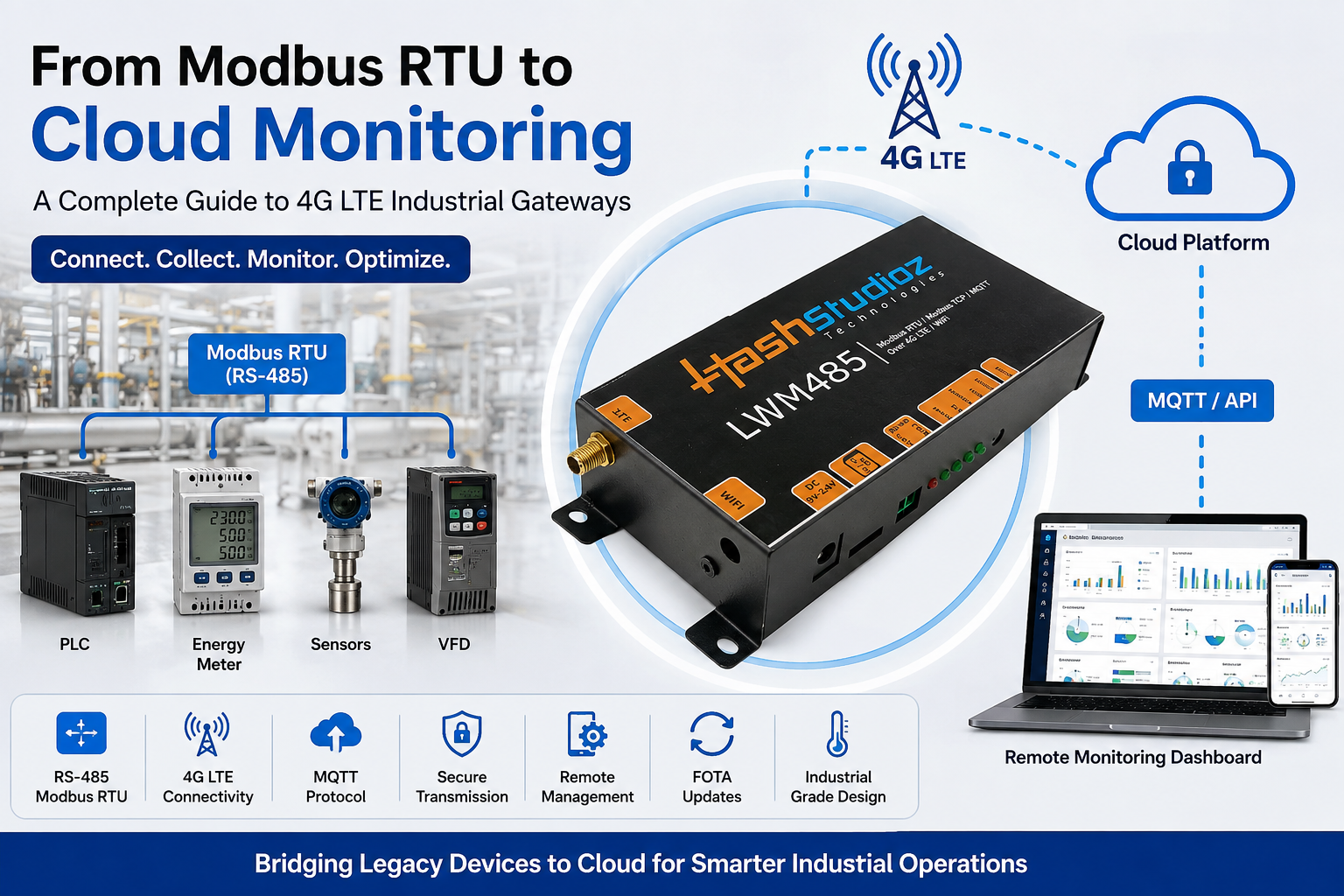
Industrial equipment has generated valuable operational data for decades, but collecting and using that data remotely has not always been straightforward. Many machines, meters, controllers, sensors, PLCs, and automation systems still communicate through RS-485 and Modbus RTU, while modern monitoring platforms increasingly depend on cloud connectivity, MQTT, APIs, dashboards, and real-time analytics.
This is where a 4G LTE industrial gateway becomes an important part of an Industrial IoT architecture. It can act as a bridge between field-level Modbus RTU devices and cloud applications, allowing businesses to collect, transmit, monitor, and analyze equipment data without replacing existing infrastructure.
What Is Modbus RTU?
Modbus RTU is a widely used industrial communication protocol designed for exchanging data between electronic devices. It commonly operates over RS-485, making it suitable for industrial environments where multiple devices need to communicate over a shared serial network.
Typical Modbus RTU devices include:
-
PLCs and industrial controllers
-
Energy meters
-
Temperature and pressure instruments
-
HVAC equipment
-
Variable frequency drives
-
Industrial sensors
-
Power monitoring systems
-
Manufacturing equipment
The major advantage of Modbus RTU is its simplicity and broad adoption. However, it was primarily designed for local device-to-device communication rather than direct cloud connectivity.
Why Connect Modbus RTU Devices to the Cloud?
A traditional Modbus network may provide useful data locally, but organizations increasingly need access to that information from centralized or remote locations.
Cloud connectivity can enable businesses to:
-
Monitor equipment from anywhere
-
Track historical operating data
-
Create centralized dashboards
-
Receive real-time alerts
-
Analyze energy consumption
-
Identify abnormal equipment behavior
-
Improve maintenance planning
-
Reduce unnecessary site visits
-
Build scalable Industrial IoT applications
Instead of replacing functioning legacy equipment, businesses can add an IoT gateway to extend the capabilities of existing systems.
How Does a 4G LTE Industrial Gateway Work?
A 4G LTE industrial gateway typically sits between field devices and the cloud.
The basic communication flow can be represented as:
Modbus RTU Device → RS-485 → Industrial Gateway → 4G LTE → MQTT/Cloud Platform → Dashboard or Application
The gateway reads registers from connected Modbus devices, processes the collected information according to the configured rules, and transmits the resulting data over a cellular network.
This approach is particularly useful for remote locations where wired Ethernet or reliable broadband connectivity may not be available.
The Role of RS-485 in Industrial IoT
RS-485 remains popular in industrial environments because it supports reliable serial communication across equipment networks and is well suited to electrically noisy environments.
However, RS-485 itself does not provide internet or cloud connectivity. A gateway adds the communication layer required to move data from the local serial network to remote systems.
For organizations with existing RS-485 equipment, this means an RS-485 Modbus Gateway can provide a practical modernization path without requiring a complete replacement of field equipment.
Why 4G LTE Connectivity Matters
A wired network is not always practical for industrial installations. Equipment may be located at remote substations, agricultural facilities, utility sites, warehouses, construction locations, or distributed manufacturing facilities.
4G LTE provides an alternative communication path where cellular coverage is available.
A cellular industrial gateway can help organizations:
-
Connect remote equipment without installing new network cabling
-
Deploy monitoring systems faster
-
Access equipment from centralized locations
-
Reduce dependence on local IT infrastructure
-
Scale monitoring across geographically distributed sites
For remote Industrial IoT deployments, cellular connectivity can therefore simplify both installation and ongoing data access.
Modbus RTU to MQTT: Bridging Two Worlds
One of the important functions of an industrial IoT gateway is protocol translation.
Modbus RTU is designed around industrial device communication, while MQTT is widely used for IoT messaging and cloud-based applications. An IoT gateway can collect Modbus registers and publish the relevant information through MQTT.
For example:
Energy Meter → Modbus RTU → RS-485 Gateway → MQTT → Cloud Platform
This allows existing industrial devices to participate in modern IoT architectures without requiring their internal communication protocols to be redesigned.
The LTE RS-485 Modbus Gateway supports Modbus RTU and MQTT and is designed to connect traditional Modbus devices with cloud platforms. The product page also lists compatibility with AWS, Azure, ThingsBoard, and custom MQTT brokers.
Key Features to Look for in a 4G LTE Modbus Gateway
Choosing the right gateway is important because the device becomes a critical communication layer between industrial equipment and remote applications.
1. Reliable RS-485 and Modbus RTU Support
The gateway should support the baud rates, addressing, and communication requirements of the existing Modbus network. A configurable baud rate provides greater flexibility when integrating different devices.
The gateway supports configurable Modbus RTU baud rates from 1200 to 115200 bps.
2. 4G LTE Connectivity
Cellular connectivity enables remote deployments without depending exclusively on Ethernet infrastructure. For distributed industrial applications, this can significantly simplify deployment.
3. MQTT Support
MQTT is lightweight and well suited to IoT environments. A gateway with MQTT support can publish field data to cloud platforms or custom MQTT brokers.
4. Cloud Compatibility
Before selecting a gateway, verify that it can communicate with the cloud platform used by your organization.
The gateway supports platforms including AWS, Azure, ThingsBoard, and custom MQTT environments.
5. Secure Data Transmission
Industrial data may contain operational information that should not be transmitted without adequate protection. TLS/SSL encryption and secure communication mechanisms can help protect data between the gateway and cloud infrastructure.
The product documentation lists TLS/SSL encryption as part of its secure communication capabilities.
6. Remote Configuration and Management
Remote installations can become expensive to maintain when every configuration change requires an on-site visit.
Remote access and configuration capabilities allow technicians to manage deployments from a central location, reducing maintenance effort.
7. FOTA Support
Firmware Over-The-Air, or FOTA, allows firmware updates to be delivered remotely. This can be particularly valuable when gateways are installed across multiple locations.
The gateway is designed for remote FOTA updates without requiring routine physical access to the device.
8. Data Processing and Mapping
Industrial systems do not always expose data in exactly the format required by cloud applications. Features such as scaling, byte swapping, and custom register mapping can simplify the process of converting raw device data into usable information.
The gateway's listed capabilities include byte swapping, scaling, and custom register mapping.
Common Applications
A 4G LTE RS-485 Modbus Gateway can be used across a wide range of Industrial IoT scenarios.
Energy Management
Energy meters can provide voltage, current, power, consumption, and other measurements. Connecting these devices to the cloud enables centralized energy dashboards and historical analysis.
Industrial Automation
Factories can connect PLCs, controllers, drives, and other Modbus-enabled equipment to remote monitoring systems.
HVAC Monitoring
HVAC equipment can be monitored remotely for operating parameters, alarms, and performance trends.
Smart Infrastructure
Distributed infrastructure can use gateways to collect equipment data from multiple locations and transmit it to a central monitoring platform.
Remote Equipment Monitoring
Businesses operating equipment across multiple sites can use cellular gateways to reduce dependence on manual data collection and physical inspections.
The product page specifically identifies industrial automation, energy management, smart infrastructure, telemetry, and remote equipment monitoring as suitable application areas.
Example: Turning a Legacy Energy Meter into a Cloud-Connected Device
Consider a facility with several Modbus RTU energy meters.
Traditionally, an operator may need to access a local system to view readings. With a 4G LTE gateway, the architecture can be modernized:
Step 1: Connect the energy meters to the RS-485 network.
Step 2: Configure the gateway for the meters' Modbus addresses and communication parameters.
Step 3: Map the required registers, such as voltage, current, power, and energy consumption.
Step 4: Configure MQTT communication and cloud credentials.
Step 5: Connect the gateway to a 4G LTE network.
Step 6: Send the processed data to the cloud.
Step 7: Display the information through dashboards, reports, alerts, or analytics applications.
The result is a connected monitoring architecture built around existing meters rather than requiring replacement of the entire field infrastructure.
Benefits of Cloud-Connected Modbus Monitoring
When implemented correctly, the combination of Modbus, RS-485, 4G LTE, and cloud technology can provide several operational benefits.
Reduced Infrastructure Changes
Existing Modbus equipment can remain in operation while the gateway adds cloud connectivity.
Remote Visibility
Operations teams can access equipment information without being physically present at the installation site.
Faster Fault Detection
Real-time monitoring and alerts can help teams identify abnormal conditions sooner.
Better Historical Analysis
Cloud systems can store historical readings for trend analysis, reporting, and operational optimization.
Easier Multi-Site Management
Organizations can create centralized monitoring systems for equipment distributed across different facilities.
Simplified Maintenance
Remote configuration and FOTA capabilities can reduce the number of maintenance visits required for gateway management.
What Should You Consider Before Deployment?
A successful deployment requires more than simply connecting an RS-485 cable and inserting a SIM card.
Consider the following factors:
Device compatibility: Verify the Modbus RTU parameters and register structure of every connected device.
Cellular coverage: Confirm that reliable 4G LTE coverage is available at the installation location.
Data requirements: Determine which registers need to be collected and how frequently they should be transmitted.
Cloud architecture: Decide whether the application will use AWS, Azure, ThingsBoard, a private server, or another MQTT-based platform.
Security: Define authentication, encryption, credentials, and access-control requirements.
Remote management: Consider how configuration and firmware updates will be handled after deployment.
Environmental conditions: Select hardware appropriate for the temperature, humidity, enclosure, and installation requirements of the site.
The gateway, for example, is specified for -20°C to +70°C operation, 9–24V DC power, and optional DIN-rail mounting.
The Future of Legacy Industrial Equipment
Industrial digital transformation does not always require replacing older equipment. In many cases, the smarter approach is to connect existing assets to modern communication and analytics systems.
A 4G LTE Industrial Gateway provides the connectivity layer that can bridge this gap. By combining RS-485, Modbus RTU, cellular communication, MQTT, and cloud platforms, organizations can transform isolated equipment data into remotely accessible operational information.
For applications requiring a practical connection between legacy Modbus equipment and modern cloud monitoring, the LTE RS-485 Modbus Gateway from is designed around this exact use case, with 4G LTE connectivity, MQTT support, cloud compatibility, remote management, FOTA, and support for 500+ Modbus RTU devices listed among its capabilities.
Conclusion
Moving from Modbus RTU to cloud monitoring is not simply a protocol upgrade—it is a way to extend the value of existing industrial infrastructure.
By introducing a capable RS-485 Modbus Gateway, businesses can collect data from legacy equipment, transmit it through 4G LTE, convert it into cloud-friendly formats, and make it available for monitoring, alerts, analytics, and automation.
For organizations looking to modernize industrial systems without replacing every existing device, this architecture offers a scalable path toward connected and data-driven operations.

 English
 Arabic
 French
 Spanish
 Portuguese
 Deutsch
 Turkish
 Dutch
Dutch
 Russian
 Romaian
 Portuguese (Brazil)
 Greek
Greek