
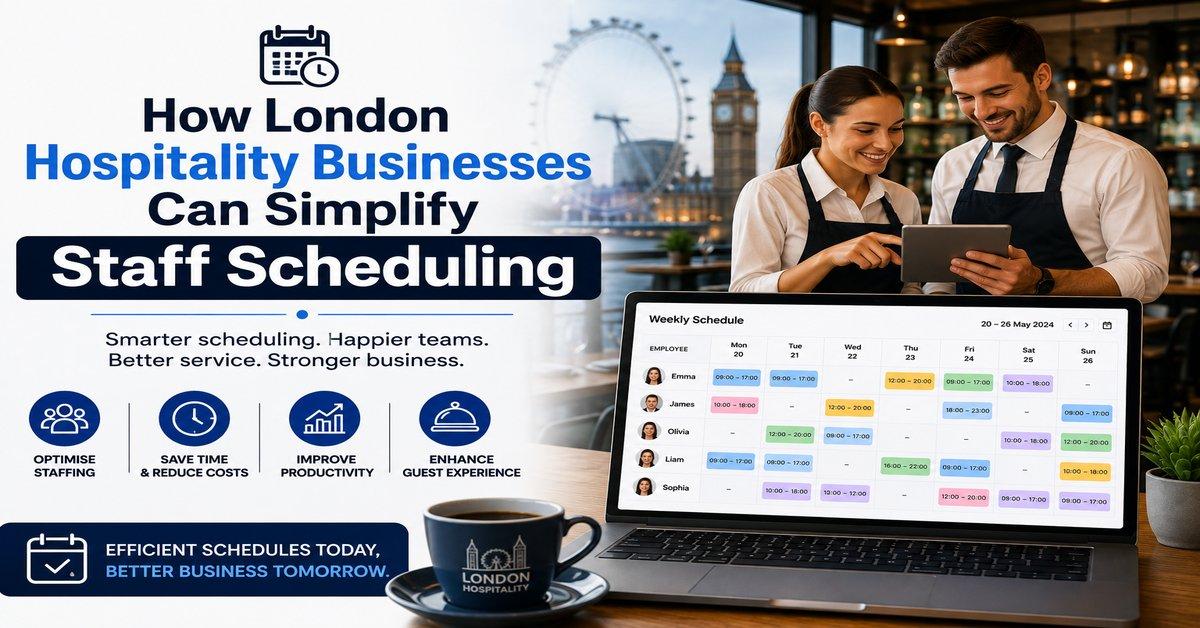
For London hospitality businesses, staff scheduling can quickly become one of the most time-consuming parts of daily operations. Restaurants, cafés, pubs, bars and hotels all face changing customer demand, staff availability, last-minute absences and busy weekends.
A poorly managed rota can lead to understaffing, unnecessary overtime, higher labour costs and frustrated employees. On the other hand, a well-planned schedule helps managers put the right people in the right place at the right time.
Modern rota softwaref can make this process significantly easier by bringing scheduling, availability, attendance and workforce information into one system. Hospitality workforce platforms increasingly combine rota planning with attendance, leave management and labour-cost visibility, helping London operators replace spreadsheets and disconnected communication channels.
Why Staff Scheduling Is Challenging for London Hospitality Businesses
Hospitality businesses rarely operate on a simple Monday-to-Friday schedule. Customer demand can change throughout the day, while weekends, events, holidays and seasonal periods can require additional staff.
London businesses can also have multiple departments operating at the same time, including:
-
Front-of-house teams
-
Kitchen staff
-
Bar teams
-
Housekeeping
-
Reception
-
Supervisors and managers
-
Cleaning and support staff
Creating a rota manually means managers must consider employee availability, holidays, skills, contracted hours and expected demand before publishing the schedule.
A spreadsheet may work for a small team, but it becomes increasingly difficult to manage when there are multiple departments or venues. Modern scheduling systems can help managers build rotas around roles, availability, demand and locations while giving staff access to their schedules digitally.
1. Build Rotas Around Business Demand
The first step towards simpler staff scheduling is to understand when your business actually needs employees.
A restaurant, for example, may need fewer employees during a quiet afternoon but significantly more staff during Friday and Saturday evening service. A hotel may need different staffing levels across reception, housekeeping and food and beverage throughout the day.
Instead of assigning the same number of employees to every shift, review:
-
Historical sales
-
Expected bookings
-
Busy and quiet periods
-
Events in the local area
-
Seasonal demand
-
Department requirements
-
Expected staff availability
This approach helps managers schedule according to operational demand rather than simply repeating the previous week's rota.
2. Keep Employee Availability in One Place
One of the biggest scheduling problems is not knowing who is actually available.
When availability is collected through WhatsApp messages, emails, paper forms and conversations, information can easily become outdated or missed.
A better approach is to maintain employee availability in one central system. Staff should be able to communicate their availability, request leave and view assigned shifts without relying on multiple communication channels.
This is particularly useful for London hospitality businesses with part-time employees, flexible workers and teams working different shift patterns.
3. Use Rota Software Instead of Spreadsheets
Spreadsheets can be useful for basic planning, but hospitality scheduling often requires more flexibility.
Dedicated rota software can make it easier to:
-
Create weekly schedules
-
Assign employees to specific roles
-
Manage open shifts
-
Handle shift changes
-
Share rotas with employees
-
Manage multiple locations
-
Track attendance
-
Monitor scheduled hours
-
Review labour costs
Hospitality-focused scheduling platforms commonly provide visual rota builders, real-time updates and employee communication features.
For managers, this means less time spent manually updating spreadsheets and fewer opportunities for scheduling errors.
4. Connect Scheduling With Attendance Tracking
Creating a rota is only part of workforce management. Managers also need to know whether employees actually worked their scheduled shifts.
Connecting rota planning with attendance information gives businesses better visibility into:
-
Late arrivals
-
Early departures
-
Absences
-
Actual working hours
-
Overtime
-
Attendance patterns
For example, if an employee is regularly scheduled for an 8-hour shift but consistently works longer, the manager can investigate whether staffing levels or shift patterns need to change.
For businesses looking to connect scheduling with time and attendance processes, see Rota Software & Employee Attendance Tracking for more information.
5. Make Shift Changes Easier
Hospitality is unpredictable. Employees may become unavailable, bookings may increase and managers may need additional cover.
A good scheduling process should make it easy to respond to these changes.
Instead of sending multiple WhatsApp messages asking who can cover a shift, managers can use open-shift and shift-swap functionality where available. Employees can see available shifts and communicate changes through a central platform.
This creates a clearer record of who is working and reduces confusion caused by informal schedule changes.
6. Consider UK Working Time Requirements
Staff scheduling should also take working-time requirements into account.
In the UK, workers generally cannot work more than an average of 48 hours per week unless they have opted out of the 48-hour limit.
Rest requirements are also important. Under the Working Time Regulations, workers are generally entitled to 11 consecutive hours of daily rest, although exceptions can apply in certain circumstances.
Night workers have additional rules. Workers who regularly work at least three hours during the night period can be classed as night workers, and additional limits may apply.
For London hospitality managers, this means rotas should be reviewed carefully before publication. Scheduling software with compliance alerts can help identify potential issues, but businesses should still seek appropriate HR or legal advice when dealing with complex employment situations.
7. Create Clear Scheduling Rules
Technology works best when it supports a consistent scheduling process.
London hospitality businesses can establish simple internal rules such as:
-
Publish rotas at a consistent time each week.
-
Give employees reasonable notice of shifts.
-
Record availability centrally.
-
Establish a clear process for shift swaps.
-
Record approved holidays and absences.
-
Avoid unnecessary last-minute changes.
-
Review overtime before publishing the rota.
-
Make managers responsible for approving schedule changes.
Clear rules make the rota more predictable for employees and easier for managers to maintain.
8. Manage Multiple London Locations From One System
Multi-site hospitality businesses face an additional challenge: managing employees and schedules across different venues.
A central workforce management platform can allow managers to view locations, departments and employees from one system. This can be particularly useful for hospitality groups operating several restaurants, cafés, pubs or hotels.
Instead of maintaining separate spreadsheets for every location, managers can have a consistent scheduling process across the organisation.
This also makes it easier to review workforce information and identify staffing gaps across locations. Multi-location scheduling is already a key feature offered by hospitality workforce platforms.
9. Give Employees Mobile Access to Their Rotas
Employees should not have to contact a manager every time they want to check their next shift.
Mobile-friendly scheduling allows staff to access their rota when they need it. Depending on the software, employees may also receive notifications about new shifts, changes, leave requests or other workforce updates.
This reduces repetitive questions for managers and gives employees greater visibility over their working schedules.
For hospitality businesses with employees working different shifts, mobile access can be especially valuable because teams may not be together in one location at the same time.
10. Monitor Labour Costs Before Publishing
Labour is one of the most important operational costs for hospitality businesses.
Scheduling too many employees can increase unnecessary labour expenditure. Scheduling too few can affect service quality and put pressure on existing employees.
A better approach is to review scheduled hours and expected labour costs before publishing the rota.
Some hospitality scheduling platforms provide labour-cost visibility while managers build schedules, allowing them to compare staffing levels with budgets and expected demand.
The goal should not simply be to reduce staff hours. Instead, managers should aim to achieve the right balance between customer service, employee wellbeing and labour efficiency.
A Simple Staff Scheduling Process for London Hospitality Businesses
A practical scheduling workflow can look like this:
Step 1: Review demand
Check bookings, sales patterns, events and expected busy periods.
Step 2: Check availability
Review employee availability, holidays and existing commitments.
Step 3: Identify staffing requirements
Determine how many employees are required for each department and shift.
Step 4: Build the rota
Assign employees according to their roles, skills and availability.
Step 5: Check hours and costs
Review overtime, staffing levels and potential working-time issues.
Step 6: Publish the rota
Share the final schedule digitally with employees.
Step 7: Track actual attendance
Compare scheduled shifts with actual hours worked.
Step 8: Review performance
Use the information to improve future rotas.
This creates a repeatable process rather than forcing managers to rebuild their scheduling system from scratch every week.
What Should London Businesses Look for in Rota Software?
Not every scheduling platform is designed for hospitality. Before choosing software, businesses should consider whether it supports their specific operational requirements.
Important features may include:
-
Staff rota creation
-
Employee availability management
-
Leave management
-
Shift swaps
-
Open shifts
-
Attendance tracking
-
Mobile access
-
Labour-cost visibility
-
Multiple locations
-
Role-based permissions
-
Scheduling reports
-
Notifications
-
Working-time compliance alerts
The right solution depends on the size and complexity of the business. A small independent café may need simple scheduling and employee communication, while a multi-site hospitality group may require workforce management, attendance and labour-cost controls in one platform.
Final Thoughts
Simplifying staff scheduling does not mean removing the human element from hospitality management. It means giving managers better tools to plan their teams, communicate changes and make informed workforce decisions.
For London restaurants, cafés, pubs, bars and hotels, moving away from spreadsheets and disconnected messages can create a more organised scheduling process. By combining demand-based planning, centralised availability, attendance tracking, mobile access and labour-cost monitoring, businesses can make their rotas easier to manage.
The best approach is to create a consistent scheduling process and use technology to support it. With the right rota software, London hospitality businesses can spend less time managing schedules and more time focusing on their customers, employees and overall business performance.

 English
 French
 Spanish
 Portuguese
 Deutsch
 Turkish
 Dutch
Dutch
 Italiano
 Russian
 Romaian
 Portuguese (Brazil)
 Greek
Greek