
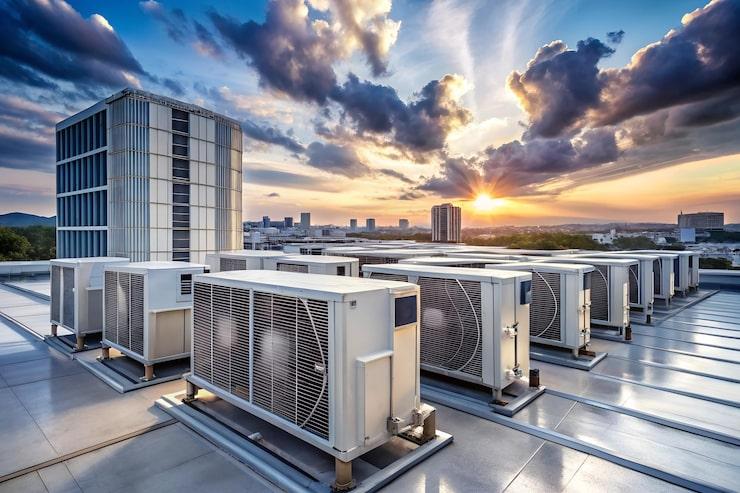
Morocco’s heating, ventilation, and air conditioning landscape is being shaped by expanding construction activity, urbanization, tourism infrastructure, industrial development, and increasing attention to energy efficiency. Rising cooling requirements are encouraging households and businesses to adopt modern climate-control equipment, while new construction and renovation projects are creating demand for room air conditioners, VRF systems, chillers, ventilation equipment, and specialized industrial solutions.
A comprehensive market assessment by Markntel Advisor reveals that the Morocco HVAC market was valued at USD 376 million in 2025 and is projected to grow from USD 398 million in 2026 to USD 512 million by 2032, expanding at a CAGR of 4.29% during 2026–2032. Room air conditioners account for approximately 52.8% of the market in 2026, while R32 leads the refrigerant segment with a 46.7% share.
Construction Activity Creates New HVAC Requirements
Morocco’s construction pipeline is creating additional requirements for climate-control equipment across residential complexes, offices, hotels, hospitals, educational facilities, and mixed-use developments. The study notes that the construction and public works sector grew by 5.0% in 2024, while construction activity also showed momentum during the first quarter of 2025.
HVAC systems are increasingly incorporated into building planning because temperature control, ventilation, indoor air quality, and energy performance are becoming important elements of modern infrastructure. New developments can therefore require different combinations of room air conditioners, VRF systems, chillers, packaged systems, and ventilation equipment depending on building size and function.
The Moroccan energy-efficiency framework also places attention on improving efficiency across buildings and other major energy-consuming sectors.
Tourism Infrastructure Broadens Commercial Demand
Tourism is another important source of HVAC requirements. Morocco welcomed 17.4 million international tourists in 2024, representing a 20% increase from the previous year, according to data cited in the study. The country’s target of 26 million tourists by 2030 is also supporting investment in hotels, resorts, airports, restaurants, and related infrastructure.
Hospitality facilities require reliable temperature control across guest rooms, restaurants, kitchens, conference areas, and recreational spaces. As tourism infrastructure expands, demand can increase for both decentralized room air conditioners and larger centralized systems.
The Moroccan tourism sector is therefore an important contributor to commercial HVAC requirements, particularly as hospitality facilities are developed and upgraded across major tourism destinations.
Room Air Conditioners Maintain a Leading Position
Room air conditioners account for approximately 52.8% of the Morocco HVAC market in 2026, making them the leading product category. Expanding urban populations, residential construction, and household demand for accessible cooling continue to support their position.
Split air conditioners represent the majority of installations because of their energy efficiency, quieter operation, and suitability for apartments and independent homes. Window units continue to serve selected residential and small commercial applications where straightforward installation and lower initial costs are important considerations.
Room air conditioners are also widely used in offices, retail outlets, restaurants, educational institutions, and healthcare clinics. Their comparatively simple installation and maintenance requirements support adoption where decentralized cooling is preferred.
R32 Adoption Reflects the Efficiency Transition
R32 represents approximately 46.7% of the market by refrigerant type in 2026. Its position is supported by the growing adoption of room air conditioners and light commercial systems, alongside greater attention to cooling efficiency and environmental performance.
Manufacturers are expanding R32-compatible product portfolios across split systems, cassette units, packaged equipment, and other applications. Its thermodynamic characteristics also support compact equipment designs and efficient cooling performance.
Morocco’s regulatory environment is reinforcing this transition. Decree No. 1529.24 updated minimum energy-performance standards and energy-labeling requirements for air conditioners, with the measures entering into force in March 2025. The International Energy Agency’s policy record documents the updated requirements.
Energy Efficiency Becomes a Stronger Purchasing Consideration
Energy consumption is becoming increasingly important for Moroccan households and businesses as cooling demand rises. Efficient systems can help reduce electricity requirements while maintaining indoor comfort, particularly in buildings where air conditioning operates for extended periods.
The updated minimum energy-performance standards are encouraging manufacturers, distributors, and end users to place greater emphasis on equipment efficiency. Inverter technology, improved compressors, smart controls, and efficient refrigerant configurations are consequently becoming more relevant to product selection.
The broader policy direction is consistent with Morocco’s objective of improving energy efficiency. The International Monetary Fund notes that the country has made energy efficiency a priority within its national energy strategy, including the development of efficiency standards for air conditioners.
Water Scarcity Influences Cooling Technology
Water scarcity is another factor influencing HVAC planning, particularly for commercial and industrial facilities. Morocco’s prolonged drought conditions are increasing attention toward cooling configurations that can reduce dependence on freshwater resources.
Air-cooled chillers, closed-loop systems, hybrid cooling technologies, and intelligent building-management platforms can provide alternatives where water consumption is an important operational consideration. This is particularly relevant for manufacturing facilities, hotels, hospitals, and large commercial properties.
The country’s water-security investments also underline the importance of resource-efficient infrastructure. The Morocco water and climate policy framework provides broader context on the country’s ongoing water-resource challenges and infrastructure priorities.
Industrial Expansion Creates Specialized HVAC Demand
Morocco’s industrial sector is creating additional applications for HVAC equipment. Industrial production increased by 12% in 2024, while industrial investment rose by 30%, according to the study. Expansion across automotive, aerospace, electrical equipment, and manufacturing is increasing requirements for industrial ventilation, process cooling, air filtration, and controlled environments.
Manufacturing facilities can require more specialized systems than residential buildings because temperature, humidity, air quality, and operating reliability can directly influence production processes. The development of automotive and battery manufacturing is particularly relevant for precision climate control and clean-air applications.
Infrastructure Projects Add Further Demand
Preparations for the 2030 FIFA World Cup are also supporting infrastructure development across Morocco. Stadium modernization, airport expansion, transportation improvements, hotels, restaurants, and commercial facilities can all require HVAC systems capable of handling varying occupancy and operating conditions.
Large venues typically require extensive ventilation and centralized cooling, while hospitality and retail facilities can use combinations of room air conditioners, VRF systems, chillers, and packaged equipment.
Morocco’s HVAC Sector Moves Toward Efficient Climate Management
Morocco’s HVAC landscape is gradually moving toward systems that combine thermal comfort with energy efficiency, improved refrigerant performance, smart controls, and reduced water consumption. Residential room air conditioners remain central to demand, while construction, tourism, industrial expansion, and major infrastructure projects are broadening applications.
Regulatory developments are also influencing equipment selection by placing greater emphasis on minimum energy performance and labeling. Alongside water-resource pressures, these factors are encouraging a gradual transition toward HVAC technologies designed to provide reliable climate control while using energy and resources more efficiently.

 English
 Arabic
 French
 Spanish
 Portuguese
 Turkish
 Dutch
 Italiano
 Russian
 Romaian
 Portuguese (Brazil)
 Greek