
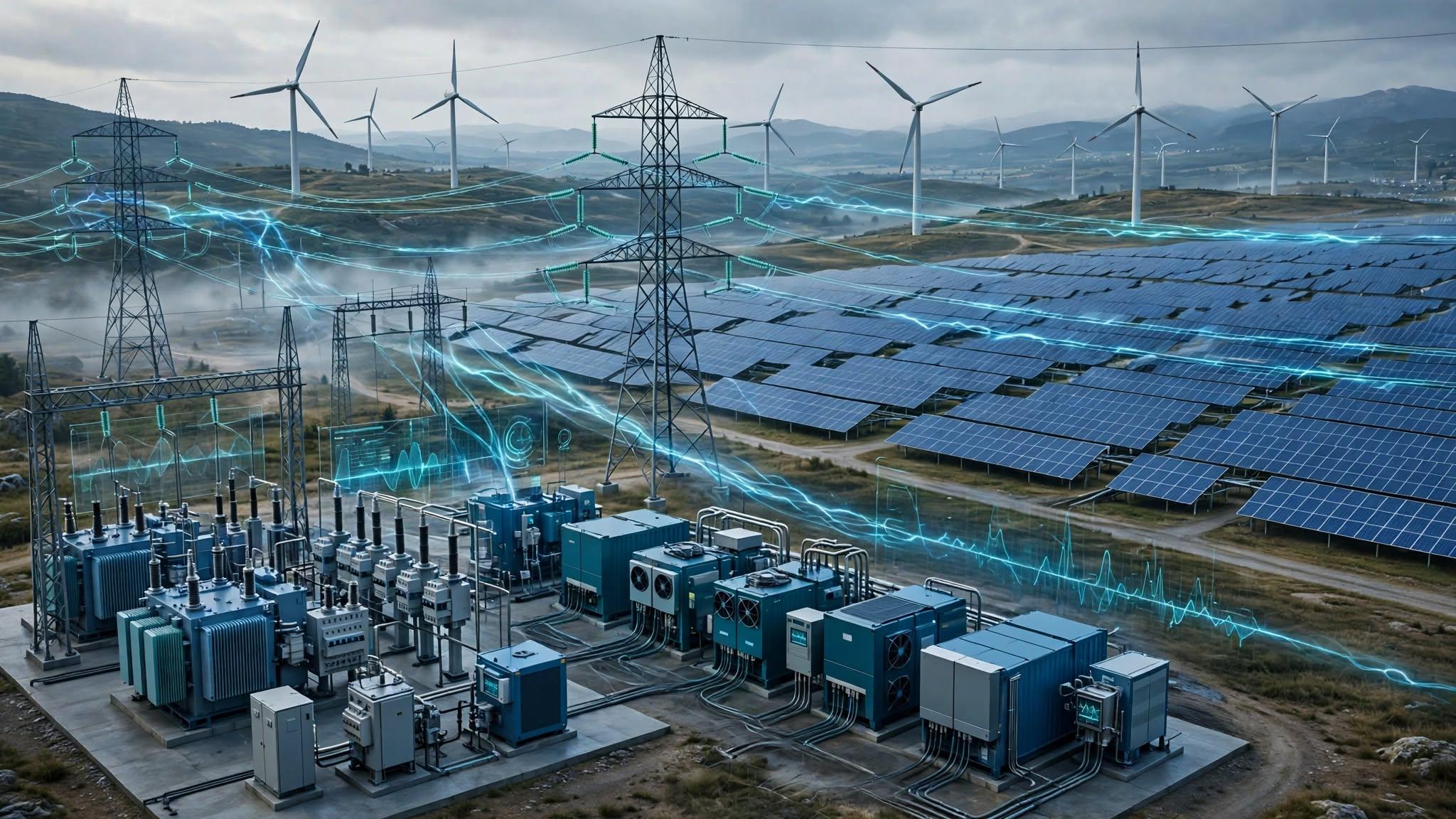
Electrical grids are becoming more complex as renewable energy sources, inverter-based resources, and large industrial loads continue to expand. While these developments support the transition toward cleaner energy, they also introduce new challenges for grid operators, particularly in electrically weak networks. Weak grids often experience voltage fluctuations, limited short-circuit strength, frequency instability, and difficulties maintaining reliable power delivery.
Battery Energy Storage Systems (BESS) offer an effective solution to many of these challenges. Beyond storing electricity for later use, modern battery systems can provide fast-response grid support, improve voltage regulation, and help maintain stable operating conditions. With advanced inverter controls, including grid-forming and grid-following technologies, battery storage can play an important role in strengthening weak electrical networks.
1. Understanding the Challenges of Weak Electrical Grids
A weak electrical grid typically has limited short-circuit capacity relative to the connected generation and load. This means the network has less ability to maintain stable voltage and frequency when disturbances occur.
Weak-grid conditions are commonly found in remote transmission networks, renewable energy development zones, isolated power systems, and areas with long transmission lines. They can become more pronounced when large solar or wind facilities connect to networks with limited electrical strength.
Several technical challenges are associated with weak grids:
-
Voltage instability: Small changes in power injection or demand can cause significant voltage variations.
-
Frequency fluctuations: Imbalances between electricity generation and consumption can affect system frequency.
-
Reduced system strength: Low short-circuit capacity can make inverter-based resources more sensitive to network disturbances.
-
Control interactions: Multiple inverter-based resources operating together may experience control instability.
-
Limited fault response: Reduced synchronous generation can lower available fault current and affect protection system performance.
Addressing these challenges requires more than additional generation capacity. Grid operators need resources that can respond quickly and provide dynamic electrical support.
2. How BESS Grid Stability Solutions Strengthen Weak Networks
Battery Energy Storage Systems can improve network performance by responding rapidly to changing electrical conditions. Unlike conventional generation, which may require additional time to adjust output, battery inverters can change active and reactive power output within very short timeframes, depending on their design and control capabilities.
BESS grid stability applications include frequency regulation, voltage support, ramp-rate control, and active power balancing.
For example, when a sudden increase in demand creates a generation shortfall, a battery system can discharge stored energy to help restore the power balance. When renewable generation exceeds demand, the battery can absorb excess electricity and reduce the risk of operational constraints.
BESS can also provide reactive power to support voltage regulation. This is particularly valuable in weak networks where voltage changes can become more pronounced during disturbances.
However, battery performance depends on inverter ratings, available energy, state of charge, control settings, and grid conditions. Proper engineering studies are essential to determine how much support a particular installation can deliver.
3. Grid-Forming Battery Energy Storage and Its Role in System Strength
Traditional grid-following inverters generally rely on an existing grid voltage waveform to synchronize their operation. In contrast, grid-forming battery energy storage systems can establish and regulate an internal voltage waveform, providing characteristics that support stable operation in low-strength networks.
Grid-forming battery energy storage can contribute to system stability through several capabilities:
Voltage source behavior: Grid-forming controls regulate voltage magnitude and phase, helping support network operation during changing conditions.
Frequency response: These systems can adjust active power output in response to frequency deviations through suitable control functions.
Virtual inertia and damping: Advanced control algorithms can emulate selected dynamic characteristics of synchronous machines, helping manage frequency changes and oscillations.
Improved renewable integration: Grid-forming BESS can support networks with high levels of inverter-based generation, including solar and wind facilities.
One important consideration is that grid-forming capability does not automatically guarantee stability under every operating condition. Performance must be evaluated through detailed dynamic studies, including fault response, protection coordination, and interactions with other inverter-based resources.
4. Understanding GFM and GFL Control Strategies
Selecting the right inverter control strategy is essential when integrating battery storage into weak electrical networks. The two major approaches are Grid-Forming (GFM) and Grid-Following (GFL) controls.
Grid-Following (GFL) Control
GFL inverters synchronize with an existing grid voltage reference, typically using a phase-locked loop (PLL). They inject or absorb active and reactive power based on external control references.
These systems are widely used in renewable energy installations and battery applications. However, their performance can become more challenging in weak grids because the voltage reference may be less stable. Interactions between PLL dynamics, network impedance, and other inverter controls can contribute to instability.
Grid-Forming (GFM) Control
GFM inverters establish their own controlled voltage reference and can operate without relying on a strong external voltage waveform in the same way as GFL systems.
Depending on their design, they can provide frequency and voltage support, improve system damping, and contribute to stable operation in networks with high inverter penetration.
Choosing Between GFM and GFL
Neither strategy is universally superior. GFL systems remain suitable for many grid-connected applications, while GFM technology can offer important advantages in weak-grid and low-inertia environments. Hybrid arrangements combining both approaches may also be appropriate, provided their control interactions are properly assessed.
5. Engineering Considerations for Integrating BESS into Weak Grids
Successful BESS integration requires comprehensive electrical engineering analysis. Installing a battery system without evaluating the surrounding network can introduce new operational challenges instead of resolving existing ones.
Key engineering assessments include:
-
Short-circuit analysis: Evaluates network strength and available fault current at the proposed connection point.
-
Power flow studies: Identify voltage profiles, power transfer limits, and reactive power requirements.
-
Dynamic stability studies: Assess system response to disturbances and changes in operating conditions.
-
Electromagnetic transient (EMT) studies: Examine fast inverter control interactions, PLL behavior, and grid-forming performance where detailed modeling is required.
-
Harmonic studies: Evaluate harmonic emissions and potential resonance conditions.
-
Protection coordination: Reviews fault detection, relay settings, and protection performance with inverter-based resources.
-
Controller testing: Validates inverter control behavior under different grid conditions.
Engineers must also consider battery energy capacity, inverter power ratings, state-of-charge management, thermal limitations, and operating requirements. These factors determine how effectively the system can provide support during normal operation and grid disturbances.
6. The Future of Battery Storage in Weak Electrical Networks
As renewable energy penetration increases, battery storage is becoming an important component of modern grid infrastructure. Its role is expanding beyond energy shifting toward advanced grid-support applications that improve reliability, flexibility, and operational resilience.
Grid-forming technology is particularly promising for remote networks, renewable energy clusters, and systems with limited synchronous generation. Combined with appropriate GFL resources, advanced protection systems, and coordinated control strategies, BESS installations can help address some of the technical challenges associated with weak electrical grids.
For project developers and utility operators, the key is selecting the right technology and validating its performance through network-specific engineering studies.
At Keentel Engineering LLC, understanding these technical requirements is essential to developing reliable power infrastructure. Careful power system analysis, interconnection assessments, and dynamic performance evaluations help ensure that battery storage installations meet grid requirements while supporting long-term network stability.
Conclusion
Battery Energy Storage Systems offer more than backup power and renewable energy integration. They can provide fast frequency response, voltage regulation, and advanced inverter-based grid support. Through appropriate GFM and GFL control strategies, BESS can help strengthen weak electrical networks and support the reliable operation of increasingly renewable power systems.
The long-term success of these solutions depends on sound engineering, accurate modeling, and comprehensive grid stability assessments.

 Arabic
 French
 Spanish
 Portuguese
 Deutsch
 Turkish
 Dutch
 Italiano
 Russian
 Romaian
 Portuguese (Brazil)
 Greek