
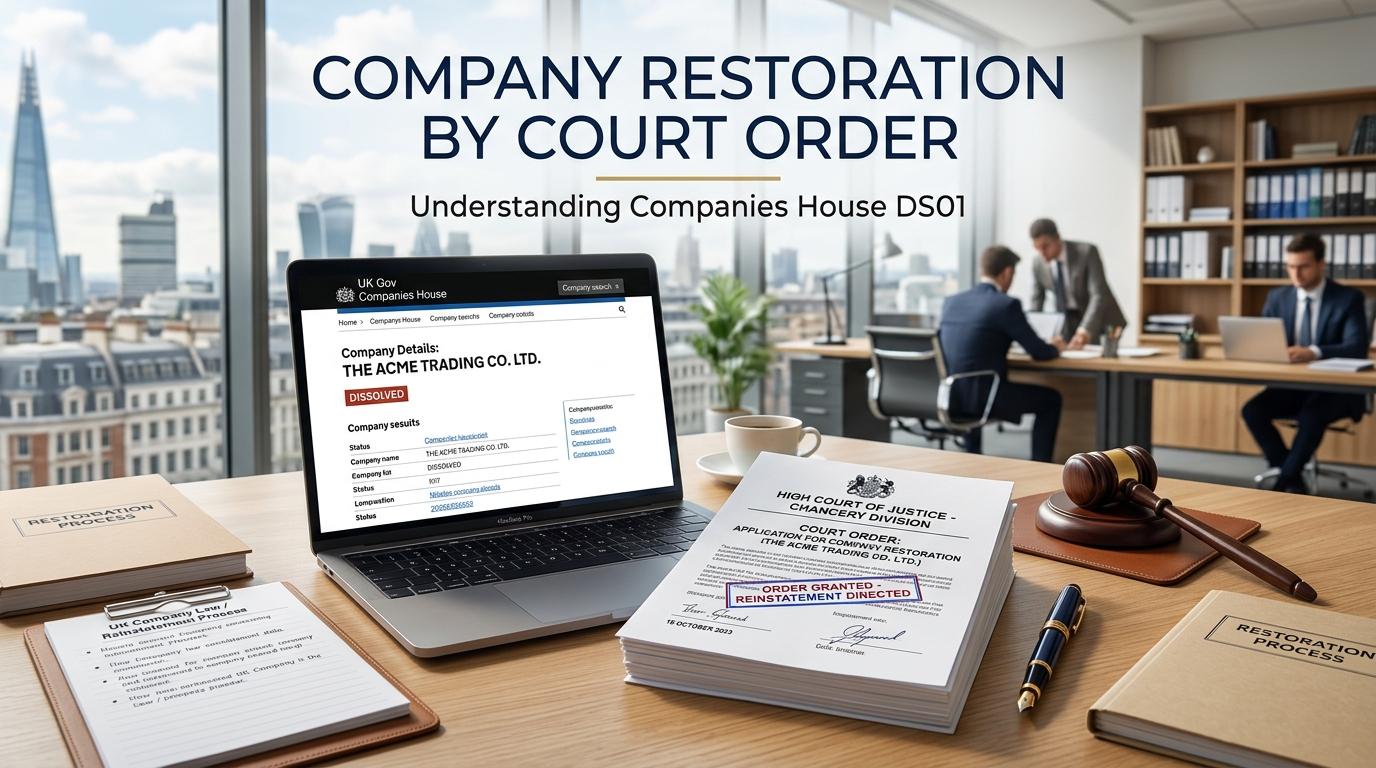
Company Restoration by Court Order: When Is It Needed and How Does It Work?
If a company has been dissolved and removed from the Companies House register, it is no longer recognised as a legal entity. However, this does not always mean the end of the business. In certain situations, it is possible to bring a dissolved company back to life through company restoration by court order.
This legal process is commonly used when administrative restoration is not available. Whether you need to recover company assets, resolve legal disputes, or continue trading, understanding the restoration process can save both time and money.
What Is Company Restoration by Court Order?
Company restoration by court order is a legal procedure that allows a dissolved company to be restored to the Companies House register after obtaining approval from the court. Once restored, the company is generally treated as though it had never been dissolved, allowing it to resume its legal rights and obligations.
This route is usually required when a company was voluntarily dissolved or when it does not meet the conditions for administrative restoration.
When Is a Court Order Required?
There are several situations where restoration through the court is necessary, including:
-
The company was voluntarily dissolved.
-
More than administrative restoration requirements cannot be met.
-
A creditor wishes to recover outstanding debts.
-
Company assets need to be reclaimed.
-
Legal claims need to continue against the dissolved company.
Former directors, shareholders, creditors, liquidators, and other parties with a legitimate interest may be eligible to apply, depending on the circumstances. Applications can generally be made within six years of dissolution, although exceptions exist for certain claims such as personal injury cases.
The Restoration Process
Although every case is different, the process usually involves several key steps:
-
Confirm that the company qualifies for restoration.
-
Prepare a court application and supporting witness statement.
-
Notify Companies House and any other required parties.
-
Submit outstanding company documents if required.
-
Attend the court hearing if necessary.
-
Deliver the sealed court order to Companies House once approved.
After the court order is received by the Registrar, the company is restored to the register and is generally treated as though it had continued in existence without interruption.
What About Companies House DS01?
Many business owners confuse restoration with Companies House DS01.
A DS01 form is used to apply for the voluntary strike-off of a company that is no longer trading and meets the legal requirements for dissolution. Filing a DS01 is a way to close an eligible company—it is not used to restore one. If a company has already been voluntarily dissolved using Companies House DS01, restoring it will usually require a court order rather than administrative restoration.
For this reason, directors should carefully consider the long-term consequences before submitting a voluntary strike-off application.
Common Reasons for Restoration
Businesses seek restoration for many reasons, including:
-
Recovering bank accounts or company property.
-
Resolving ownership of assets.
-
Pursuing or defending legal proceedings.
-
Completing unfinished contracts.
-
Restarting business operations.
-
Correcting an accidental dissolution.
Once restored, the company regains its legal status, allowing these matters to be dealt with properly under company law.
Important Things to Consider
Before applying for restoration, keep these points in mind:
-
Outstanding accounts and confirmation statements may still need to be filed.
-
Late filing penalties and statutory fees may apply.
-
Court applications require supporting evidence.
-
Professional legal advice can simplify complex restoration cases.
-
Every restoration application is assessed on its own facts and legal requirements.
Preparing accurate documentation from the outset can help avoid unnecessary delays.
Final Thoughts
Restoring a dissolved company can be a straightforward process when the correct legal route is chosen. If administrative restoration is unavailable, company restoration by court order may provide the solution needed to recover assets, resolve legal matters, or continue business activities.
Likewise, business owners considering Companies House DS01 should fully understand that voluntary dissolution is intended to permanently close an eligible company. If circumstances change later, restoration by court order may become the only available option.
Seeking professional guidance before either dissolving or restoring a company can help ensure compliance with UK company law and avoid costly mistakes.

 English
 French
 Spanish
 Portuguese
 Deutsch
 Turkish
 Dutch
 Italiano
 Russian
 Romaian
 Portuguese (Brazil)
 Greek