
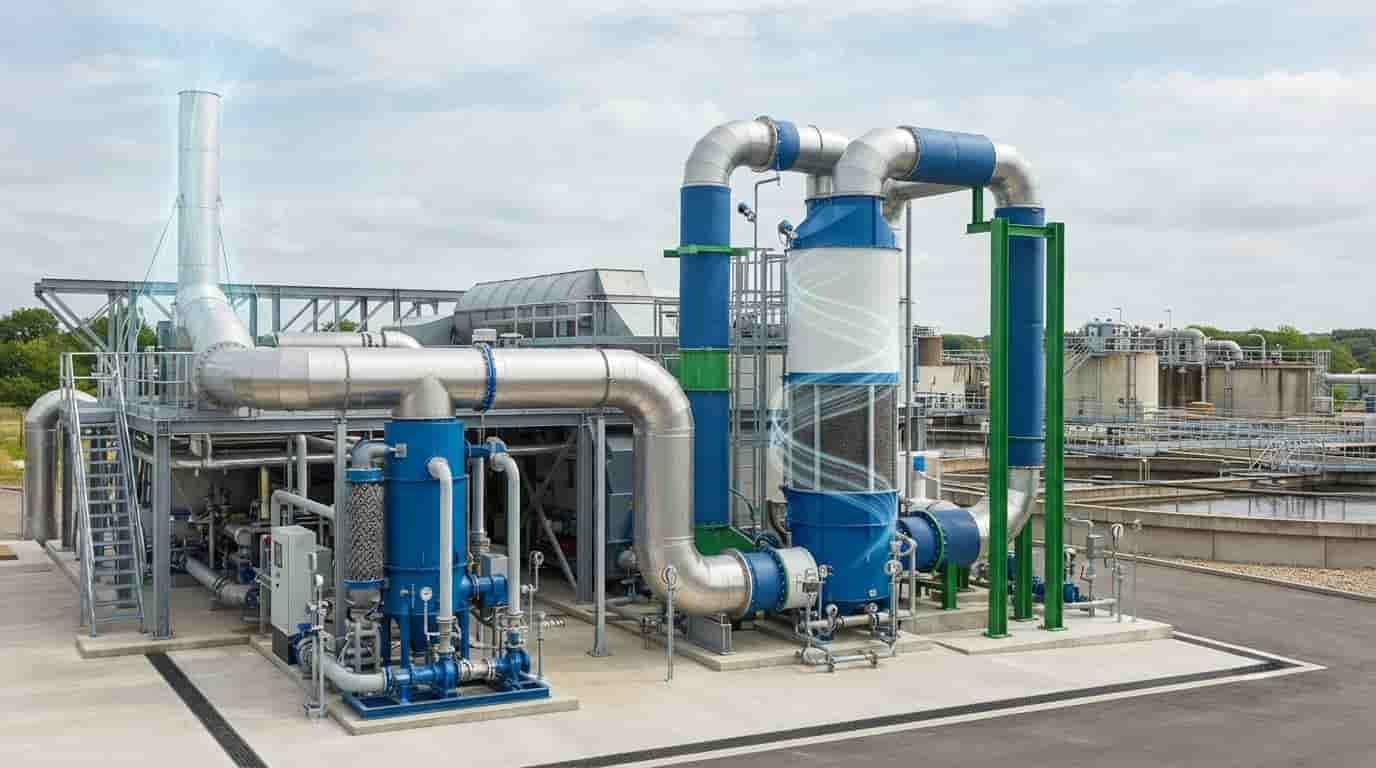
Unpleasant odours from industrial facilities can affect workplace conditions, nearby communities and overall environmental performance. Industries such as wastewater treatment, food processing, pharmaceuticals, pulp and paper and chemical manufacturing can generate odorous gases during production and waste treatment activities.
Implementing suitable industrial odour control solutions helps facilities manage these emissions, reduce nuisance odours and maintain better air quality around their operations.
What Causes Industrial Odour Problems?
Industrial odours are commonly associated with the release of volatile compounds during manufacturing, wastewater treatment and organic waste decomposition.
Some common odour-producing compounds include:
-
Hydrogen sulphide (H₂S): A gas associated with anaerobic decomposition and wastewater systems, recognised by its rotten-egg smell.
-
Ammonia (NH₃): Can be released from nitrogen-containing waste and industrial processes.
-
Volatile organic compounds (VOCs): Organic chemicals that can contribute to unpleasant industrial emissions.
-
Mercaptans: Sulphur-containing compounds associated with strong and unpleasant smells.
-
Organic acids: Produced during the decomposition of certain organic materials.
The type and concentration of these compounds determine which odour management approach is appropriate.
Common Industrial Odour Control Technologies
Different facilities require different technologies depending on their emission sources, operating conditions and treatment requirements.
1. Chemical Scrubbers
Chemical scrubbers use liquid treatment solutions to remove or chemically react with selected gaseous contaminants. They are commonly used in industrial exhaust systems where controlled gas-liquid contact is required.
2. Biofilters
Biofilters use microorganisms growing on a suitable filter medium to degrade biodegradable odorous compounds. They can be useful for treating certain low-concentration odour streams under suitable moisture, temperature and loading conditions.
3. Biotrickling Filters
Biotrickling filters use a biological medium with a circulating liquid to support microbial degradation of odorous gases. They are often considered for applications involving hydrogen sulphide and other biodegradable compounds.
4. Odour Neutralisation Systems
Odour neutralisation systems use specialised formulations to manage odour perception or interact with selected odorous compounds. Their effectiveness depends on the formulation, application method, concentration and contact conditions.
5. Biological Odour Control
Biological odour control approaches use selected microorganisms or biological formulations to help manage odour-producing organic matter at wastewater treatment and waste handling locations.
Industries That Need Odour Management
Industrial odour control is relevant across several sectors.
-
Wastewater treatment plants: Headworks, equalisation tanks, sludge handling and anaerobic zones can generate hydrogen sulphide and other odorous gases.
-
Food processing facilities: Organic residues, fats and decomposing materials can contribute to unpleasant smells.
-
Pharmaceutical industries: Certain manufacturing and wastewater treatment activities may release odorous chemical compounds.
-
Pulp and paper industries: Sulphur-containing compounds and process emissions can create strong odour concerns.
-
Chemical manufacturing: VOCs and other process-related emissions may require dedicated treatment systems.
How to Choose the Right Odour Control Solution
Selecting an appropriate system starts with identifying the source of emissions. Facilities should assess the type of odorous compounds, emission concentration, airflow, temperature, humidity and required treatment performance.
For example, a chemical scrubber may be suitable for a concentrated exhaust stream, while a biofilter may be considered for a compatible, lower-concentration biodegradable odour stream.
Regular monitoring, equipment maintenance and correct chemical or biological dosing are also important for maintaining performance.
Industrial Odour Management with Amalgam Biotech
Amalgam Biotech provides odour management solutions through its OdoServe product range, designed for industrial and wastewater treatment applications.
The right approach may combine source control, biological treatment, suitable odour-neutralising formulations and application equipment, depending on the facility's requirements.
Managing industrial emissions requires identifying the actual odour source rather than simply masking unpleasant smells. Choosing suitable industrial odour control solutions can help facilities manage odour-related challenges and maintain better environmental conditions.

 English
 Arabic
 French
 Spanish
 Portuguese
 Turkish
 Dutch
 Italiano
 Russian
 Romaian
 Portuguese (Brazil)
 Greek