
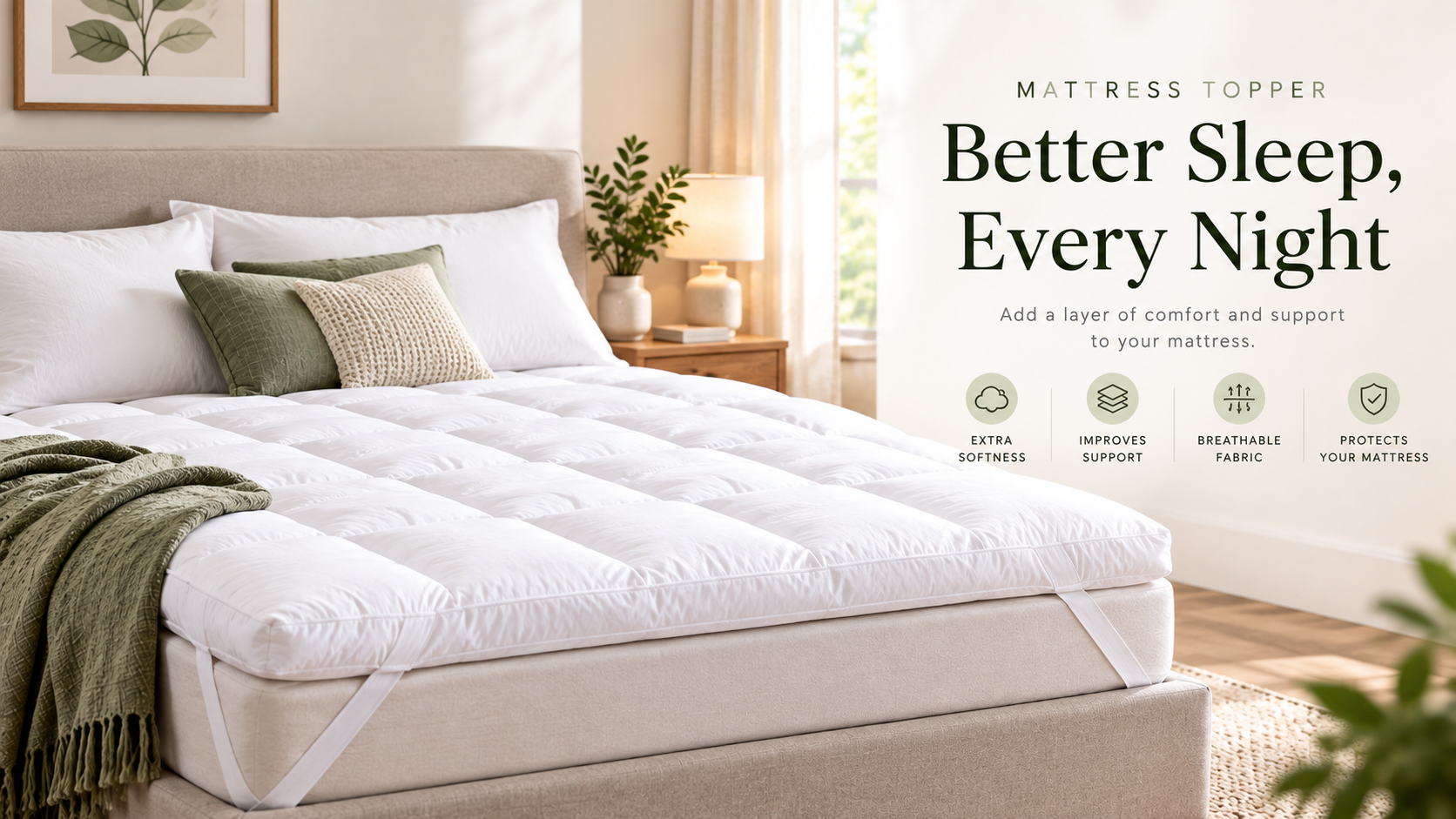
A mattress topper is a removable, standalone cushioning layer—typically 2 to 4 inches thick—designed to sit directly on top of your existing mattress to alter its firmness, enhance pressure relief, and upgrade overall sleep quality. Unlike thin mattress pads or waterproof protectors that mainly shield against spills and dust, a mattress topper fundamentally transforms how your bed feels without the expense of buying a brand-new mattress.
Key Benefits of Using a Mattress Topper
Adding a high-quality topper delivers immediate structural and hygienic improvements to your sleep setup:
-
Customized Comfort and Firmness Adjustment: If your current mattress feels overly rigid or slightly too soft, a topper acts as a quick corrective layer, dialing in plushness or adding responsive support.
-
Targeted Pressure Point Relief: Quality toppers distribute body weight evenly across a broader surface area, reducing concentrated stress on sensitive joints like the shoulders, hips, and lower back.
-
Extended Mattress Lifespan: By absorbing daily friction, body weight, and night sweats, a topper shields the underlying mattress core from premature sagging and wear.
-
Cost-Effective Bed Upgrade: Replacing a premium mattress requires a major financial investment, whereas a topper revitalizes an aging—yet structurally sound—bed for a fraction of the cost.
-
Motion Isolation for Couples: Dense materials like memory foam absorb kinetic energy, preventing one partner’s tossing and turning from disturbing the other.
-
Improved Sleep Hygiene: Many models feature removable, machine-washable covers and naturally antimicrobial fills that block dust mites, allergens, and moisture buildup.
Types and Materials of Mattress Toppers
Choosing the right topper starts with understanding how each core material behaves under body weight and heat:
| Material / Type | Feel & Support Profile | Best Suited For | Average Lifespan |
| Memory Foam | Slow-responding, deep body-hugging contour | Side sleepers, joint pain relief, couples | 3–5 years |
| Natural Latex | Buoyant, springy lift without sinking | Back/stomach sleepers, hot sleepers, eco-buyers | 7–10 years |
| Wool | Firm-ish, breathable, springy surface cushioning | Year-round temperature control, night sweaters | 5–10 years |
| Feather & Down | Airy, cloud-like softness with minimal pushback | Lightweight sleepers wanting luxury plushness | 3–5 years |
| Down Alternative | Soft, lightweight microfiber or polyester loft | Budget shoppers and allergy-prone sleepers | 2–4 years |
| Hybrid (Microcoils + Foam) | Responsive bounce paired with plush top contouring | Combination sleepers needing both lift and cushioning | 5–8 years |
1. Memory Foam (Traditional, Gel, & Copper-Infused)
Viscoelastic polyurethane foam softens in response to body heat, molding closely to your curves. Because traditional memory foam can retain warmth, modern versions incorporate open-cell structures, cooling gel beads, graphite, or copper infusions to draw heat away from the body.
2. Latex (Dunlop & Talalay)
Harvested from rubber tree sap, natural latex offers instant responsiveness—pushing back gently so you never feel "stuck" when changing positions. Dunlop latex is denser and firmer, making it ideal for spinal support, while Talalay latex undergoes an aeration process that yields a lighter, softer, and even more breathable feel.
3. Natural Wool & Cotton
Wool toppers consist of densely quilted natural fibers that regulate microclimate temperature—keeping you cool in humid summers and warm in winter. Organic cotton covers and fills add crisp breathability and moisture absorption for sensitive skin.
4. Featherbeds & Down Alternatives
Filled with duck or goose down and feathers inside baffle-box stitching, featherbeds recreate the plush, sink-in feel of luxury hotel bedding. Down alternatives mimic this loft using hypoallergenic polyester microfibers that are easier to machine-wash and far more affordable.
5. Hybrid Toppers
Hybrid designs combine a base layer of miniature steel microcoils with an upper layer of memory foam or latex. The coils promote vigorous airflow and prevent bottoming out, while the foam cushions pressure points.
How to Use and Maintain a Mattress Topper
Proper setup ensures your topper stays aligned, performs well, and lasts for years:
-
Unbox and Air Out: Compressed foam and latex toppers arrive vacuum-sealed. Unroll yours flat on the bed or floor in a well-ventilated room for 24 to 48 hours so it fully expands and any harmless manufacturing odor ("off-gassing") dissipates.
-
Prepare the Base Mattress: Vacuum your existing mattress and ensure it sits on a flat, supportive foundation. Note that a topper cannot fix a deeply broken or heavily sagging mattress.
-
Align and Secure: Place the topper flush with the edges of your mattress. Use built-in elastic corner straps or a non-slip grip backing to anchor it so it does not bunch up overnight.
-
Layer Your Bedding Correctly: Cover both the topper and the mattress together using a breathable mattress protector, followed by a deep-pocket fitted sheet (typically 15 to 18 inches deep) to accommodate the added height.
-
Routine Care and Rotation: Rotate the topper 180 degrees head-to-toe every three months to prevent body impressions. Fluff feather or fiber fills weekly, spot-clean foam cores with mild detergent (never submerge memory foam in a washing machine), and launder removable covers according to care tags.
Current Mattress Topper Trends
Bedding innovation has shifted heavily toward active thermoregulation, clean materials, and personalized sleep engineering:
-
Advanced Phase-Change & Mineral Cooling: Infusions of conductive graphite, copper, and phase-change fabrics (like GlacioTex) actively pull thermal energy away from the sleeper rather than relying solely on passive airflow.
-
Certified Organic & Non-Toxic Construction: Shoppers increasingly demand third-party safety certifications—such as CertiPUR-US (low VOC emissions and zero heavy metals in foams), GOLS (Global Organic Latex Standard), and OEKO-TEX—to ensure healthier indoor air quality.
-
Zoned Ergonomic Support: Newer toppers feature sculpted or multi-density zones that provide firmer support beneath the lumbar region while offering softer give under the shoulders and knees.
-
Smart Temperature-Controlled Toppers: High-end active water- or air-circulating toppers with dual-zone app controls allow couples to heat or cool each side of the bed independently while tracking sleep metrics.
How to Buy the Right Mattress Topper: A Step-by-Step Guide
Before purchasing, evaluate five practical criteria to match a topper to your body and bedroom environment:
-
Match Thickness to Your Goal: Choose a 2-inch topper for subtle comfort adjustments or minor firmness tweaks. Opt for a 3- to 4-inch topper if you need substantial pressure relief or want to soften an overly hard mattress.
-
Factor in Sleeping Position:
-
Side sleepers need thicker (3–4 inch), medium-soft memory foam or Talalay latex to cushion hips and shoulders without misaligning the spine.
-
Back sleepers perform best on medium-firm latex or high-density foam (2–3 inches) that supports the natural lumbar curve.
-
Stomach sleepers require thinner (1.5–2 inch), firmer surfaces so the pelvis does not sink and strain the lower back.
-
-
Consider Body Weight: Lighter sleepers (under 130 lbs) experience closer contouring on softer, lower-density foams or down fills. Heavier sleepers (over 230 lbs) need high-density foam (4–5 lbs per cubic foot) or firm latex to prevent sinking straight through to the mattress underneath.
-
Prioritize Breathability in Warm Climates: If you sleep hot or live in a warm, humid climate, avoid dense, unventilated polyurethane foam in favor of perforated latex, wool, bamboo-viscose covers, or gel/copper-infused open-cell designs.
-
Check Trials, Warranties, and Dimensions: Verify exact mattress measurements (Twin, Queen, King, or custom sizes) and look for brands offering at least a 30- to 100-night sleep trial and a 1- to 5-year warranty.
Conclusion
A well-chosen mattress topper is one of the simplest, highest-value upgrades you can make to your bedroom. Whether you are softening a rigid mattress with plush memory foam, cooling down humid nights with perforated natural latex or wool, or extending the life of a guest bed, matching the right material and thickness to your sleeping position transforms nightly rest. With proper care—using a protective cover, deep-pocket sheets, and seasonal rotation—your topper will deliver years of restorative, hotel-grade comfort.
Frequently Asked Questions (FAQs)
1. What is the difference between a mattress topper and a mattress pad?A mattress topper is a thick (2–4 inches), dense cushioning layer engineered to change the firmness and support of your bed. A mattress pad is much thinner (usually under 1 inch) and primarily protects the mattress surface from light spills, sweat, and everyday wear.
2. Can a mattress topper fix a sagging mattress?A topper can smooth out minor surface lumps or slight wear, extending a mattress's usable life by a year or two. However, because a topper conforms to whatever sits beneath it, it cannot fix deep structural sagging or broken springs—those require a new mattress.
3. Which mattress topper is best for lower back pain?High-density memory foam and medium-firm natural latex are the strongest choices for back pain. Both materials keep the spine neutrally aligned by cradling pressure points while preventing the hips from sinking too deeply.
4. How do I stop my mattress topper from sliding around? Look for toppers equipped with elastic corner anchor straps or silicone non-slip bottom grips. Placing a snug, deep-pocket fitted sheet over both the topper and the mattress together will also lock the layers securely in place.
5. Can I wash a mattress topper in a washing machine? Solid foam and latex cores should never be machine-washed or put in a dryer, as agitation and heat will tear or melt the material. Instead, remove and machine-wash the outer zip cover, and spot-clean the foam core with mild soap and cold water before air-drying completely. Thin microfiber or down-alternative toppers may be machine-washed only if explicitly permitted on their care label.

 English
 French
 Spanish
 Portuguese
 Deutsch
 Turkish
 Dutch
 Italiano
 Russian
 Romaian
 Portuguese (Brazil)
 Greek