
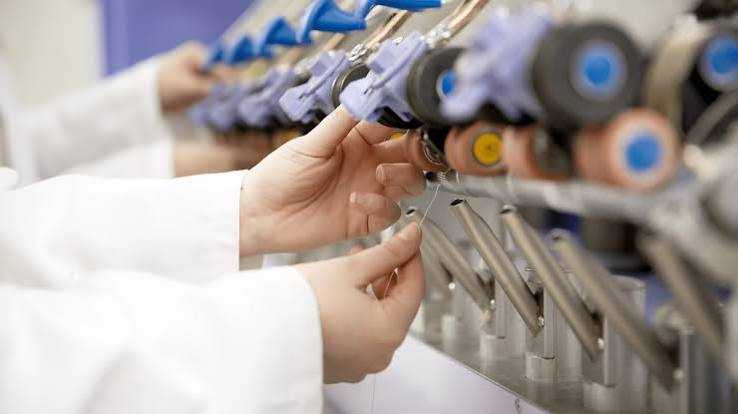
Textile chemicals are formulations used to prepare and colour and finish fabric. They include sizing agents that strengthen yarn and dyes that give lasting colour and finishes that add softness. Mills choose each formulation for a specific fibre and end use since a shirt and a curtain face different wear. Good chemistry stays invisible and shows only as colour that holds.
A recent study by Markntel Advisor highlights that the Saudi Arabia textile chemicals industry was valued at USD 206 million in 2026 and are projected to grow from USD 214 million in 2027 to USD 269 million by 2033, registering a CAGR of 3.89% during 2027–2033. Coating and sizing chemicals account for 28% of product revenue. Apparel and garments account for 40% of application revenue.
Coating And Sizing Give Yarn Strength For The Loom Ahead
Coating and sizing chemicals lead product use because they prepare yarn for the stress of weaving. Coatings add abrasion resistance and water repellency and surface protection. Sizing agents coat fibres and reduce hairiness and cut breakage on the loom. Their value shows up in fewer stoppages and steadier output. Mills that skimp on this stage often pay later through torn yarn and uneven cloth.
Dyes and pigments form the next large product group and give cloth its colour range and fastness. Reactive dyes suit cotton and other plant fibres while disperse dyes suit polyester and similar synthetics. Consistent shade matters greatly since a batch that drifts cannot sit beside an earlier batch. Suppliers therefore pair dyes with levelling and fixing and dispersing agents that keep colour even across long runs.
Apparel Makers Drive The Strongest Call For Colour And Finish
Apparel and garments take the largest application share supported by local fashion design efforts. A product-development studio opened in 2024 at Misk City supports local designers and brands in developing apparel under a local making concept. Such studios create steady work for dyeing and finishing suppliers since each collection needs tested colours before it reaches shops. Local design thus feeds local chemical use order by order.
Retail growth adds a second pull on supply. Online retail broadens garment ranges which widens colours mills must handle. The General Authority for Statistics recorded a 13.4% rise in the retail e-commerce sales index in the second quarter of 2026. More choice for shoppers means more short runs and faster shade changes for mills. Suppliers that deliver small exact batches on time gain ground.
Hotels And Homes Open A Wider Door For Treated Furnishings
Home textiles and furnishings are the fastest-growing application carried by expanding hospitality and housing activity. Hotels need bed linen and towels and curtains and upholstery that withstand frequent washing while keeping colour and softness. That demand calls for softeners and antimicrobial agents and flame-retardant formulations and stain-resistant finishes each tested for repeated use. A hotel pipeline approaching one hundred properties shows the scale of furnishing work ahead.
Wholesale and retail trade and restaurants and hotels together contributed 12.3% of gross domestic product in 2025. That weight explains why furnishing textiles matter beyond the home since every new hotel room needs treated cloth. Suppliers must also meet revised testing rules after a 2024 regulatory update added new standards. Documentation and consistent performance data now count as part of the product.
Imported Dyes Leave Local Mills Exposed To Supply Delays
Local mills still depend heavily on imported specialty dyes which leaves them exposed when suppliers falter. Trade data show imports of reactive dyes worth USD 1.16 million in 2024 with one country providing close to 80% of value. Disperse dye imports reached USD 1.40 million in the same year led by two supplier countries. Such concentration means a delay at one source can ripple through dyeing schedules.
Domestic blending and formulation capacity offers a partial answer to that exposure. The Saudi Industrial Development Fund supports industrial projects through financing and localisation programmes. A standard incentives programme announced in January 2025 covers part of eligible project investment for qualifying plants. Closer suppliers could shorten replenishment cycles and give mills faster technical help and tailor formulations to local fibres and water conditions.
What Local Blending Capacity Could Mean For Future Supply
Local blending capacity could change how Saudi mills plan buying and shift orders toward shorter flexible orders. The General Authority for Statistics publishes national data behind these patterns while MODON supports industrial cities where plants take shape. If local formulation grows mills could test new finishes faster and respond to fashion cycles sooner. The gain will come gradually as skills and testing and supplier trust build together.

 English
 Arabic
 French
 Portuguese
 Deutsch
 Turkish
 Dutch
 Italiano
 Russian
 Romaian
 Portuguese (Brazil)
 Greek