
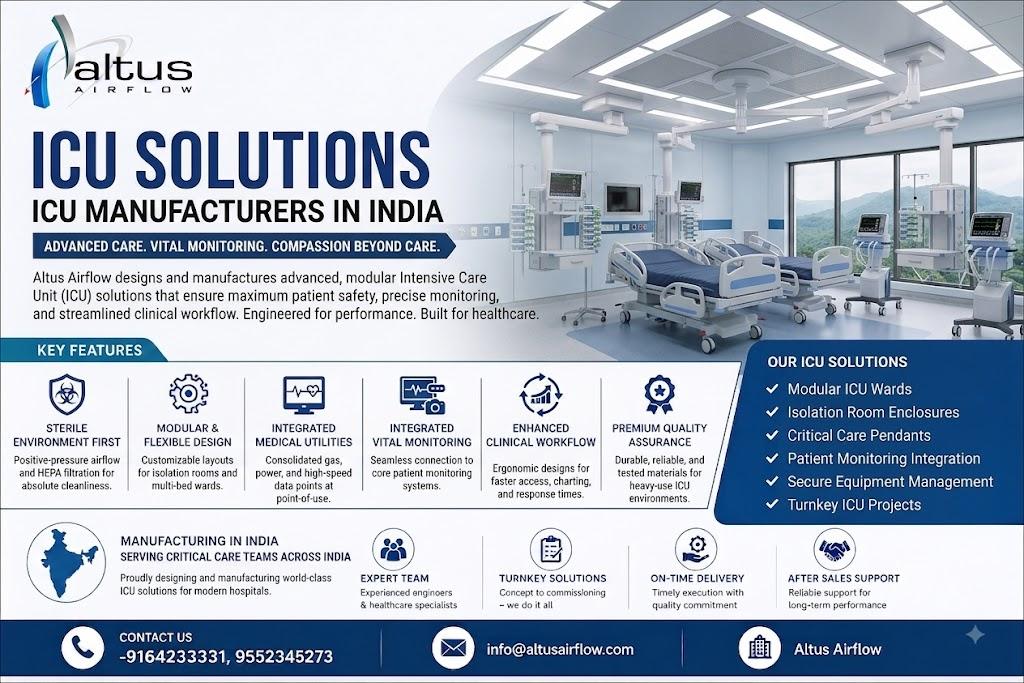
Introduction
An Intensive Care Unit (ICU) is one of the most critical departments in a hospital. It provides specialised care to patients who require continuous monitoring, advanced medical equipment, and immediate clinical attention. Designing an effective ICU requires careful planning, suitable infrastructure, and coordination between multiple healthcare systems.
Selecting reliable ICU Manufacturers In India is an important decision for hospitals planning to establish a new critical care facility or upgrade an existing one. The right manufacturer should understand hospital requirements and provide solutions that support patient safety, infection prevention, efficient workflows, and long-term operational performance.
Before making a decision, hospital administrators and project planners should evaluate several factors, including technical expertise, infrastructure quality, ventilation arrangements, equipment integration, customisation, and after-installation support.
Understanding the Role of ICU Manufacturers
ICU manufacturers contribute to developing specialised critical care environments by providing infrastructure components and integrated systems. Their work may involve designing and supplying modular ICU solutions, medical utility arrangements, patient bed spaces, equipment support systems, and other essential infrastructure.
A well-planned ICU should accommodate clinical staff, patients, monitoring equipment, emergency systems, and essential services without creating unnecessary obstacles.
Depending on the project requirements, an ICU setup may include:
-
Modular wall and ceiling systems
-
Medical gas pipeline arrangements
-
Electrical and emergency power connections
-
Patient monitoring equipment interfaces
-
Bedhead panels and utility systems
-
HVAC and air filtration arrangements
-
Nurse station and observation facilities
-
Storage and equipment support provisions
Manufacturers should understand how these components work together to create a functional critical care environment.
Important Factors to Consider When Selecting ICU Manufacturers
1. Experience in Healthcare Infrastructure Projects
Experience is one of the first factors hospitals should evaluate. ICU projects involve specialised technical requirements that differ from conventional commercial or residential construction.
An experienced manufacturer is more likely to understand patient bed layouts, medical utility requirements, equipment positioning, hygiene considerations, and clinical workflows.
Hospitals should review the manufacturer's previous healthcare projects and assess whether its experience matches the scale and complexity of the proposed facility. Relevant project experience can provide a clearer understanding of its ability to manage specialised infrastructure requirements.
2. Quality of Materials and Infrastructure Components
The materials used in an ICU directly influence its durability, maintenance requirements, and suitability for healthcare operations.
Hospitals should evaluate the quality of modular panels, wall finishes, ceiling systems, doors, fixtures, and other supplied components. Surfaces should be suitable for regular cleaning and compatible with the hospital's infection prevention procedures.
The manufacturer should also provide clear information about material specifications, installation methods, and maintenance requirements.
Choosing durable and appropriate components can help hospitals maintain their ICU infrastructure over an extended period.
3. Ventilation and Air Quality Management
Ventilation is an important consideration in critical care environments. ICU spaces require appropriate temperature, humidity, and air circulation arrangements based on their design and clinical requirements.
Hospitals should assess whether the manufacturer can coordinate HVAC systems, filtration components, ducting, air distribution, and pressure-control requirements where applicable.
Proper ventilation planning should also consider patient bed locations, equipment placement, staff movement, and the operational needs of different ICU areas.
A manufacturer with relevant technical expertise can help coordinate these requirements during the planning and installation stages.
4. Medical Gas and Electrical System Integration
ICU patients often require oxygen, medical air, suction, monitoring systems, and other essential clinical services. Reliable integration of medical gas and electrical infrastructure is therefore important.
Hospitals should check whether the manufacturer can coordinate bedhead panels, medical gas outlets, electrical sockets, emergency power provisions, and alarm interfaces according to the approved project specifications.
These systems should be appropriately positioned to support patient care while allowing healthcare professionals convenient access during routine and emergency situations.
5. Customisation According to Hospital Requirements
Every hospital has different space limitations, patient capacities, clinical workflows, and infrastructure requirements. A standardised ICU layout may not be suitable for every project.
Reliable manufacturers should be able to understand the hospital's operational needs and develop solutions around the available space and intended patient capacity.
Customisation may involve:
-
Patient bed arrangements
-
Bedhead panel configurations
-
Medical gas outlet positioning
-
Electrical and monitoring provisions
-
Nurse station placement
-
Equipment storage facilities
-
Staff movement and access areas
A customised layout helps hospitals make better use of available space while supporting efficient patient care.
6. Compliance With Relevant Technical Standards
Healthcare infrastructure must be planned and executed with attention to applicable building, electrical, fire safety, medical gas, and healthcare facility requirements.
Hospitals should ask manufacturers about the standards and specifications followed during design, material selection, installation, and testing.
They should also review relevant product documentation, technical drawings, and quality records before finalising a project.
Understanding these details helps hospitals evaluate whether the proposed infrastructure is suitable for the intended clinical environment.
Evaluating ICU Design and Infrastructure Capabilities
A reliable manufacturer should offer more than individual products. Its capabilities should cover the coordination of essential infrastructure elements within a practical ICU layout.
Patient Bed Space Planning
Each patient bed area should provide sufficient room for clinical staff, monitoring equipment, medical utilities, and emergency access. Bed positioning should support observation and allow healthcare professionals to perform necessary procedures without unnecessary obstruction.
Nurse Station and Observation Facilities
Nurse stations should be positioned to support effective communication and patient observation. Their placement should consider visibility, staff movement, monitoring requirements, and access to essential information systems.
Equipment and Utility Accessibility
Medical equipment and utility connections should be positioned according to clinical requirements. Proper planning can help reduce cable congestion, improve accessibility, and support organised patient care activities.
Infection Prevention Considerations
ICU infrastructure should support regular cleaning and maintenance. Appropriate material selection, smooth finishes, well-planned service openings, and coordinated ventilation arrangements can contribute to a more manageable clinical environment.
The Importance of Integrated Critical Care Infrastructure Planning
An ICU functions through the combined operation of several infrastructure systems. Medical gases, electrical services, ventilation, monitoring equipment, patient bed spaces, and staff work areas must be coordinated during the design and installation stages.
Critical Care Bedside Systems Integration is an important consideration because patient bed areas bring together multiple clinical services. Medical gas outlets, electrical connections, monitoring interfaces, lighting, and equipment supports should be arranged to provide convenient access for healthcare professionals.
Manufacturers should work closely with hospital engineers, architects, clinical teams, and equipment suppliers to identify technical requirements before installation begins.
This coordination helps reduce conflicts between different systems and supports a more organised project delivery process.
Why After-Sales Support and Maintenance Matter
Selecting an ICU manufacturer should not be based only on the initial supply and installation. Hospitals also need to consider the support available after project completion.
Critical care infrastructure requires regular inspection, maintenance, and occasional upgrades. Manufacturers should provide appropriate technical documentation, maintenance guidance, and support for the supplied components.
Important points to evaluate include:
-
Availability of technical assistance
-
Product warranties and service conditions
-
Maintenance instructions and documentation
-
Availability of replacement components
-
Support for equipment modifications
-
Guidance during system upgrades
A dependable support arrangement can help hospitals manage infrastructure issues and maintain operational continuity.
Common Mistakes Hospitals Should Avoid
Choosing an ICU manufacturer without a detailed evaluation can create problems during installation and hospital operations. Hospitals should avoid the following mistakes:
Focusing Only on Initial Cost
A low initial quotation does not necessarily indicate better value. Material quality, technical capabilities, installation standards, maintenance requirements, and long-term support should also be considered.
Ignoring Clinical Workflow Requirements
An ICU layout should reflect how healthcare professionals work. Insufficient bed access, poorly positioned utilities, and limited equipment space can create operational difficulties.
Overlooking System Coordination
Ventilation, medical gas, electrical infrastructure, and monitoring interfaces must be planned together. Treating them as separate activities can lead to installation conflicts.
Not Reviewing Previous Projects
Hospitals should examine relevant project experience and request technical details where appropriate. This provides a better understanding of the manufacturer's capabilities.
Neglecting Maintenance Planning
Long-term infrastructure performance depends on proper maintenance. Hospitals should understand the service requirements and technical support arrangements before finalising a manufacturer.
Conclusion
Selecting an ICU manufacturer requires careful evaluation of technical expertise, material quality, ventilation arrangements, medical gas integration, electrical infrastructure, customisation capabilities, and after-sales support. Hospitals should consider both immediate project requirements and the long-term operational needs of their critical care departments.
Reliable ICU Manufacturers In India should understand the importance of patient safety, clinical workflows, infrastructure coordination, and dependable technical solutions. By reviewing these factors before making a decision, hospitals can develop organised, functional, and adaptable ICU environments that support modern critical care requirements.
Frequently Asked Questions
1. What should hospitals consider when selecting ICU manufacturers?
Hospitals should evaluate healthcare project experience, infrastructure quality, ventilation capabilities, medical gas and electrical integration, customisation options, technical documentation, and after-sales support.
2. Why is experience important when choosing an ICU manufacturer?
Experience helps manufacturers understand the specialised requirements of critical care environments, including patient bed layouts, equipment positioning, medical utilities, hygiene considerations, and clinical workflows.
3. What infrastructure systems are required in a modern ICU?
A modern ICU may require modular wall and ceiling systems, medical gas pipelines, electrical connections, HVAC arrangements, patient monitoring interfaces, bedhead panels, nurse stations, and equipment support facilities.
4. How does ICU layout planning improve patient care?
Effective layout planning provides suitable space for patients, medical equipment, and healthcare professionals. It also supports patient observation, equipment accessibility, staff movement, and emergency response.
5. Why should hospitals consider after-sales support before selecting an ICU manufacturer?
After-sales support helps hospitals manage maintenance requirements, technical issues, component replacement, and infrastructure upgrades. It can contribute to the long-term reliability of ICU facilities.
Read Our Previous Blog-----------> Why Are Professional Modular OT Installation Services Important for Hospitals?

 English
 French
 Spanish
 Portuguese
 Deutsch
 Turkish
 Dutch
 Italiano
 Russian
 Romaian
 Portuguese (Brazil)
 Greek