
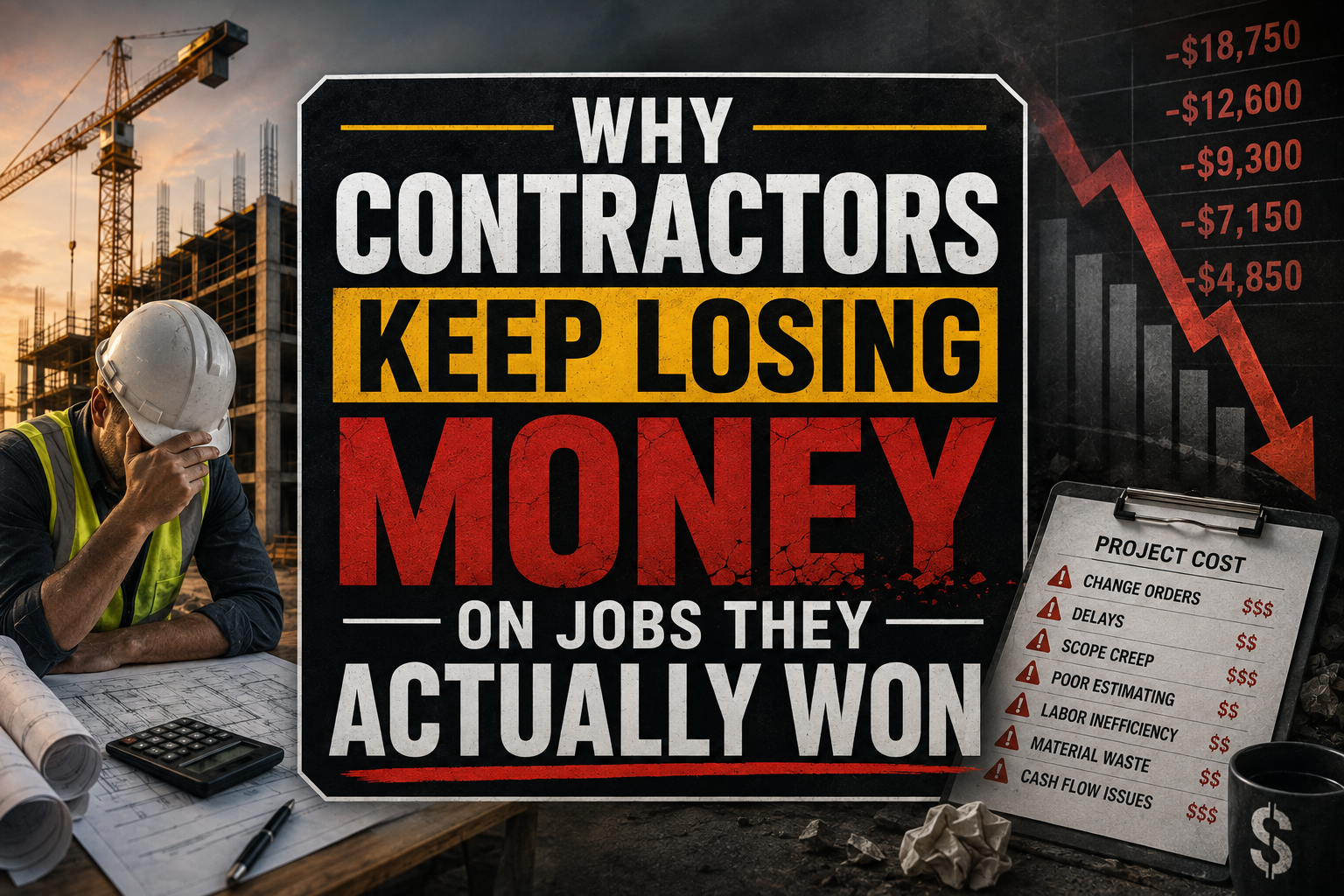
There's a strange pattern in construction that trips up even experienced contractors: the bid gets won, the crew shows up, and somewhere around month two, the project manager realizes the numbers don't add up anymore. Not because the work was priced wrong on purpose, but because the estimate that won the job was never built to survive contact with the real project.
Winning a bid and running a profitable job are two different skills, and the gap between them almost always traces back to what happened or didn't happen during estimating.
The Bid Wasn't Wrong, It Was Incomplete
Most cost overruns don't come from one dramatic mistake. They come from a dozen small omissions that seemed reasonable at the time. A labor rate that didn't include burden. A material quantity that skipped the waste factor. A subcontractor scope that got priced from a gut-feel number instead of an actual quote. None of these look like errors on the day the bid goes out. They look like errors three months later, when the crew is on site and the money's already spent.
The fix isn't more caution, it's more structure. A cost estimate has three layers that all need to be accounted for separately: the direct cost of materials, labor, and equipment; the indirect costs of running the job day to day; and the markup, contingency, and escalation sitting on top. Skip any one of these and the total looks fine on paper right up until it isn't.
Why "Experience" Alone Doesn't Catch Everything
There's a temptation to trust a seasoned estimator's gut over a formal breakdown, and for a lot of scopes that instinct is genuinely good. But gut estimates tend to fail in predictable ways; they're strongest on familiar work and weakest exactly where it matters most: unusual site conditions, long-duration projects where material prices will move before procurement, and subcontracted scopes the in-house team doesn't price every day.
This is where a structured, line-item approach earns its keep. Breaking a project down by CSI division, pricing quantities against current material and labor data, and separating what's confirmed from what's still an assumption gives a project manager something to manage against instead of something to hope holds up. Firms that specialize in construction cost estimating services build estimates this way specifically because it removes the guesswork that experience alone can't always catch, especially on scopes outside a contractor's usual wheelhouse.
The Documents Matter More Than the Number
A number without context is almost useless once a project starts moving. If a bid wins and then the drawings get revised, or an addendum shifts scope, the team needs to know exactly what the original number assumed otherwise nobody can tell whether a change is a legitimate cost increase or something that should have been caught the first time.
This is why a good estimate isn't just a total; it's a document. It should show what's included, what's excluded, and where the contingency sits, so that when reality diverges from the plan and it always diverges somewhere there's a clear record of what changed and why.
Contingency Isn't a Buffer for Bad Estimating
One of the more common misunderstandings on a job site is treating contingency like a cushion for sloppy numbers. It isn't. Contingency exists to cover what the design documents haven't resolved yet, not to paper over gaps in the estimate itself. When contingency gets used to quietly absorbing missed quantities or underpriced labor, a project can look healthy right up until the contingency runs dry with months of work still left and at that point there's no fallback left at all.
Estimates that separate true design uncertainty from estimating gaps let a team see this coming instead of discovering it the hard way.
The Real Lesson
Jobs don't usually lose money because a crew worked slowly or a supplier raised prices unexpectedly. They lose money because the number the job was built around wasn't solid enough to begin with and nobody realized it until the schedule and the budget started pulling in opposite directions.
Tightening up how a project gets estimated before the bid goes out is one of the few places a contractor can meaningfully change the odds on every job that follows, not just the current one.

 Arabic
 French
 Spanish
 Portuguese
 Deutsch
 Turkish
 Dutch
Dutch
 Italiano
 Russian
 Romaian
 Portuguese (Brazil)
 Greek
Greek