
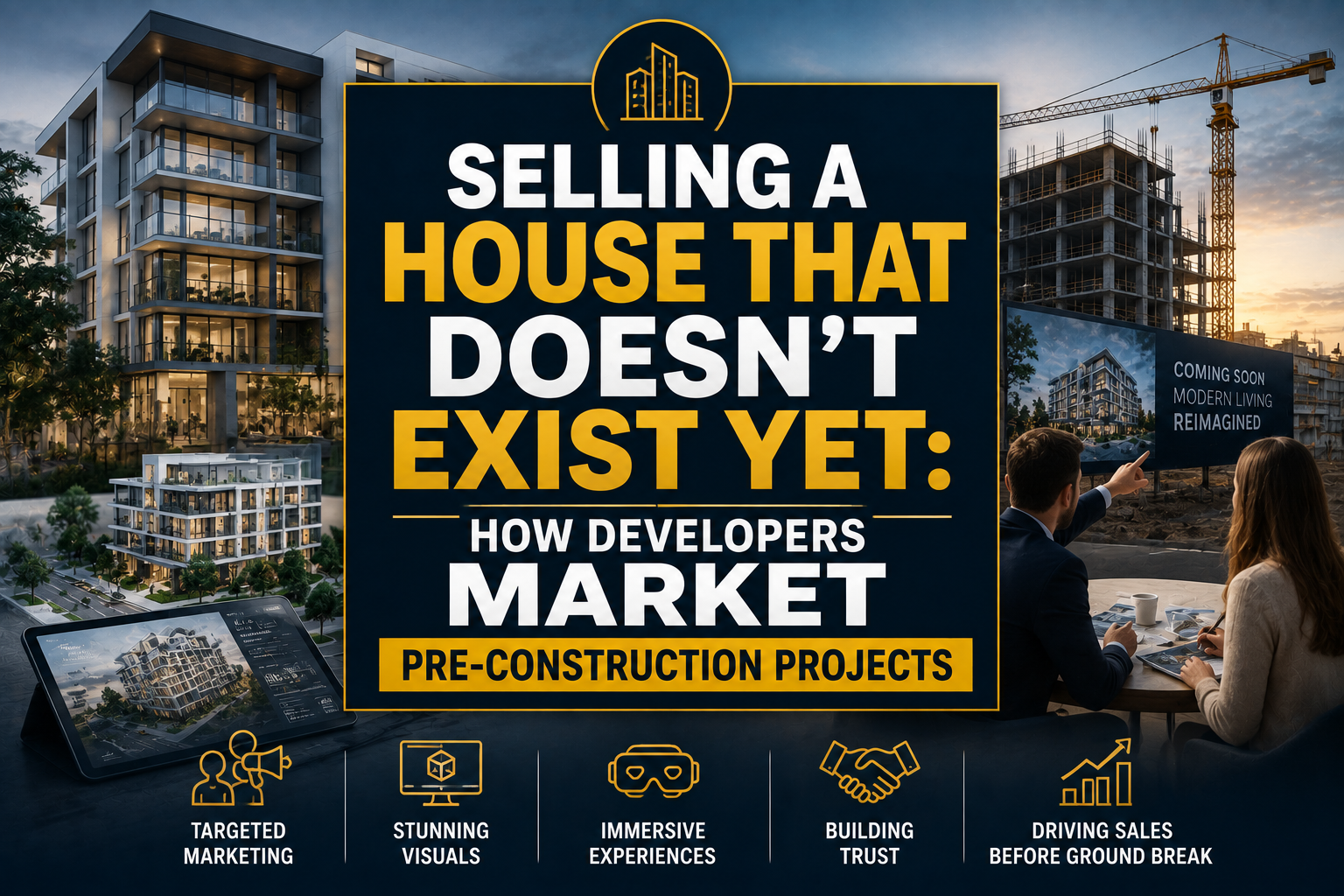
There's a strange sales challenge unique to real estate development: how do you convince someone to commit six or seven figures to a home or building that's currently a hole in the ground, a set of blueprints, or a patch of undeveloped land? Traditional listing photos obviously don't work; there's nothing to photograph yet. And a floor plan, while useful to an architect, does almost nothing to help an ordinary buyer imagine what it would actually feel like to stand in that kitchen with morning light coming through the windows.
This is the exact gap that transformed pre-construction marketing over the last couple of decades, and it's worth understanding how developers actually closed it.
The Old Way Left a Lot to the Imagination
Before realistic digital visuals became standard, developers leaned on a mix of tools that all had the same weakness: they asked buyers to do the imagining themselves. Hand-drawn renderings looked artistic but rarely resembled the finished product closely enough to build real confidence. Physical scale models were impressive in a sales office but expensive to produce and impossible to update once a design changed. And written descriptions "spacious open-concept living area with premium finishes" meant something different to every reader.
The result was a sales process that relied heavily on trust and a buyer's willingness to picture something abstract. That worked fine for confident buyers with strong spatial imagination. It worked a lot less well for everyone else, and it left plenty of money on the table.
What Changed the Game
The shift came from computer-generated visualization technology maturing to the point where a rendered image of an unbuilt space could look genuinely, convincingly like a photograph. Not a stylized illustration suggesting what a room might look like, but something close enough to reality that a buyer's brain stops working to interpret it and just responds to it the way it would respond to an actual photo.
That distinction matters more than it sounds. A sketch asks the viewer to fill in gaps. A photorealistic render closes those gaps for them, which changes the entire emotional experience of evaluating a property. For anyone who wants the technical side of how this actually works the software, the rendering pipeline, and why it's become standard across the architecture and real estate industries this breakdown of how computer generated imagery works in architecture covers the process end to end and explains why the technology took off the way it did.
Why It Works Better Than It Sounds Like It Should
There's a psychological reason photorealistic visuals outperform every previous marketing tool, and it isn't just that they look nicer. Buyers make emotional decisions before they make logical ones. A well-lit render of a living room with the right furniture, the right light quality, and a believable sense of scale triggers the same "I could live here" response a real photo would and that response happens fast, often before a buyer has consciously evaluated square footage or layout at all.
Developers figured this out quickly. A rendered image that makes a buyer emotionally commit to a space does more selling in three seconds than a spec sheet does in three paragraphs.
Beyond the Static Image
The technology didn't stop at still renders. Interactive walkthroughs now let prospective buyers move through a space at their own pace, looking around corners and up at ceiling heights instead of relying on a single fixed camera angle a developer chose for them. Virtual staging lets the same empty floor plan be shown furnished in multiple styles for different buyer profiles, without physically staging a single room. And lighting studies let developers show accurately how natural light will move through a space across different times of day, a detail that used to be pure guesswork until move-in day.
None of this replaces the finished building. But it closes the gap between "trust us" and "see for yourself" in a way that fundamentally changed how confident buyers feel putting down a deposit on something that doesn't exist yet.
The Bigger Shift
What's really happened is that the burden of imagination moved from the buyer to the visualization. Buyers no longer need strong spatial reasoning skills to evaluate a pre-construction property fairly; the technology does that translation for them. That's not a small marketing upgrade. It's a fundamental change in who developers can successfully sell to, and it's a big part of why photorealistic visuals have become table stakes rather than a premium add-on in modern real estate marketing.

 English
 Arabic
 French
 Spanish
 Portuguese
 Deutsch
 Turkish
 Dutch
Dutch
 Russian
 Romaian
 Portuguese (Brazil)
 Greek
Greek