
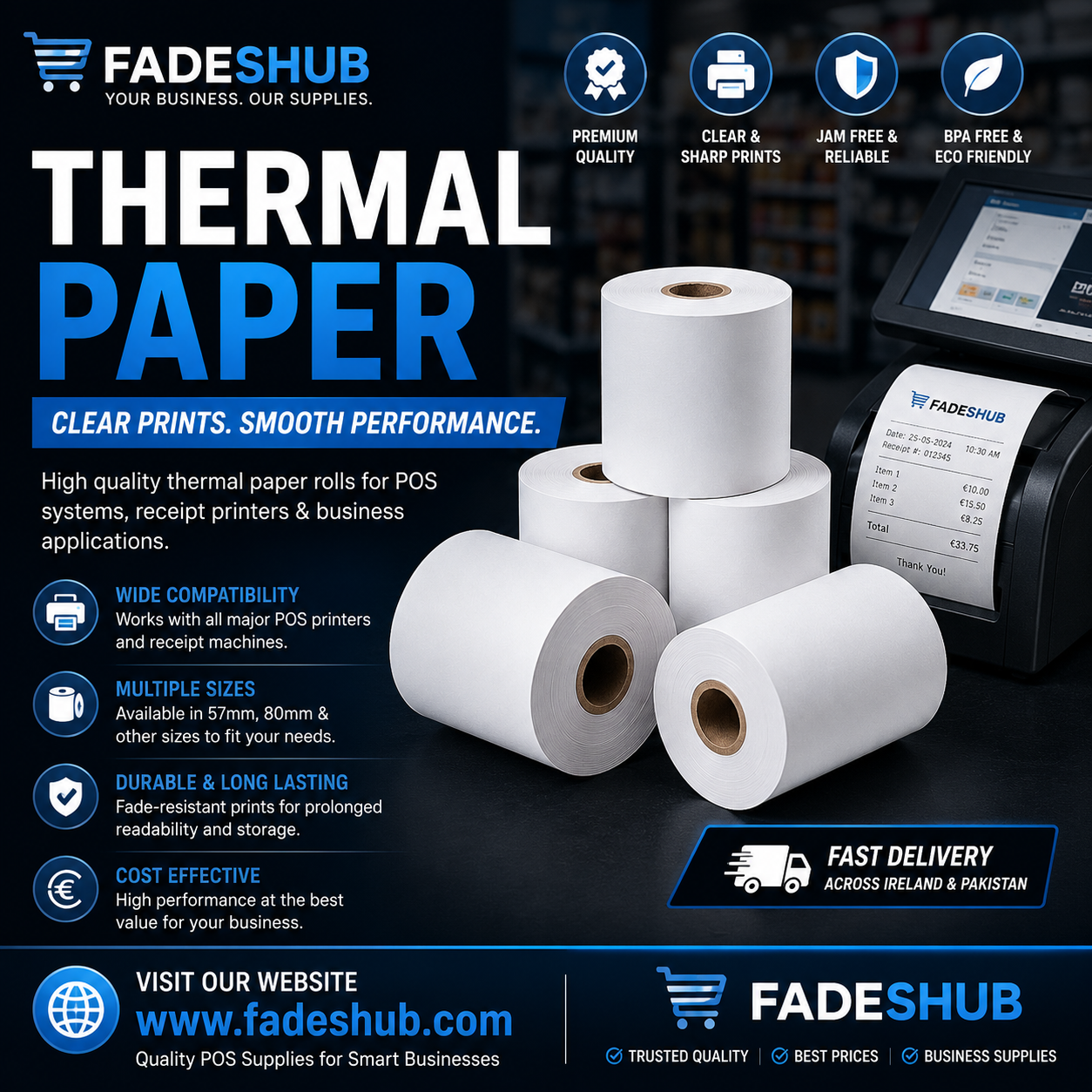
Why Are Rolls of Thermal Paper Important for Regular Business Printing?
Businesses that depend on receipts, transaction records, order tickets, and payment slips need printing supplies that work consistently throughout the day. Thermal receipt rolls for POS printers, direct thermal till paper, and heat-sensitive cash register rolls are designed for this kind of fast commercial printing. Choosing the right thermal paper rolls can affect print clarity, checkout speed, barcode readability, printer performance, and how often staff need to replace paper. For retailers, restaurants, pharmacies, hotels, transport services, and other busy workplaces, the paper roll is a small supply that can have a direct effect on daily operations.
What Are Thermal Paper Rolls?
Thermal paper rolls are made from specially coated paper that reacts when exposed to controlled heat. A compatible direct thermal printer uses a heated printhead to create the image directly on the paper surface. This means the printer does not need traditional ink cartridges or toner for normal operation. The process is commonly used for short-format printing where speed matters.
What Can Be Printed on Thermal Paper?
Depending on the printer and software, thermal paper can display:
-
Transaction details
-
Prices and totals
-
Dates and receipt numbers
-
Barcodes and QR codes
-
Order information
-
Basic branding or promotional messages
Clear print quality is especially important when the receipt needs to be scanned or used later for returns and record keeping.
Why Do Businesses Prefer Direct Thermal Printing?
One of the main advantages is simplicity. A direct thermal printer has fewer consumables to manage than many traditional printing systems. Businesses mainly need compatible paper and regular printer maintenance. This can be particularly useful at busy counters where staff cannot afford frequent interruptions.
Does Thermal Printing Save Time?
Yes, especially during high-volume transactions. The image appears immediately as the paper moves through the printer. There is no wet ink that needs time to dry, and staff do not need to replace cartridges during normal receipt printing. This makes thermal systems useful for supermarkets, cafés, restaurants, ticket counters, and payment terminals.
Which Thermal Paper Roll Size Should You Buy?
The correct size depends on the printer.
Businesses often focus only on paper width, but several measurements affect compatibility. These include roll width, outer diameter, core diameter, paper thickness, and total length.
Are 80mm Thermal Paper Rolls Standard?
80mm rolls are widely used in many countertop POS printers, but they are not suitable for every machine. Smaller equipment may require narrower rolls such as 57mm thermal paper. The safest approach is to check the printer manual or manufacturer specifications before ordering.
Why Does Outer Diameter Matter?
Even if the paper width is correct, the roll may still be too large for the printer compartment. A roll that prevents the lid from closing properly should not be forced into the machine.
How Does Paper Quality Affect Printing?
Thermal paper quality influences how evenly the surface reacts to heat.
A good coating can support sharper text and more consistent contrast. Poor-quality paper may create pale sections, unclear barcodes, or excess dust inside the printer.
Why Is Dark Print Important?
Receipts often contain information that needs to remain readable.
Customers may use them for refunds, warranty claims, expense records, or purchase confirmation.
Strong contrast also helps scanners recognise QR codes and barcodes more efficiently.
For businesses using thermal printing for order or inventory systems, clear output can reduce avoidable delays.
What Causes Thermal Receipts to Fade?
Thermal paper is sensitive by design.
The same chemical reaction that allows fast printing also means the surface can be affected by environmental conditions.
Heat, direct sunlight, moisture, oils, solvents, and some chemicals may gradually reduce the readability of thermal paper.
Can Important Thermal Receipts Be Preserved?
They can be protected by keeping them in a cool, dry place away from strong light and heat.
For important business or financial records, maintaining a digital copy may also be useful.
This provides a backup if the physical receipt deteriorates over time.
How Should Unused Thermal Paper Be Stored?
Storage conditions can influence how the paper performs before it is even loaded into a printer.
Unused rolls should remain in a dry area with stable temperatures.
Avoid storing them near radiators, hot equipment, sunny windows, or sources of moisture.
Should Rolls Stay in Their Packaging?
Yes, keeping unused rolls packaged until required can help protect them from dust, handling, and environmental exposure.
Businesses purchasing larger quantities can also rotate stock so older rolls are used before newer deliveries.
This helps prevent supplies from sitting unused for unnecessarily long periods.
Why Does a Thermal Printer Produce Blank Paper?
Incorrect loading is one common explanation. Most thermal paper has a specific coated side that needs to face the printhead.
If the roll is inserted the wrong way, the printer may continue feeding paper without creating visible text. If reversing the roll does not fix the issue, the paper compatibility, printhead, and printer settings should be checked.
What Causes Paper Jams in Thermal Printers?
Several factors can contribute to feeding problems.
A roll may be too wide, too large in diameter, damaged around the edge, or incorrectly positioned.
Paper fragments and dust inside the printer can also interfere with movement. Regular cleaning according to manufacturer instructions helps reduce these problems.
Can Low-Quality Paper Affect the Printer?
Poorly manufactured paper can sometimes produce more dust or feed less consistently. Over time, residue may collect around the printhead and rollers.
Choosing reliable paper and maintaining the printer can support smoother operation.
Are Longer Thermal Paper Rolls Better?
Longer rolls can be useful because staff need to replace them less often.
However, roll length should not be considered alone.
A longer roll may have a larger outside diameter, and that could make it unsuitable for the printer.
Businesses need to balance usable paper length with physical compatibility.
Why Is Cost Per Roll Not Enough?
Two products may contain the same number of rolls but different amounts of paper.
A cheaper box can appear attractive while offering shorter rolls.
For businesses purchasing frequently, comparing usable length, quality, and price together provides a more realistic picture of value. Want to read more?? If yes then click here
Where Are Thermal Paper Rolls Commonly Used?
Thermal printing appears across many industries.
Retail stores use it for receipts and returns. Restaurants can print bills and order tickets. Hotels may issue transaction records, while card terminals produce payment confirmations.
Parking systems, transport services, pharmacies, queue systems, and selected warehouse operations also use direct thermal media.
This broad range of applications makes compatibility particularly important because different equipment may require different specifications.
Can Businesses Reduce Thermal Paper Waste?
Yes.
Receipt layout can have a significant impact on paper consumption.
Large blank spaces, oversized headers, repeated offers, and automatic duplicate copies can make receipts unnecessarily long.
Businesses can review their templates and keep only useful or required information.
Digital receipts can also complement physical printing where appropriate.
Key Takeaways
The most important points to remember are simple.
-
Confirm printer dimensions before ordering.
-
Compare usable roll length, not only box price.
-
Store unused stock away from heat and moisture.
-
Keep the printhead clean.
-
Replace damaged rolls instead of forcing them into the printer.
-
Review receipt layouts to reduce unnecessary paper use.
What Should You Look for in a Thermal Paper Supplier?
A reliable supplier should provide clear specifications instead of vague product descriptions.
Businesses should be able to confirm roll width, diameter, core details, length, and intended printer type before buying.
Consistent packaging and dependable availability also matter for organisations that use large volumes.
Price remains important, but reliability can provide better long-term value than choosing the lowest-cost option without considering quality.
Why Thermal Paper Rolls Remain Important
Digital payment systems continue to grow, but many businesses still depend on printed transaction information.
Receipts, order slips, tickets, labels, and payment records remain part of everyday workflows.
Quality thermal paper rolls support these processes by providing quick output in compact and widely used printing systems.
The strongest purchasing approach considers the full printing environment. Printer compatibility, paper coating, roll capacity, storage conditions, maintenance, and receipt design all affect performance.
When these factors are managed properly, businesses can reduce printing problems, improve transaction speed, and keep customer-facing operations moving with fewer interruptions.
Frequently Asked Questions
Do Thermal Paper Rolls Need Ink?
No. Direct thermal printers use heat to activate the coated paper surface, so standard ink or toner is not required.
What Is the Most Common Thermal Paper Size?
80mm and 57mm widths are commonly used, but the correct size depends on the specific printer.
Can I Use Any 80mm Roll in My POS Printer?
Not always. The width may match while the roll diameter, core size, or thickness does not.
Why Does Thermal Paper Turn Black With Heat?
The coating on the paper reacts to heat and changes colour, which is how the printer creates text and graphics.
How Long Do Thermal Receipts Stay Readable?
Durability depends on paper quality and storage conditions. Heat, sunlight, moisture, oils, and chemicals can reduce readability.
Is Buying Thermal Paper in Bulk a Good Idea?
Yes, when usage is predictable and the correct paper specifications are already confirmed.
How Can I Reduce Thermal Paper Usage?
Shorter receipt layouts, fewer duplicate copies, and digital receipt options can help reduce unnecessary consumption.

 English
 Arabic
 French
 Portuguese
 Deutsch
 Turkish
 Dutch
Dutch
 Italiano
 Russian
 Romaian
 Portuguese (Brazil)
 Greek
Greek