
A safe home is about more than comfortable rooms, attractive interiors, and reliable heating. Indoor air quality also plays an important role in protecting your family. One potential danger that many homeowners overlook is radon, a naturally occurring radioactive gas that can enter buildings from the soil beneath their foundations. Because it has no colour or smell, it cannot be detected without appropriate testing.
Radon mitigation Ottawa is an important consideration for homeowners who want to identify elevated radon levels and reduce their exposure. Ottawa Public Health confirms that elevated radon levels occur in Ottawa, Ontario, and across Canada. Testing is the only reliable way to determine how much radon is present inside a property.
Understanding how radon enters a home, when professional mitigation is necessary, and which solutions are available can help property owners make informed decisions about their indoor environment.
What Is Radon and Why Is It a Concern?
Radon is a naturally occurring radioactive gas produced by the breakdown of uranium in soil and rock. It can move through the ground and enter buildings through cracks in concrete floors, gaps around pipes, foundation joints, and other openings.
Once inside, radon can accumulate, particularly in basements and lower levels with limited air exchange. However, its presence is not limited to older houses or properties with unfinished basements. Any building may contain radon, and its concentration varies from one property to another.
Long-term exposure to elevated radon increases the risk of lung cancer. Health Canada identifies radon as the leading cause of lung cancer among people who do not smoke. The danger makes testing and appropriate mitigation important parts of responsible home maintenance.
Why Is Radon Mitigation Ottawa Important?
Ottawa homeowners should not assume their properties are safe simply because they are well maintained or located in a particular neighbourhood. Radon concentrations depend on several factors, including local soil conditions, foundation design, air pressure, and ventilation.
The Canadian guideline recommends corrective action when the average annual radon concentration in normally occupied areas exceeds 200 becquerels per cubic metre (Bq/m³). Health Canada recommends taking action within one year when results exceed this level, with faster action warranted at higher concentrations.
Professional radon mitigation Ottawa services can help homeowners address elevated readings using systems designed for their building's construction and radon conditions.
Benefits of appropriate mitigation include:
-
Reducing exposure to harmful radon gas.
-
Improving confidence in the home's indoor air quality.
-
Supporting a healthier living environment for occupants.
-
Helping homeowners make informed property maintenance decisions.
-
Providing a practical solution to an otherwise invisible environmental concern.
How Can You Tell If Your Home Needs Radon Mitigation?
Start With a Reliable Radon Test
Radon cannot be identified by smell, sight, or ordinary household inspections. A dedicated radon test is therefore essential.
Health Canada recommends long-term testing, generally lasting at least three months, because radon concentrations can fluctuate over time. Testing should take place in the lowest level of the home that is regularly occupied, such as a finished basement or frequently used living area.
Homeowners can use an appropriate do-it-yourself test kit or hire a qualified radon measurement professional. Following the test instructions carefully is essential for obtaining useful results.
Understand Your Test Results
Once testing is complete, compare the long-term average with the Canadian guideline. If your result exceeds 200 Bq/m³, contact a certified mitigation professional to discuss suitable corrective measures.
For example, a homeowner who discovers elevated radon in a basement used as a family room should arrange an assessment rather than relying on occasional ventilation alone. A professional can examine the foundation, evaluate possible entry routes, and recommend a suitable system.
What Radon Mitigation Methods Are Available?
1. Sub Slab Depressurization
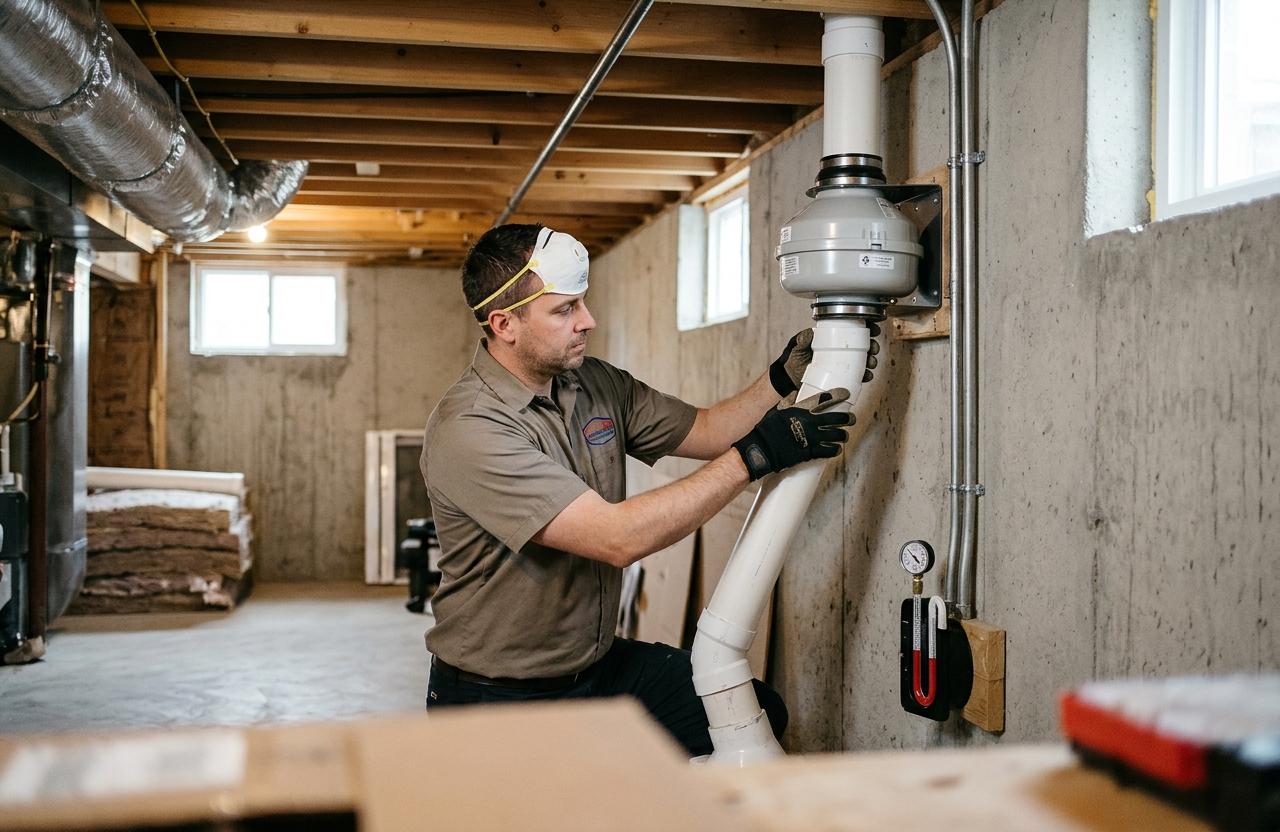
Sub-slab depressurization is one of the most common methods of reducing radon in existing homes. It generally involves installing a pipe through the foundation slab and connecting it to a fan that draws radon-containing soil gas from beneath the building.
The gas is then discharged outdoors through a properly positioned exhaust outlet, reducing the amount that enters the living space. System design depends on the home's foundation, soil conditions, and measured radon concentration.
2. Sealing Foundation Openings
Cracks, joints, and gaps around utility pipes can provide pathways for radon to enter a building. Sealing these openings is often part of a mitigation project.
However, sealing alone is not usually a reliable solution for significantly elevated radon levels. It is more effective when incorporated into a properly designed mitigation strategy.
3. Improving Ventilation
Ventilation can help dilute indoor radon concentrations in certain circumstances. Mechanical ventilation systems may be considered as part of an appropriate indoor air quality plan.
Nevertheless, ventilation alone may not adequately control high radon concentrations. A qualified professional can determine whether it should supplement a dedicated radon reduction system.
What Should You Expect From Professional Radon Mitigation Ottawa Services?
Choosing professional radon mitigation Ottawa services begins with understanding your property's specific requirements. A qualified contractor should assess the test results, inspect relevant foundation areas, explain the proposed system, and provide clear information about installation and ongoing operation.
Look for a professional certified through the Canadian National Radon Proficiency Program (C-NRPP). Health Canada recommends using a certified radon mitigation professional when elevated readings require corrective action.
A typical project may involve the following stages:
-
Reviewing existing radon test results.
-
Assessing the building's foundation and potential entry points.
-
Selecting and installing a suitable mitigation system.
-
Checking system operation and explaining maintenance requirements.
-
Conducting follow-up radon testing to verify the results.
Installation time varies according to building conditions and system complexity. Homeowners should also confirm how the system will be monitored and when future testing is recommended.
How Can Homeowners Help Prevent Radon Problems?
Although radon cannot always be prevented from entering a property, homeowners can take practical steps to manage the risk.
-
Arrange long-term radon testing, even if the home appears to be in good condition.
-
Test after major renovations that affect the foundation or ventilation.
-
Keep records of radon test results and mitigation work.
-
Inspect accessible foundation areas for cracks and gaps.
-
Maintain installed mitigation equipment according to the manufacturer's instructions.
-
Retest when recommended by a qualified professional.
These measures help homeowners identify changing conditions and confirm that existing solutions continue to perform as intended.
Why Choose a Local Radon Mitigation Service?
Working with a professional serving Ottawa can make it easier to arrange property assessments, discuss local building conditions, and obtain support after installation. A suitable contractor should explain the recommended approach clearly, answer questions about equipment, and provide a plan for verifying reduced radon levels.
Homeowners should compare qualifications, written estimates, installation details, and follow-up testing arrangements before making a decision. Avoid choosing a service based solely on price or promises of a guaranteed result without an appropriate assessment.
Conclusion
Radon is an invisible indoor air concern that deserves attention from homeowners throughout Ottawa. Since no visual inspection can confirm whether a property has elevated radon, long-term testing is the first step toward understanding the risk.
When test results exceed the Canadian guideline, professional radon mitigation Ottawa services can help reduce indoor concentrations through suitable systems, careful installation, and follow-up testing. Combining reliable measurements with qualified professional advice gives homeowners a practical way to make their living spaces safer and better informed.
Taking action early can help protect occupants from unnecessary long-term exposure and provide greater confidence in the quality of the home's indoor environment.

 English
 Arabic
 French
 Spanish
 Portuguese
 Deutsch
 Turkish
 Dutch
 Italiano
 Russian
 Portuguese (Brazil)
 Greek